
www.ptreview.co.uk
09
'25
Written on Modified on
Autonomous Pallet Transport for Warehouse Inbound Automation
At its Iserlohn site, DURABLE implemented autonomous low-lift vehicles for inbound logistics to stabilize material flow, reduce manual transport, and enable scalable warehouse automation with Jungheinrich as technology partner.
www.jungheinrich.co.uk
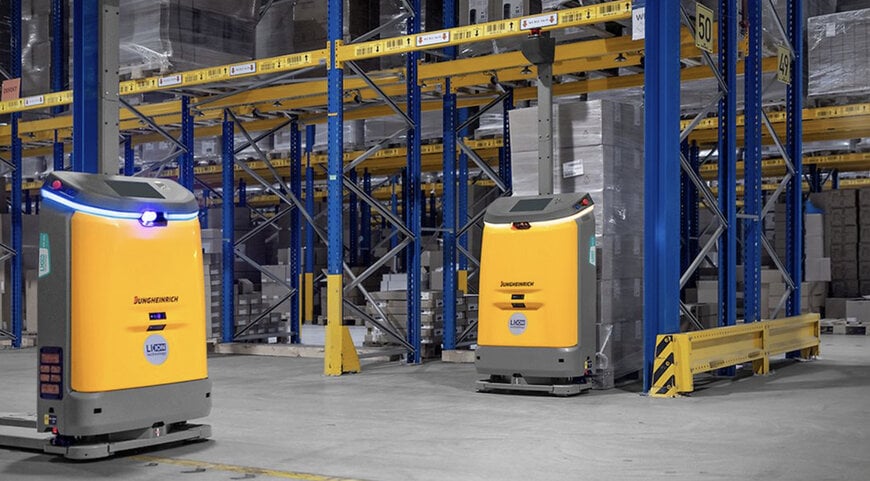
In industrial warehousing and distribution, inbound logistics represents a critical bottleneck for throughput, labor efficiency, and process stability. At its 24,000-square-meter distribution center in Iserlohn, DURABLE automated pallet transport in goods receiving using three autonomous low-lift mobile robots. The system now handles pallet transfers from unloading zones to defined storage handover points, enabling continuous material flow while reducing manual transport tasks.
The solution is based on autonomous vehicles designed for pallet handling in mixed human–machine environments. After truck unloading, pallets are automatically transferred to different storage areas, where manual narrow-aisle and reach trucks complete the storage process. This hybrid automation approach ensures uninterrupted flow from inbound receiving to narrow- and wide-aisle storage without restructuring the existing warehouse layout.
Safe mixed operation with validated navigation technology
The deployed mobile robots operate without physical guide infrastructure. Navigation is based on laser scanners and 3D camera systems that continuously map the surroundings and detect obstacles, vehicles, and personnel in real time. This enables safe mixed operation in active warehouse environments without segregated robot zones.
Each vehicle supports loads of up to 1,200 kilograms and uses automated pallet detection to compensate for imprecise pallet positioning. If a load cannot be safely handled, the system automatically requests human intervention, preventing unsafe pickup attempts and ensuring validated operational reliability.
Energy-efficient multi-shift operation
The three vehicles operate as a stand-alone fleet with automated charging and lithium-ion battery systems for multi-shift use. Energy consumption remains low due to opportunity charging and coordinated fleet management. Each vehicle requires no more than one charging cycle per shift, maintaining continuous availability without production interruptions.
Differentiation through retrofit automation
Unlike conventional fixed conveyor or automated guided vehicle systems that require structural modifications, this solution was integrated into existing warehouse processes with minimal construction and limited IT adaptation. This retrofit capability differentiates the system from infrastructure-heavy alternatives and enables staged automation without operational downtime.
DURABLE participated as an early field-test partner during system validation. Operational data from live warehouse use directly supported final system configuration for series deployment. The project demonstrates how warehouse automation can be introduced incrementally in brownfield logistics environments using mobile robots rather than fixed automation.
Measurable impact on warehouse operations
Since commissioning, inbound throughput has stabilized, manual transport distances have been reduced, and personnel are now primarily assigned to unloading and exception handling instead of internal pallet transport. The automation therefore directly supports labor availability, process consistency, and scalable warehouse automation without full system replacement.
www.jungheinrich.com
