
www.ptreview.co.uk
17
'25
Written on Modified on
Automated transport logistics stabilise chocolate warehouse operations
Alfred Ritter GmbH & Co. KG uses a semi-automated intralogistics solution from Jungheinrich to increase throughput, safety and process reliability at its external warehouse in Dettenhausen.
www.jungheinrich.co.uk
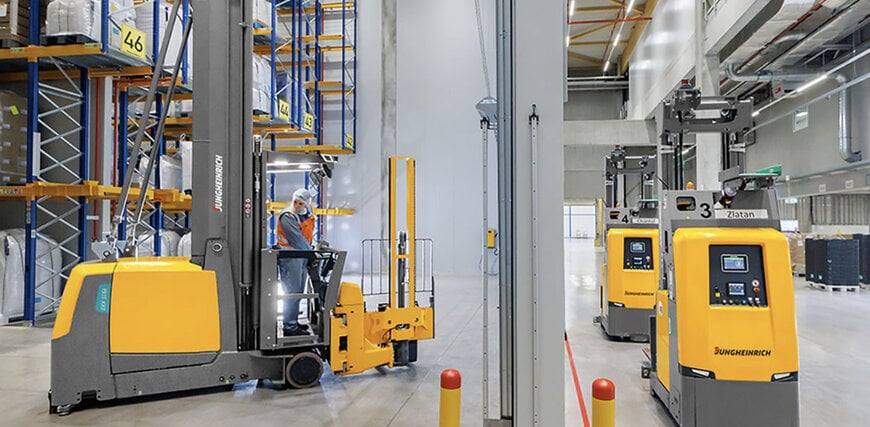
Alfred Ritter GmbH & Co. KG, the family-owned manufacturer behind the Ritter Sport chocolate brand, supplies production sites worldwide. At the Dettenhausen external warehouse, all raw materials and packaging components — including nuts, marzipan and biscuits — are staged and transported to the nearby Waldenbuch production plant.
Rising requirements for material availability, transport speed and operational safety prompted Ritter to expand the warehouse. The challenge was to manage high throughput reliably while maintaining flexibility and ensuring safe interaction between employees and vehicles.
Objectives: Throughput, safety and scalability
The company aimed to automate the majority of ground transport while retaining manual processes where flexibility was required. Key objectives included stabilising material flows, reducing manual transport effort, increasing process reliability in mixed operations and creating a system that could be expanded as demand grows.
Semi-automated solution with mixed operation
Ritter selected a scalable, semi-automated material handling solution from Jungheinrich. The decision was based on the ability to combine automated guided vehicles with manually operated narrow-aisle trucks under a single software-controlled system.
Approximately 90 per cent of internal ground transport is now automated. Four EKS 215a automated guided vehicles equipped with lithium-ion technology form the core of the system. Using warehouseNAVIGATION, the mobile robots navigate autonomously through the facility and handle up to 60 transport tasks per hour.
To ensure continuous availability in multi-shift operation, two high-capacity charging stations with 300-amp charging power minimise downtime through short charging cycles.
Integrated control of automated and manual vehicles
The automated fleet is complemented by EKX 516k and EFX 413 manual narrow-aisle trucks. Both automated and manual vehicles are coordinated via the Jungheinrich Logistics Interface, which manages traffic flows and ensures safe operation in shared warehouse zones.
An intelligent traffic light system prevents collisions and controls right-of-way between humans and machines. This coordinated control allows smooth interaction between automated transport and manual storage and retrieval processes.
Addressing load-specific challenges
A specific technical challenge involved the handling of big bags that extend up to 15 centimetres beyond pallet edges. To ensure damage-free transport, Jungheinrich implemented project-specific control adjustments and adapted spacing parameters within the system. These modifications enabled stable handling of non-standard loads without reducing throughput.
“Handshake” process ensures operational reliability
To further increase process stability, Jungheinrich developed an automated “handshake” process for lane changes in narrow-aisle areas. When a manual truck signals a lane change, all mobile robots are automatically routed out of the affected zone. The area is only released again once the truck has returned to its designated lane.
This mechanism protects material flow at all times and ensures predictable, safe interaction between automated and manual vehicles in confined spaces.
Daniel Vrban, site manager at the Dettenhausen warehouse, explains: “Jungheinrich vehicles handle around 90 per cent of our ground transport. The combination of manual and automated technologies works reliably, and the simulation phase helped us optimise processes before commissioning.”
Deployment and service support
The project included advance simulations, commissioning support and close coordination during ramp-up. To safeguard continuous operation, Ritter opted for a five-year full-service contract. This includes remote support via a dedicated hotline and guaranteed on-site technician response within four hours if required.
Results and outlook
With the semi-automated solution in place, Ritter has stabilised material flows at high throughput, increased storage capacity and improved operational reliability. The scalable system architecture allows additional mobile robots to be integrated or further warehouse areas to be automated as requirements evolve.
The project establishes a future-proof logistics foundation that supports both current production demands and long-term growth.
www.jungheinrich.com
