
www.ptreview.co.uk
03
'26
Written on Modified on
Humanoid Robotics Strengthens AI-Driven Automotive Production
BMW Group integrates humanoid robots in Leipzig to test Physical AI under real production conditions and further develop automation.
www.bmw.com
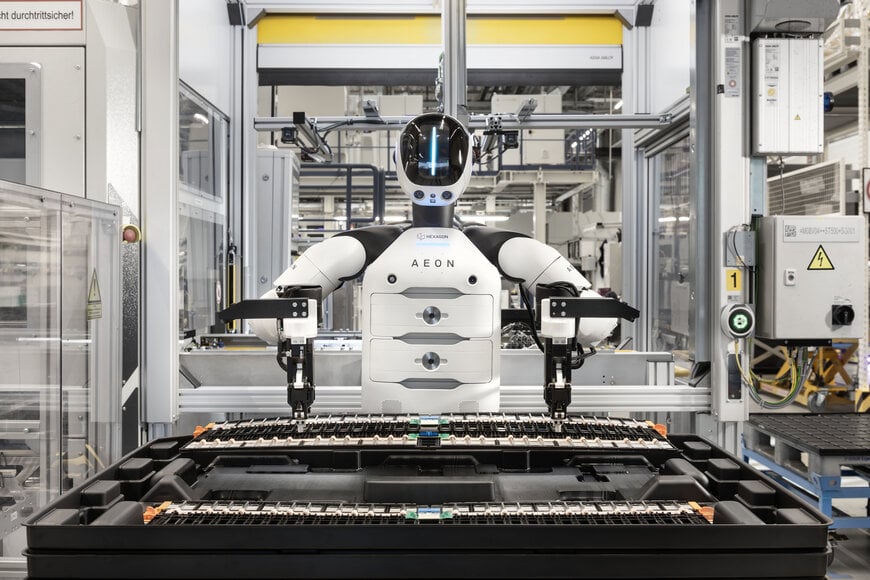
BMW Group is consistently advancing the digitalization of its global production network. A central focus is the further development of AI-driven production systems as part of the BMW iFACTORY initiative. The objective is to enhance productivity, flexibility, and ergonomics in automotive manufacturing.
Through the concept of so-called Physical AI, the company connects digital artificial intelligence with real machines and robots. This approach enables learning systems to be integrated into existing manufacturing processes. Following a successful pilot project in the United States, BMW Group is now introducing this technology to Europe for the first time.
A pilot project involving humanoid robots has started at the Leipzig plant to test their integration into series vehicle production as well as into battery manufacturing and component production.
Unified Data Model as the Foundation for Physical AI
A consistent IT and data model is a prerequisite for deploying Physical AI. In recent years, BMW Group has transformed isolated data silos within its production system into a unified data platform. Production data are now standardized, consistent, and accessible across sites.
This structure enables the deployment of digital AI agents capable of making increasingly autonomous decisions and performing complex tasks. Combined with robotics, these agents form adaptive systems that can learn continuously and integrate into existing production environments.
Michael Nikolaides, Head of BMW Group Production Network and Logistics, explains: “Pilot projects help us test and further develop the use of Physical AI — AI-supported, learning robots — under real industrial conditions.”
Humanoid Robotics as a Complement to Existing Automation
BMW Group views humanoid robots as a complement to existing automation solutions rather than a replacement. Their primary application areas include repetitive, ergonomically demanding, or safety-critical tasks.
Thanks to their human-like design, humanoid systems can operate within established work environments without requiring extensive infrastructure modifications. The objective is to reduce physical strain on employees and further improve workplace conditions.
Pilot Project in Leipzig with Hexagon Robotics
For its European pilot project, BMW Group is collaborating with Hexagon Robotics, a Zurich-based unit of Hexagon specializing in Physical AI. Hexagon introduced its humanoid robot AEON in June 2025.
Following a theoretical assessment and laboratory tests, an initial trial deployment took place at the Leipzig plant in December 2025. A further integration test is planned from April 2026, with the full pilot phase scheduled to begin in summer 2026.
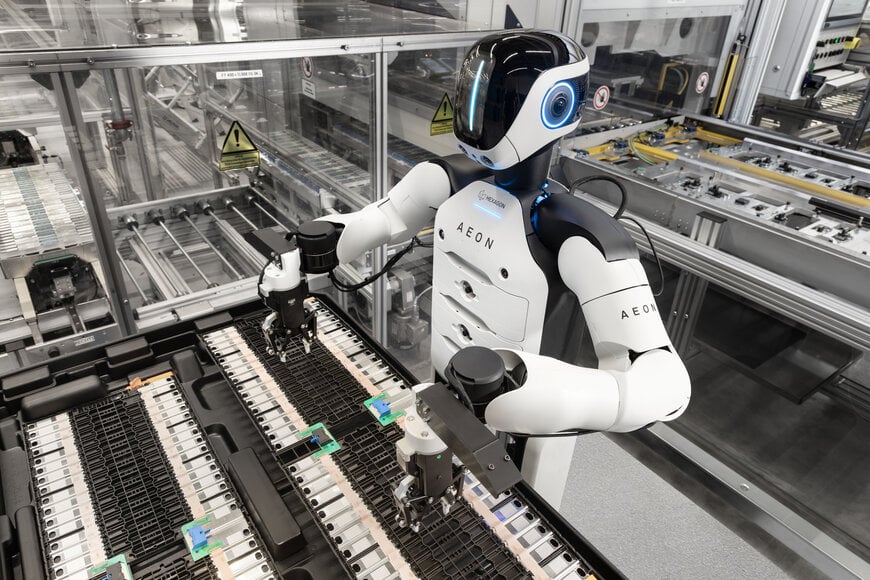
The focus is on multifunctional deployment. Due to its modular design, AEON can be equipped with various gripping and scanning tools. The robot is planned to be used in high-voltage battery assembly and in the production of exterior components.
Michael Ströbel, Head of Process Management and Digitalization in Production, states: “This year, we are focusing on the step-by-step integration into our production system to explore diverse application possibilities.”
Insights from the Spartanburg Pilot Project
The European project builds on a previous pilot at the Spartanburg plant in the United States, conducted in cooperation with technology company Figure AI.
Over a period of ten months, the humanoid robot Figure 02 supported the production of more than 30,000 BMW X3 vehicles. Working daily in 10-hour shifts, the robot handled the precise removal and positioning of sheet metal parts for the welding process. In total, it moved more than 90,000 components and accumulated approximately 1,250 operating hours.
The pilot confirmed that humanoid robots can reliably execute precise and repeatable tasks under real industrial conditions. Of particular relevance was the rapid transfer of motion sequences trained in the laboratory into stable shift operations. Integration was achieved through standardized interfaces within BMW’s Smart Robotics ecosystem.
The project also demonstrated that early involvement of production IT, occupational safety, logistics, and shopfloor management is critical for successful implementation.
Center of Competence Consolidates Expertise
To consolidate expertise in Physical AI, BMW Group has established a Center of Competence for Physical AI in Production. The center structures maturity assessments, laboratory validations, and industrial testing processes.
Technology partners are evaluated according to defined industrialization criteria. After successful laboratory validation, a test deployment under real production conditions is conducted before entering the official pilot phase.
Felix Haeckel, Head of the Center of Competence, explains: “We are consolidating our expertise to make AI and robotics knowledge broadly available within the company and to technically support pilot projects.”
Scaling Physical AI Across the Production Network
With the Leipzig pilot project, BMW Group aims to gradually integrate Physical AI into additional production areas. The results to date indicate that humanoid robotics can be technically integrated into highly automated environments while delivering reproducible quality.
The upcoming test phases will determine in which applications scalable industrial value can be achieved — particularly in battery manufacturing and ergonomically demanding assembly processes.
Physical AI thus becomes another component of BMW Group’s AI-driven production strategy.
www.bmw.com
