
www.ptreview.co.uk
27
'26
Written on Modified on
Teradyne and Flex Target Scalable Manufacturing Automation
Expanded collaboration integrates cobots, AMRs, and supply chain capabilities to validate and scale adaptive automation across complex, high-mix global production environments.
www.teradyne.com
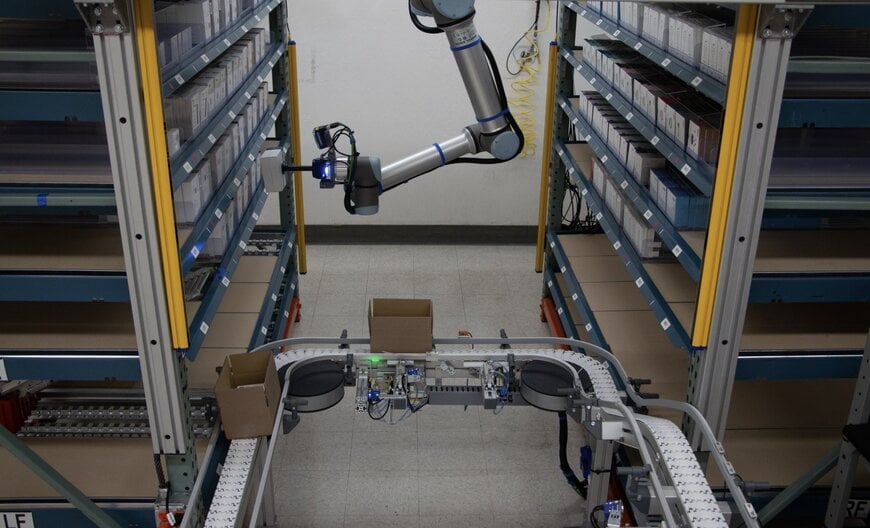
Manufacturers are increasing the use of collaborative robots and mobile systems to handle variable production volumes and product complexity. In this context, Flex and Teradyne Robotics have expanded their partnership to scale intelligent automation across global manufacturing operations.
A dual-role model linking production and deployment
The collaboration positions Flex as both a user and a supplier within the automation value chain. It deploys Teradyne Robotics technologies in its own production facilities while manufacturing key components for those same systems.
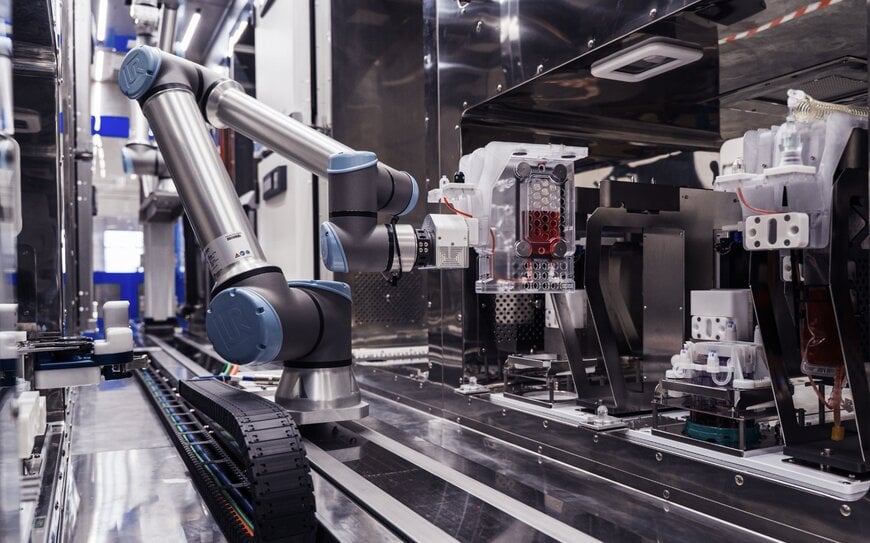
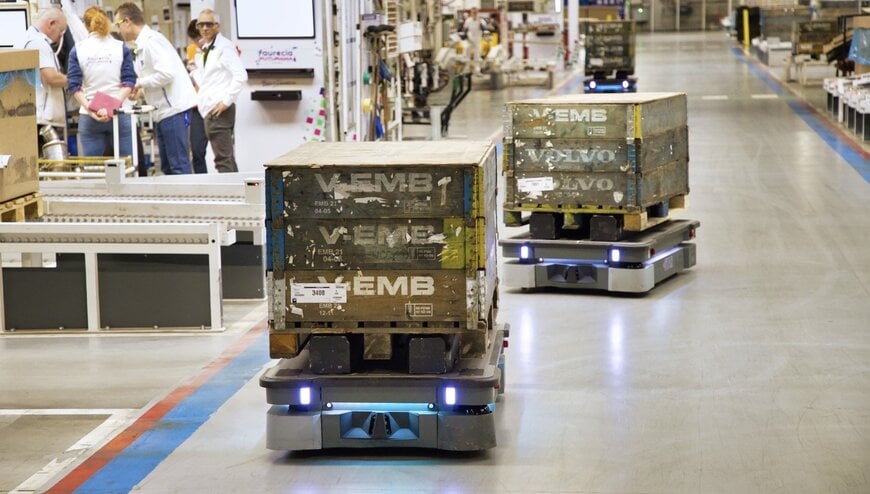
This includes hardware support for Universal Robots (UR) and deployment of UR collaborative robots alongside autonomous mobile robots from Mobile Industrial Robots (MiR). These systems are used in electronics manufacturing, industrial equipment production, and data center infrastructure assembly, where workflows require flexibility and repeatability.
The approach introduces a feedback loop: systems are tested in operational environments, and performance data is fed back into design, integration, and deployment strategies. This reduces validation cycles and supports replication of automation workflows across multiple facilities.
Extending a semiconductor-focused supply chain relationship
Flex and Teradyne have collaborated for more than two decades on semiconductor test equipment. Flex provides manufacturing, systems integration, and global supply chain execution for these platforms, which are used in electronics and semiconductor production.
Extending this relationship into robotics aligns with increasing demand for adaptable automation systems that can operate across distributed manufacturing networks. As production environments shift toward higher product variability and shorter lifecycle cycles, integration between robotics platforms and the digital supply chain becomes more critical.
Physical AI integration for adaptive automation
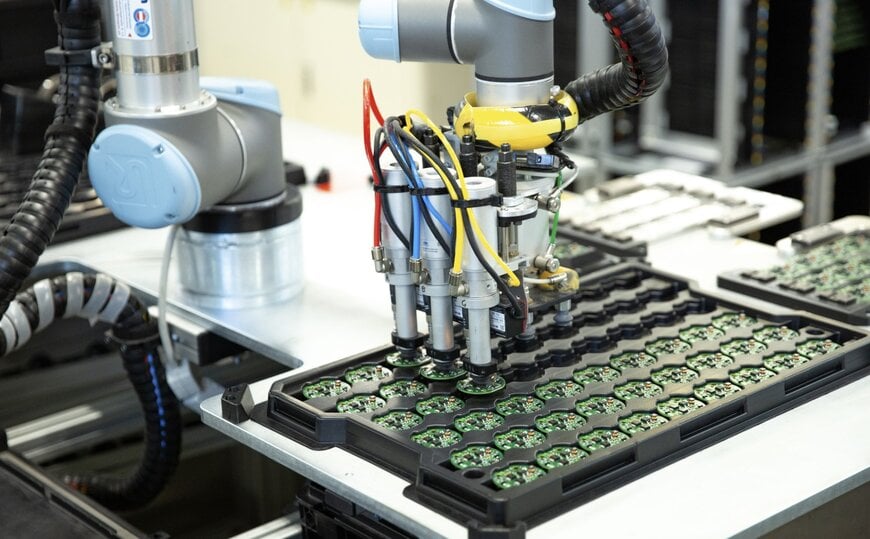
The partnership incorporates physical AI into collaborative robots and autonomous mobile robots. These systems combine sensing, control, and decision-making capabilities to adjust to dynamic production conditions, such as variable part flows or layout changes.
In practice, this enables use cases such as:
- Dynamic material transport using AMRs that adjust routes based on real-time factory conditions
- Cobot-assisted assembly where task parameters can be modified without full system reprogramming
- Coordinated workflows between fixed and mobile robots to maintain throughput under changing demand
These capabilities are designed to improve consistency and throughput while maintaining flexibility across high-mix manufacturing environments.
Scaling automation across global production networks
The integration of deployment and manufacturing capabilities allows automation solutions to be validated under real operating conditions before broader rollout. This reduces integration risk and supports faster scaling across geographically distributed facilities.
By combining robotics platforms with Flex’s global manufacturing footprint and supply chain infrastructure, the partnership addresses key constraints in automation adoption, including system interoperability, deployment speed, and lifecycle support.
The result is a model for scaling intelligent automation that aligns robotics deployment with production realities, particularly in sectors where complexity, volume variability, and supply chain coordination are tightly linked.
Edited by Aishwarya Mambet, Induportals Editor, with AI assistance.
www.teradyne.com
Scaling automation across global production networks
The integration of deployment and manufacturing capabilities allows automation solutions to be validated under real operating conditions before broader rollout. This reduces integration risk and supports faster scaling across geographically distributed facilities.
By combining robotics platforms with Flex’s global manufacturing footprint and supply chain infrastructure, the partnership addresses key constraints in automation adoption, including system interoperability, deployment speed, and lifecycle support.
The result is a model for scaling intelligent automation that aligns robotics deployment with production realities, particularly in sectors where complexity, volume variability, and supply chain coordination are tightly linked.
Edited by Aishwarya Mambet, Induportals Editor, with AI assistance.
www.teradyne.com
