
www.ptreview.co.uk
11
'26
Written on Modified on
Manufacturing Simulation Enhances Sales Cycles for Configurable Intralogistics Systems
Konecranes Agilon utilizes Visual Components' advanced visualization software to model customer layouts and material flows, transforming complex technical specifications into transparent operational data.
www.visualcomponents.com
Application Area: Warehouse Automation / Intralogistics Simulation
Industry Sector: Material Handling and Manufacturing
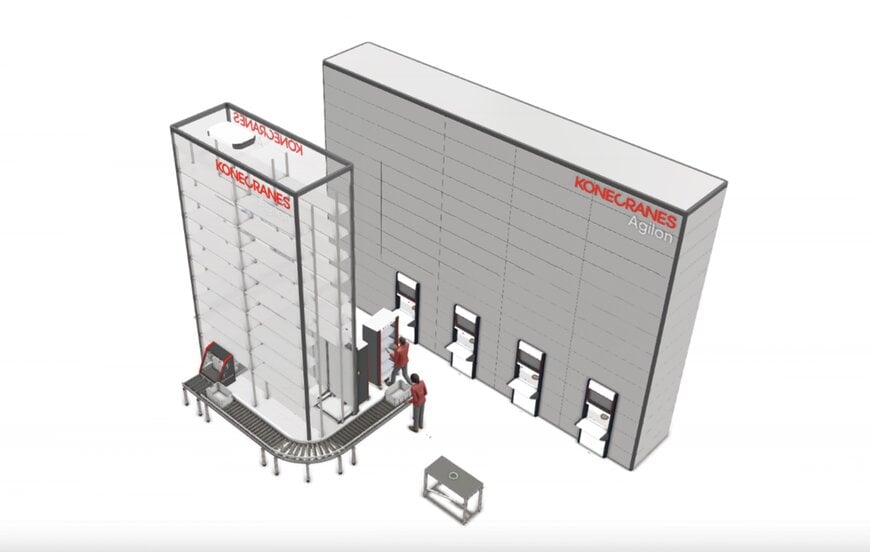
Konecranes Agilon provides automated intralogistics solutions designed to modernize warehousing and manufacturing operations. These systems are highly configurable, requiring specific adaptations to unique customer layouts, throughput requirements, and existing material flows. Historically, the company relied on static sales materials, such as tables and product documentation, which often failed to convey how a full automation solution would function within a client's specific operational environment. This led to misalignments during the sales process as stakeholders often held different visualizations of the proposed end-to-end process. The primary goal was to create a shared understanding of future workflows and demonstrate exactly how a solution would improve real-world processes.
Integrating Visual Components for Process Transparency
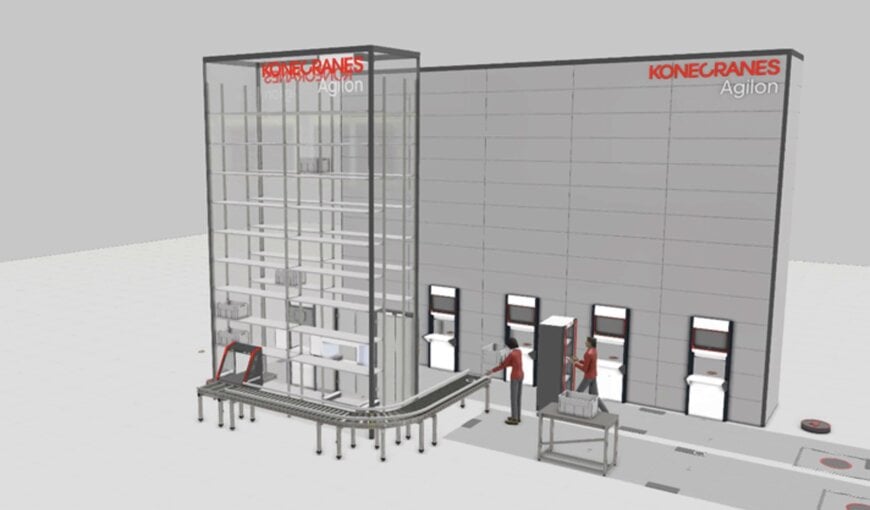
To address these communication barriers, Konecranes Agilon adopted the Visual Components manufacturing simulation platform. This technical solution allows sales teams to model 3D representations of customer layouts and integrate automated intralogistics solutions directly into those digital environments. The selection of this software was driven by its modeling features that allow for the adjustment of system heights, widths, and quantities to match real-world constraints. By transitioning from verbal descriptions to visual models, the company provides a shared reference point that facilitates collaborative problem-solving early in the sales engagement.
Optimizing Operations through Scenario Comparison
The deployment of simulation software enables the comparison of multiple operational scenarios within a single model. Sales teams can visualize the current "as-is" state of a warehouse and present it alongside the proposed Agilon solution. This side-by-side comparison highlights tangible improvements in space utilization, material flow, and operational behavior. Furthermore, the simulation provides data on operator interaction speeds and system input/output rates, allowing customers to evaluate the human-machine interface performance before any physical hardware is installed. This approach moves the discussion away from theoretical performance claims toward visible, data-driven process improvements.
Measurable Impacts on Sales Efficiency and Decision Confidence
The use of manufacturing simulation has resulted in faster customer decision-making by replacing abstraction with clarity. Providing a realistic representation of how materials move through the system has significantly increased customer confidence in the proposed investments. By visualizing the solution's fit into actual spaces and workflows, Konecranes Agilon has turned technical complexity into a competitive advantage, meeting evolving market expectations where simulation is now considered a standard component of the automation evaluation process.
Additional Context
The Visual Components platform utilized by Konecranes Agilon operates on a modular architecture that supports various CAD formats, allowing for the rapid import of existing facility blueprints. Unlike basic 3D rendering tools, this simulation engine includes a physics-based behavior library, which ensures that the modeled throughput and material handling speeds accurately reflect the mechanical limits of the Agilon hardware. In competitive benchmarking, this capability reduces the "trust gap" often found in industrial sales, as the simulation serves as a digital twin that can be validated against actual production requirements prior to contract finalization.
Edited by Romila DSilva, Induportals editor – adapted by AI.
www.visualcomponents.com
