
www.ptreview.co.uk
19
'26
Written on Modified on
Highly precise bone surgery with miniature robots
The University of Basel has automated its MIRACLE II surgical robot using Beckhoff PC-based control and TwinCAT 3, enabling high-precision, real-time laser-guided bone surgery with a compact tissue-supported design.
www.beckhoff.com
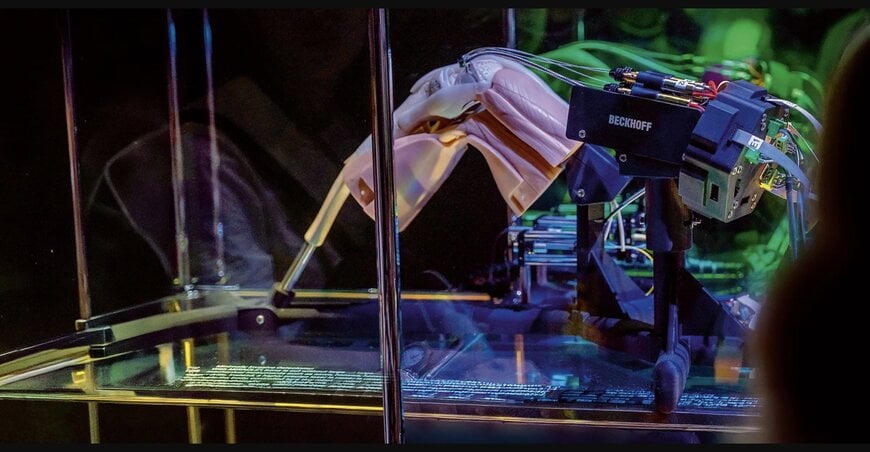
Application Area: Robotic Surgery Automation, PC-Based Control Systems, Real-Time Kinematic Simulation
Industry Sector: Medical Technology, Healthcare Robotics, Biomedical Engineering
The University of Basel's Department of Biomedical Engineering has implemented Beckhoff PC-based control technology and TwinCAT 3 Target for Simulink® to automate its MIRACLE II miniature bone-surgery laser robot. The technical deployment integrates system-integrated safety, high-precision motion execution, and real-time optimization algorithms to replace bulky, floor-anchored surgical architectures with a tissue-supported parallel robot. By embedding a unified control architecture, the research institution connects graphical design environments with physical shop-floor automation, enabling functional incisions for direct treatment-site surgical procedures.
Overcoming Force Compensation Challenges and Multi-Interface Latency in Surgical Robotics
Conventional surgical robotics rely on large, floor-mounted devices configured with lengthy kinematic chains. Because these bulky structures are positioned far from the actual surgical site, they require complex software compensation loops to stabilize the system against interfering external forces and maintain sufficient operative precision. Additionally, managing distributed measurement cards over large operational spaces traditionally involves complex PCI- or PCI Express-based bus interfaces, which introduces signal attenuation over extended cable runs and complicates real-time multi-component synchronization.
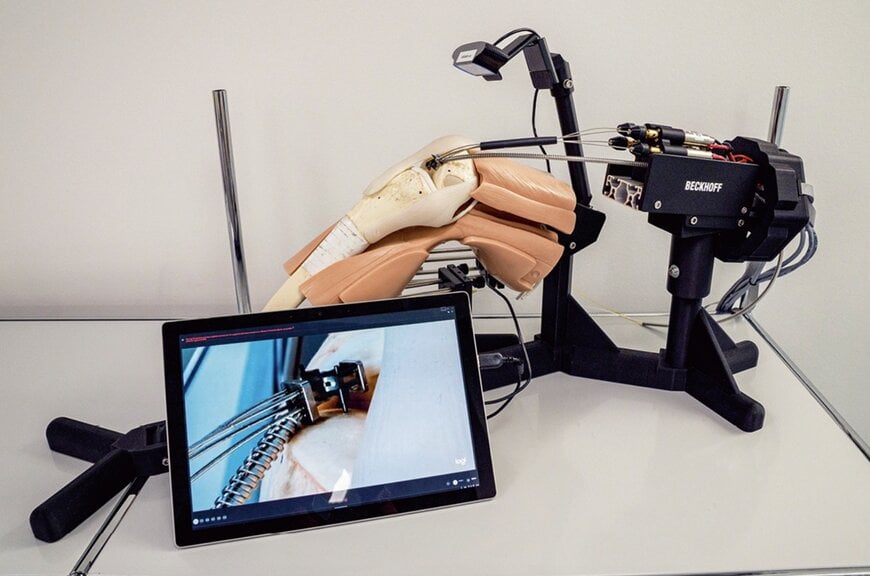
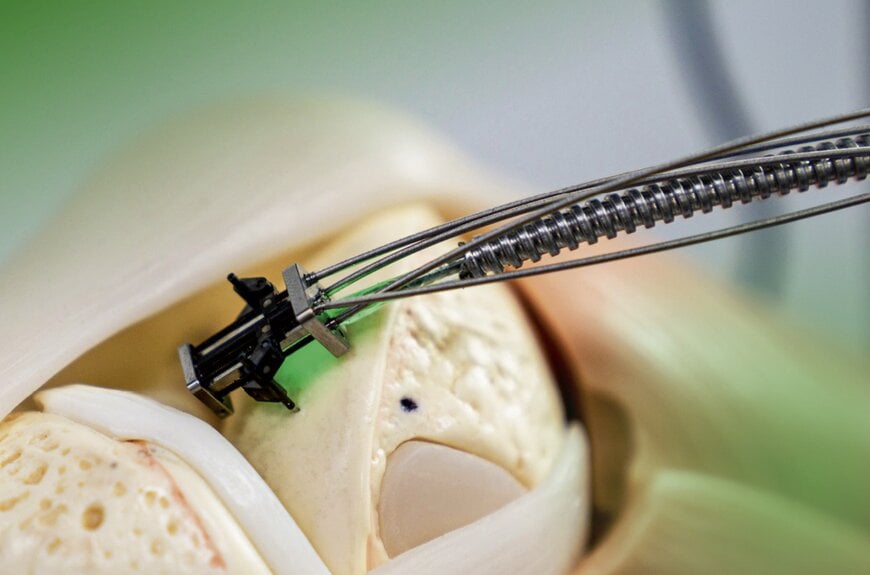
To solve these spatial and latency limitations, researchers at the University of Basel’s Bio-Inspired RObots for MEDicine Laboratory (BIROMED Lab) required a miniature parallel robot capable of mounting locally onto human tissue. The system needed to manipulate a non-contact surgical laser across three planar degrees of freedom—forward/backward, lateral, and rotation—within an ultra-compact footprint of 7.5 x 7.5 mm. Fulfilling these precise operational criteria demanded an open, high-performance control environment capable of resolving real-time optimization problems every millisecond, while maintaining strict, system-integrated safety boundaries. The laboratory selected Beckhoff’s EtherCAT-enabled PC-based control platform to establish a standardized digital thread.
Implementing System-Integrated Safety and Real-Time Optimization Across Parallel Drivetrains
The integration of the PC-based control architecture unifies mathematical modeling, multi-axis hardware orchestration, and functional safety into a singular medical automation framework:
- Graphical Model Compilation: Engineering teams utilize TwinCAT 3 Target for Simulink® to establish a direct pipeline between MATLAB® and Simulink® graphical programming surfaces and the physical machine controller. The platform compiles the high-level simulation code into a standard C++ project, generating optimized machine code that integrates directly into the real-time execution environment.
- Real-Time Kinematic Optimization: The miniature robot utilizes a redundant drive design powered by four small servo motors that actuate flexible spiral spindles from an external position. To synchronize these parallel drivetrains, a CX2043 Embedded PC processes real-time optimization math iteratively multiple times per millisecond rather than solving standard linear equations, ensuring stable and exact positioning across all degrees of freedom.
- System-Integrated Functional Safety: Instead of relying on a separate, siloed safety hardware controller, the setup leverages system-integrated TwinSAFE technology over the EtherCAT and FSoE (FailSafe over EtherCAT) protocol. This enables a single digital thread that embeds safety-critical commands natively within the primary human-machine interface (HMI).
- Open Component Interoperability: Software developers deploy TwinCAT HMI to manage data exchange across different logic blocks, spanning C++, PLC, and safety tasks. The platform’s open Automation Device Specification (ADS) protocol allows the core machine controller to communicate seamlessly with third-party components, including machine learning-based vision systems, maintaining strict geometric tolerances during laser osteotomy.
Additional Context
The section below evaluates the technical specifications and operational benchmarks not included in the original application story.
Multi-Axis Kinematic Control via PC-Based Architectures
Traditional automated surgical platforms often depend on dedicated microcontrollers or standalone proprietary robotic controllers to execute motion trajectories. Transitioning to a high-performance, machine-tool-grade embedded PC running a real-time software PLC alters the underlying communication and processing profile:
- Deterministic Cycle Ticks: Shifting control tasks to a centralized x86-based embedded processing unit allows deterministic cycle times to scale down to sub-millisecond ranges, ensuring that multi-axis parallel kinematics are adjusted fast enough to mitigate real-time tissue deflection.
- Bus-Based Device Integration: Utilizing a high-speed bus system like EtherCAT eliminates localized interface constraints by replacing thick, point-to-point analog wiring bundles with a single, industrially standardized ethernet cable, reducing signal latency and electrical noise across distributed sensor networks.
- Redundancy Processing: Managing redundant parallel actuators via localized software optimization avoids the overhead of discrete, secondary processing nodes, yielding uniform axis velocities and preventing mechanical binding within miniaturized gear assemblies.
Structural Comparison of Automation Architectures
Transitioning from traditional decoupled hardware configurations to an integrated, PC-based simulation and safety platform introduces core structural changes to system integration:
Transitioning from traditional decoupled hardware configurations to an integrated, PC-based simulation and safety platform introduces core structural changes to system integration:
- Data Synchronization: Under a traditional decoupled architecture, data synchronization is fragmented, as modifications made in graphical simulation software must be manually translated or recoded into specific controller assembly text. Conversely, an integrated software-defined control setup delivers unified data synchronization, compiling graphical simulation blocks directly into native machine code to provide a continuous thread from design to deployment.
- Safety Integration: Legacy automated systems suffer from high complexity due to separate safety controllers that require dedicated hardwiring and independent diagnostic networks to communicate with the main machine loop. An integrated platform features unified safety, utilizing bus-based safety-over-ethernet protocols to pass safe operational states directly into the core HMI and control logic without additional hardware lines.
- System Flexibility: Traditional standalone controllers offer low flexibility because connecting external vision systems or artificial intelligence nodes requires custom hardware bridges and proprietary drivers. A PC-based automation platform provides high flexibility, leveraging open communication standards like ADS to permit direct, multi-protocol data exchange with third-party machine learning components.
Edited by Romila DSilva, Induportals Editor, with AI assistance.
