
www.ptreview.co.uk
22
'26
Written on Modified on
Additive Manufacturing for Autonomous Marine Surface Cleaning Systems
IADYS leverages specialized additive manufacturing capabilities from Sculpteo to produce chemically resistant mechanical components for robotic units deployed in harsh aquatic environments.
www.sculpteo.com
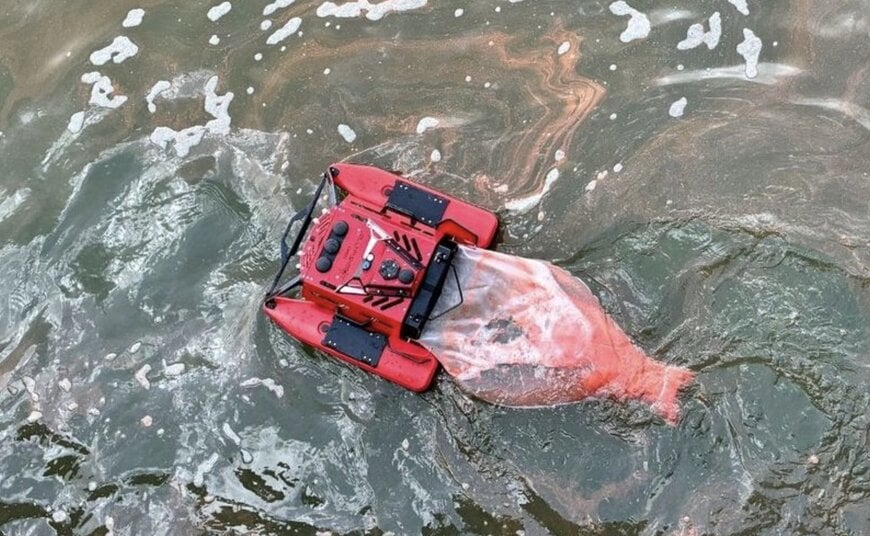
IADYS, a developer of water surface cleaning robots, partnered with additive manufacturing provider Sculpteo to produce functional chassis components for its maritime platforms. The integration of 3D-printed parts supports the operational deployment of autonomous robotics within demanding industrial and marine ecosystems.
Operational Challenges in Marine Robotics
IADYS specializes in designing autonomous solutions engineered to remove debris and pollutants from water surfaces. A primary mechanical challenge in the development of these robots involved securing and guiding the collection nets at the rear of the chassis. The hardware operates in harsh marine and industrial environments, subjecting components to constant water immersion as well as frequent exposure to aggressive substances such as hydrocarbons, oils, and fuels. Traditional manufacturing materials often suffer from degradation, swelling, or chemical breakdown under these conditions, necessitating a highly resistant structural alternative.
Material Requirements and Additive Manufacturing Solution
To ensure reliable long-term operation, IADYS required a manufacturing method and material that could deliver dimensional stability, high chemical resistance, and cost-efficiency for small to medium production runs. The company selected Sculpteo’s additive manufacturing services to fabricate structural elements, including threaded net standoff fasteners. The chosen material for this application was PA12 S, a specialized polymer suited for industrial 3D printing.
Technical Rationale for Polymer Selection
The PA12 S material was specified due to its mechanical and chemical properties. Unlike standard polyamides, PA12 S exhibits low and stable water absorption rates. This characteristic is critical for marine applications, as it ensures the dimensional stability of the fasteners during prolonged immersion, preventing the parts from warping or failing under mechanical load. Furthermore, the material offers inherent resistance to hydrocarbons and other corrosive industrial fluids, preserving the structural integrity of the robots when deployed in polluted waterways or industrial containment basins.
Production Scaling and Organizational Impact
By utilizing additive manufacturing, IADYS circumvented the high initial tooling costs and extended lead times associated with traditional injection molding. Sculpteo facilitated the transition to series production by providing a continuous, scalable workflow. The precision of the 3D printing process ensured high dimensional accuracy across all produced batches, allowing for seamless assembly of the robotic units.
"Working with Sculpteo has been a real asset for series production: consistent quality, scalable tooling, and a smooth, reliable manufacturing workflow," stated Nicolas Carlesi, CEO and Founder of IADYS.
The integration of 3D-printed PA12 S components allowed IADYS to deploy functional, field-ready environmental robotics. The material choice enhanced the maintainability and operational lifespan of the autonomous systems, structurally reducing the frequency of spare part replacements caused by environmental degradation.
Edited by Aishwarya Mambet, Induportals Editor, with AI assistance.
www.sculpteo.com
