
www.ptreview.co.uk
24
'26
Written on Modified on
Collaborative robotic automation for high-mix metal fabrication
Oliva Torras integrates a Universal Robots collaborative robotic system to automate welding and polishing for small and medium production batches.
www.universal-robots.com
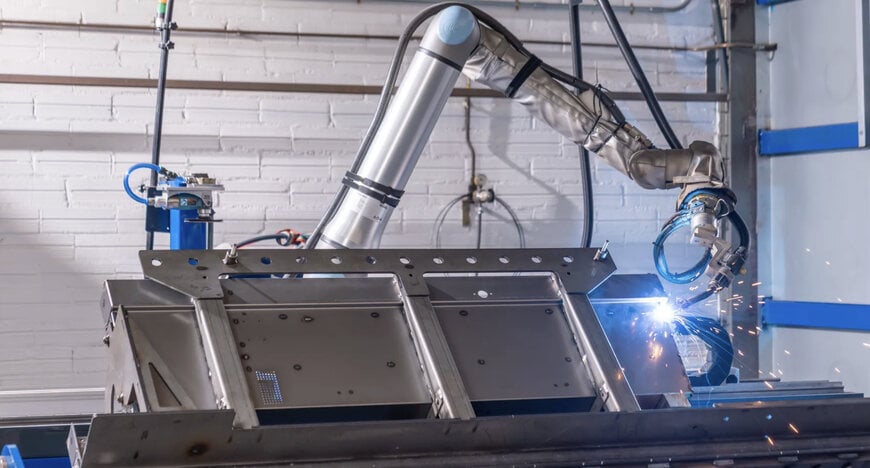
In the metal fabrication and machinery manufacturing industry, companies integrate collaborative robotic automation to maintain high flexibility while seamlessly scaling production capacity for high-mix components.
Activity and operational challenges
Founded in 1945 in Manresa, Spain, Oliva Torras operates across six business divisions, developing components for ATMs, railway interiors, compressor systems, and industrial ventilation. By managing the full value chain internally—from metal fabrication to painting, assembly, and final testing—the company maintains strict control over quality and delivery. A defining characteristic of its operations is a focus on small and medium production batches, creating high variability in production requirements. The primary operational challenges included a difficulty in recruiting qualified welders and the need to scale production without losing flexibility, particularly when customers demanded higher volumes and shorter lead times following the approval of initial prototype series.
Improvement objectives
The company aimed to seamlessly balance production flexibility with increased and consistent capacity. Management sought a compact, easily configurable automation solution capable of handling frequent adjustments for varying batch sizes. Furthermore, the objective was to expand existing automation capabilities to accommodate larger components and integrate additional processes, such as polishing, while ensuring fast and intuitive programming for frequent changeovers.
Selected technical solution
To address these requirements, Oliva Torras selected a collaborative automation solution based on the Universal Robots UR20-1750 cobot. The system features a 1,750 mm reach and a 25 kg payload, enabling the handling of larger parts without repositioning. The integrated setup includes a Böhler MIG/MAG welding torch and wire feeder, a Dynabrade automated polishing tool, an automatic tool changer, and a Robotiq force control system. The equipment is mounted alongside a rotary table that provides full access to welding positions across 2 to 2.5 meters. The UR platform was selected due to its compact footprint and the extensive URCaps ecosystem, which allows multiple technologies to be controlled from a single interface.
Deployment and support
The project was implemented in collaboration with Sokad Soluciones Mecánicas, a certified integrator, who developed the combined welding and polishing solution for carbon steel, aluminum, and stainless steel. Utilizing the URCaps ecosystem, the integrator seamlessly embedded the third-party tools into the robot software. Installation and commissioning were completed rapidly, with initial welding operations starting within a week, minimizing production downtime.
Quantifiable results and operational benefits
The implementation increased productivity by up to 50 percent, effectively doubling output with a single system. This efficiency is driven by human-robot collaboration: while the robotic cell remains restricted during active operation for safety, operators work alongside the system to prepare or finish other parts in parallel. The automatic tool changer eliminates manual intervention between the welding and polishing processes. Additionally, the accessible programming supports workforce development by allowing employees to acquire new skills. Building on this success, the company is expanding the deployment of collaborative robots to additional processes, including sealing and bonding, to support its strategy of diversification and local manufacturing.
Edited by Maria Brueva, Induportals editor – adapted by AI.
www.universal-robots.com
