
www.ptreview.co.uk
15
'26
Written on Modified on
Linear Motor Actuators for High-Speed Industrial Motion Control
Yamaha Robotics supplies its single-axis linear drives to a Japanese system integrator to overcome the physical speed limitations of traditional ball-screw mechanisms.
www.yamaha-motor.eu
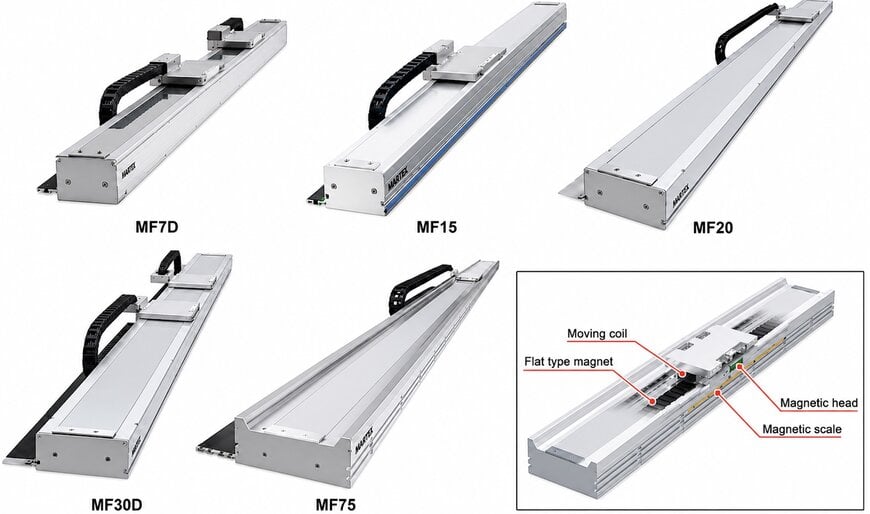
A Japanese system integration team partnered with Yamaha to deploy linear motor-driven single-axis actuators, aiming to increase factory automation productivity and resolve the mechanical constraints of conventional ball-screw drives. The deployment focuses on reducing process cycle times and consolidating multi-stage workflows within a manufacturing facility.
Operational Challenges in Workpiece Handling
The end-user required an engineering solution to increase the handling speed of workpieces across two specific automation sequences. The first process required transporting materials over a 500-millimeter distance. The existing ball-screw drives could not operate faster due to the physics of critical speed, a mechanical limitation where the unsupported length of the rotating screw restricts higher rotational velocities without inducing severe vibration.
The second process involved four distinct operations handled by two separate ball-screw drives, with an intermediate robot transferring workpieces between them. This transfer mechanism carried a high risk of handling errors and occupied significant factory floor space. Furthermore, the maintenance team struggled to maintain precise alignment between the separate drives over time. Combining the two existing setups into a longer unified ball-screw drive was not mechanically viable, as extending the stroke length inherently reduces the critical speed threshold, which would have further slowed production.
Implementing Linear Motor Technology
To bypass the rotational speed limits of the legacy equipment, the integration team replaced the existing mechanical drives with PHASER single-axis linear motor actuators. Unlike ball-screw systems, linear motors provide direct translatory motion without rotating mechanical linkages, allowing for faster acceleration and consistent dynamic performance over longer stroke distances. The specified MF models utilize flat magnets to generate high thrust, accommodating payloads of up to 160 kg.
The client selected this specific architecture due to its integrated magnetic position measurement system and multi-carriage capabilities. The semi-absolute magnetic encoders offer continuous position feedback over extended travel distances while resisting environmental contamination from dirt, condensation, and machine oil. This closed-loop control setup maintains carriage positioning with a repeatability of ±5 µm. Additionally, the linear design features fewer sliding components than a screw-driven axis, which reduces acoustic noise and utilizes stainless-steel covers to prevent particulate ingress.
Process Consolidation and Quantifiable Results
For the initial 500-millimeter transport operation, replacing the ball-screw drive with the linear actuator yielded an approximate 40 percent reduction in cycle time.
To resolve the transfer errors and space constraints in the multi-stage process, the integration team deployed a single one-meter-long linear unit. This hardware configuration allowed multiple carriers to operate on a single axis, managed by an integrated collision avoidance program. By consolidating the four operations into a single inline system, the facility eliminated the intermediate robotic transfer step, thereby mitigating handling errors and reducing the physical footprint of the equipment. Consequently, the total cycle time for this specific production sequence decreased from 2.04 seconds to 1.76 seconds.
Edited by Aishwarya Mambet, Induportals Editor, with AI assistance.
www.yamaha-motor.com
