
Why Automation and Robotics Suppliers Are Collaborating with Nvidia
Collaborations between Nvidia and several automation and robotics companies are primarily aimed at integrating AI and simulation technologies to optimise industrial processes.
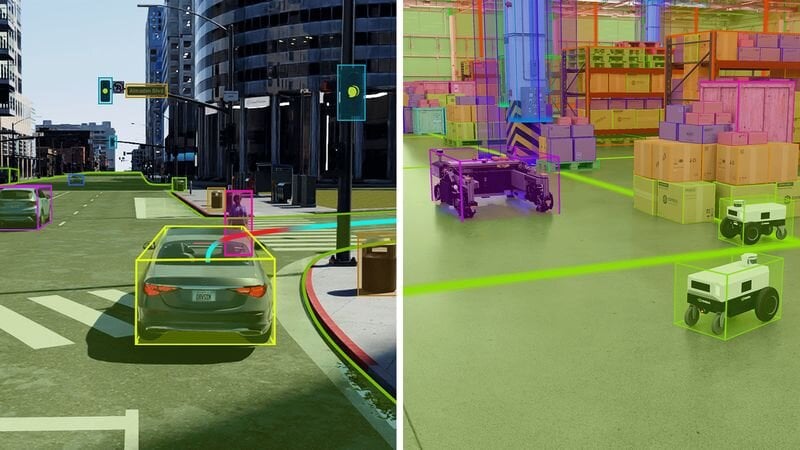
Several automation and robotics system suppliers, including ABB, Siemens, Rockwell, Universal Robots, Delta and Schneider, have in recent months announced collaborations with Nvidia and/or the integration of certain solutions from the US company into their own systems. These collaborations are intended to integrate advanced AI and simulation technologies in order to optimise industrial processes, improve robot precision and accelerate the time-to-market for new products.
Nvidia solutions involved in these collaborations
The Nvidia solutions primarily involved in these collaborations include Nvidia Omniverse libraries, the Nvidia Jetson platform, and simulation and AI technologies such as Nvidia Isaac Sim and Nvidia PhysicsNeMo. These solutions make it possible to create digital twins, generate synthetic data for training AI models, and test and optimise processes before real-world deployment.
Specific features and functions of Nvidia solutions
Nvidia Omniverse libraries provide physically accurate simulation capabilities, helping to reduce the gap between virtual simulation and the real-world deployment of robotic applications. The Nvidia Jetson platform enables AI inference to run directly at the edge, which is essential for industrial applications requiring low latency and high reliability. Nvidia’s simulation and AI technologies also enable precise modelling and analysis of infrastructure and application behaviour, regardless of the deployment configuration of AI data centres.
Why suppliers rely on Nvidia solutions
Automation and robotics system suppliers rely on Nvidia solutions for several reasons. First, Nvidia provides advanced simulation and AI technologies capable of creating virtual environments that closely replicate real-world conditions. This allows manufacturers to virtually design and test production lines, reduce installation and commissioning times, and accelerate the launch of new products. In addition, Nvidia solutions help minimise costly physical prototypes while improving the quality of components and subassemblies.
Benefits for industrial users
Collaborations between automation system suppliers and Nvidia provide several benefits for end users in industry. Firstly, they help reduce costs and accelerate the introduction of new products to the market. Nvidia solutions also improve robot precision and reliability, which is critical for certain industrial applications. Furthermore, Nvidia’s simulation and AI technologies enable precise modelling and analysis of infrastructure and application behaviour, helping to optimise performance and reduce manufacturing costs.
Some examples of technological collaboration
• ABB Robotics has integrated Nvidia Omniverse libraries into its RobotStudio software to reduce the gap between virtual simulation and real-world deployment of robotic applications. This integration helps optimise the design and commissioning of production lines, reducing costs by up to 40% and accelerating time-to-market by 50%.
• Siemens is collaborating with Nvidia to integrate artificial intelligence into industrial environments, covering the entire value chain from design to production. This collaboration aims to develop industrial and physical AI solutions using Nvidia’s computing infrastructure and simulation libraries.
• Schneider Electric is collaborating with Nvidia to develop cooling, power supply and building management systems for physical and digital AI data centres. This collaboration aims to create the next generation of AI factories.
• Rockwell Automation uses Nvidia Omniverse for high-fidelity digital twin simulations for automation process validation. This solution enables factory-scale virtual inspection testing, helping manufacturers validate automation systems before deployment.
• Universal Robots has presented its AI solutions developed in collaboration with Nvidia, Accenture and Inbolt. These innovations include faster collaborative robots (cobots) and AI acceleration kits designed to reduce the time-to-market for products based on artificial intelligence.
• Delta uses Nvidia Omniverse to drive AI-based automation processes at every level, including seamless integration with D-Bot cobots through the implementation of real-time digital twins and performance optimisation via grasp trajectory training and AI model development.
Published by Youssef Belgnaoui, editor for Induportals.
