
www.ptreview.co.uk
05
'26
Written on Modified on
Software-Defined Transport Systems for Flexible Production Lines
Beckhoff highlights software-controlled motion platforms as alternatives to conventional conveyor systems in industries requiring precision handling, adaptable layouts, and higher production throughput.
www.beckhoff.com
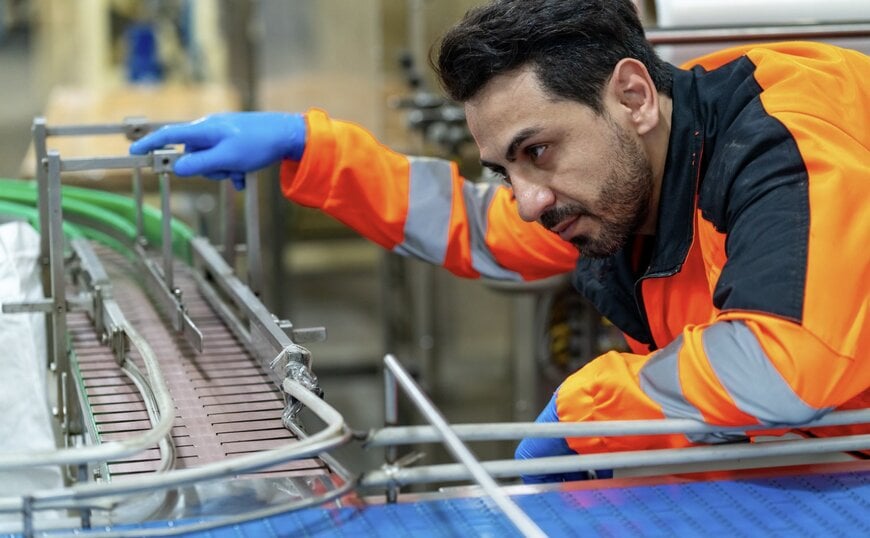
Modern production environments increasingly require adaptable manufacturing lines capable of handling varying product formats, rapid changeovers, and smaller batch sizes. Traditional conveyor systems, designed primarily for linear point-to-point transport, can limit flexibility and increase machine footprint when production requirements change. In this context, Mark Richards, UK sales manager at Beckhoff Automation, highlights software-defined transport technologies designed to replace or complement conventional conveyor mechanisms in advanced manufacturing.
Limits of Conventional Conveyor Transport
Conveyor belts and chain-driven systems have long been used to move products through manufacturing lines. These systems typically transport items in a fixed linear path, which can require multiple conveyors arranged in sequence when direction changes or higher throughput are needed.
Such configurations increase floor space requirements and add mechanical complexity. When production processes change—such as introducing new product types or adjusting assembly steps—mechanical modifications to conveyors can lead to extended downtime.
As production systems evolve toward flexible manufacturing and data-driven automation, the rigid mechanical structure of conventional conveyors can also affect throughput, energy consumption, and product handling precision.
Precision Requirements in Advanced Manufacturing
The limitations of traditional transport systems are particularly visible in sectors where product sensitivity and process accuracy are critical.
In semiconductor manufacturing, wafers must be handled in ultra-clean environments with micron-level positioning accuracy. Vibrations or inconsistent motion profiles in mechanical conveyors can introduce risks during wafer transport, where contact points or particulate contamination may affect yield.
In battery manufacturing, production lines handle components that are both heavy and sensitive to positioning errors. Battery cells and modules often require precise alignment during processes such as welding or assembly. At the same time, growing electric vehicle production volumes increase pressure on throughput and traceability across the battery supply chain.
Similarly, in medical device manufacturing, product formats and assembly processes frequently change. Manufacturers must maintain strict regulatory compliance while accommodating rapid product variation, making rigid mechanical transport systems less suited to highly adaptable production environments.
Motion Control Moves into Software-Defined Automation
Advances in PC-based control systems and modular automation platforms have enabled new approaches to product transport within production lines. Instead of relying solely on mechanical conveyors, transport motion can be defined through software and coordinated within the broader automation architecture.
Beckhoff’s transport technologies illustrate this shift toward software-defined motion control.
The XPlanar system uses planar motor tiles combined with contactless, levitating movers that can travel in multiple directions across a flat surface. Because the movers float magnetically, the system eliminates mechanical contact and associated wear. Products can move omnidirectionally, rotate, tilt, or stop at specific positions, which supports precise handling in environments requiring minimal contamination or vibration.
Another approach is the XTS linear transport system, which combines elements of rotary and linear drive technologies. In this system, independently controlled movers travel along a continuous track. Each mover can follow a programmable motion profile, allowing the system to perform micro-adjustments in speed and positioning during operation.
Such motion control capabilities enable production lines to adapt dynamically to spatial variations or process requirements, supporting continuous product flow in high-throughput manufacturing environments.
Transport Systems as Part of the Digital Production Architecture
As industrial automation systems become increasingly integrated with data-driven production management, transport technology is also evolving. Modern manufacturing systems require traceability, process monitoring, and integration with machine feedback across the production line.
Software-defined transport platforms allow motion parameters and production layouts to be adjusted through configuration changes rather than mechanical modification. Modular system designs can also integrate with existing equipment, supporting incremental upgrades to legacy manufacturing lines.
In manufacturing environments where automation flexibility, precise handling, and scalable throughput are critical, software-controlled transport systems provide an alternative to conventional conveyor technology while aligning product movement with the broader digital automation infrastructure.
www.beckhoff.com
