
Essential Components for the Safety and Autonomy of AMRs
Laser scanners, encoders and other safety controllers are essential for autonomous mobile robots (AMRs). They enable them to map their environment and navigate safely.
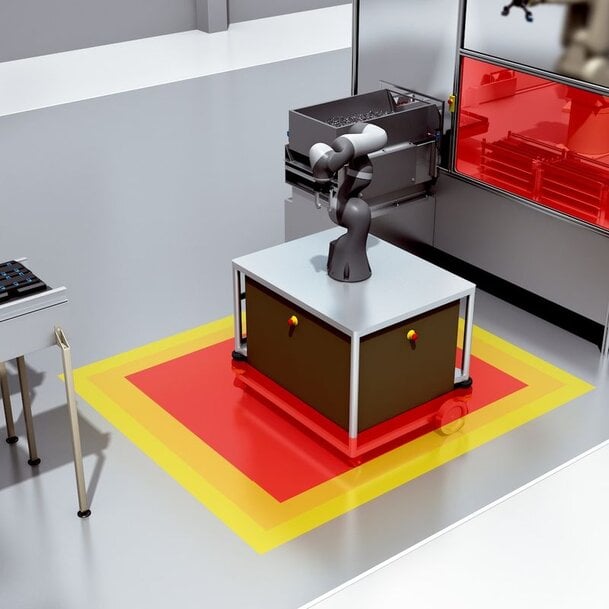
Autonomous Mobile Robots (AMRs) move independently throughout workshops and warehouses. Their ability to operate smoothly relies on the combined action of laser scanners, encoders and an onboard safety controller. While optical sensors and encoders serve as the AMR’s sensory receptors, the safety controller acts as its central processing unit. Based on the information received, it instructs the mobile robot’s axes to move to a safe state as soon as an obstacle is detected.
These mobile robots are being deployed on a large scale across industrial sites and logistics platforms. They offer greater flexibility than traditional AGVs (Automated Guided Vehicles), which follow rigid physical guidance systems installed on the floor, such as magnetic strips, rails or inductive wires. AMRs transport loads from one point to another without depending on fixed physical infrastructure.
To navigate, they generally use SLAM (Simultaneous Localization and Mapping) technology. This process enables the robot to create and continuously update a map of its environment while locating itself in real time. A simple software configuration is sufficient to modify routes or assign new tasks, eliminating the extensive floor-marking modifications required for AGVs.
The Essential Role of Onboard Detection Devices
The autonomy and safety of AMRs depend on the reliability of their sensors and safety controllers. These devices make it possible to detect an operator or moving obstacle nearby in order to avoid it, reduce speed or trigger an emergency stop.
Each manufacturer integrates appropriate detection systems to ensure compliance with the essential health and safety requirements of the European Machinery Directive 2006/42/EC. To meet these regulatory obligations, the use of laser scanners and safety incremental encoders is essential.
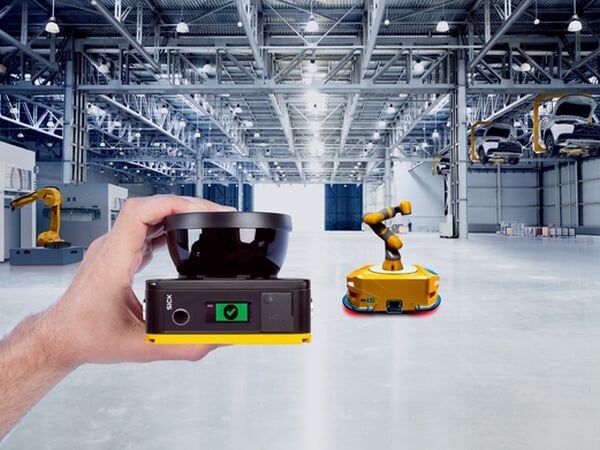
Safety laser scanners detect objects or people within their field of view remotely and without contact. The system calculates the stopping distance required before impact based on vehicle speed. The nominal safety stop is ensured by logical safety functions that monitor the robot’s speed or axis position.
In practice, a laser scanner can monitor several dynamically configured zones. A first warning zone detects the approach of an operator and triggers a reduction in the mobile robot’s speed, while a second, closer zone activates an immediate and safe stop when critical distance thresholds are exceeded.
From a technical perspective, the integration of compact models (less than 80 mm high) simplifies installation beneath the chassis of low-profile robots. Current devices use time-of-flight measurement technologies based on multiple laser pulses combined with filtering algorithms. These processes isolate the signal from environmental disturbances such as light variations, dust and contamination. The most sensitive sensors can detect objects with extremely low reflectivity (down to 1.8%, equivalent to dark clothing) over protective field ranges of several metres, with wide scanning angles of up to 275 degrees and management of dozens of programmable field configurations.
Safety Encoders
While the laser scanner manages external detection, safety encoders are essential for monitoring the AMR’s internal dynamic parameters, such as actual speed and direction of travel. They provide data relating to the position, angle and number of revolutions of drive systems.
To ensure the vehicle’s functional safety, these optical or magnetic components carry high-level safety certifications, typically reaching SIL 2 (according to IEC 62061) or PL d (according to ISO 13849). They natively support standardised safety functions dedicated to electric drive systems.
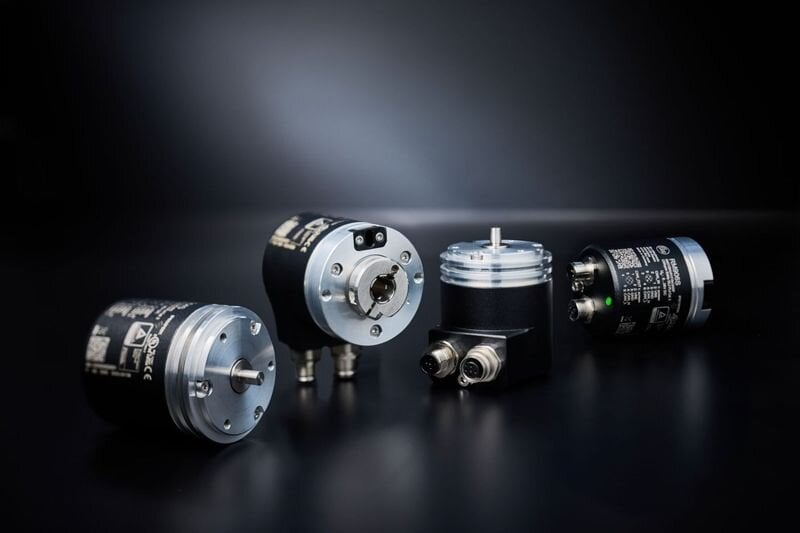
Ifm’s safety encoder is specifically designed for safety-critical applications. It provides signalling information essential for the safe control and monitoring of mobile applications.
The Safety Controller
The operation of an AMR requires information to be centralised: laser scanners indicate the position of obstacles, while encoders provide the vehicle’s speed and direction. This data must be analysed in real time to determine whether to slow down or stop.
This task is performed by the programmable safety control system. The controller executes the safety program and instantly transmits the appropriate commands to the AMR’s drives and motion systems. Electronic modules dedicated to motion monitoring supervise the motor safety functions defined by IEC 61800-5-2:
• Safe Stop: safe removal of motor power (STO, SS1, SS2).
• Safe Operating Stop (SOS): maintains the stopped position while torque is applied.
• Safe Speed Monitoring (SSM): verifies that speed remains within authorised limits.
• Safely Limited Speed (SLS): controlled reduction of robot speed.
• Safe Direction (SDI): monitoring of wheel rotation direction.
• Safe Brake Control (SBC): management of mechanical holding brakes.
• Safely Limited Position: monitoring of end-of-travel limits and operating zones.
Published by Youssef Belgnaoui, editor for Induportals.
