
www.ptreview.co.uk
25
'26
Written on Modified on
Ethernet-APL Advances Intelligent Flow Measurement
ABB showcases how high-speed connectivity unlocks richer diagnostics and smarter process operations.
global.abb
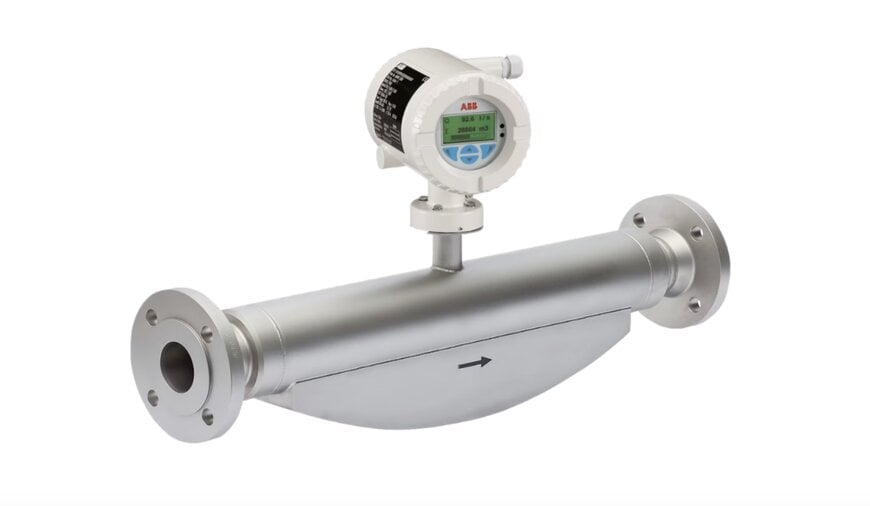
Modern flowmeters are more than just flowmeters. Flow measurement devices have evolved from basic volume or mass counters into multiparameter sensing tools that deliver rich, contextual data about a process. Technologies such as Coriolis flow measurement, thermal mass flow vortex or swirl measurement and electromagnetic flow (EMF) measurement enable instruments to measure not only flow rate but also fluid density, temperature, viscosity and even composition.
For example, Coriolis meters directly measure mass flow and fluid density, allowing real-time calculation of concentration or product quality (Image 1). Vortex or swirl flowmeters can measure energy flow, while EMF meters often integrate temperature and conductivity sensors to provide insight into fluid condition.
Modern flowmeters also include digital signal processing and onboard diagnostics, enabling them to detect issues such as air entrainment, fouling, or pipe vibration.
Additionally, many devices now support predictive maintenance, using trends in vibration, signal strength or calibration drift to warn of impending failures. As a result, today’s flowmeters act as intelligent field instruments, delivering not just flow data but a comprehensive view of process health and efficiency.
Getting to the HART of the matter
Traditionally, field device networks in industrial plants have communicated with controllers and engineering tools in a central control room via 4 to 20 mA analog current loops, often using HART protocol to transfer data. The advent of fieldbuses — such as PROFIBUS, Foundation Fieldbus and Modbus — introduced digital communication for field devices, but HART remains prevalent: most installed field devices continue to use this industry standard.
While the low power consumption, long cable length, intrinsic safety, robustness and simplicity of HART’s 4 to 20 mA current loop implementation are well suited for HART application areas, there are three major limitations:
- The transmission speed cannot accommodate the profusive stream of diagnostic and ancillary data that now accompanies the primary measurement.
- The protocol is tightly linked to the physical layer and does not tolerate any other protocol in the same network.
- HART telegrams are not routable through the IP-based networks found on upper automation layers and they do not have any semantics, functional safety and security capabilities.
This is where Ethernet-APL comes in.
Making the connection
Ethernet-APL addresses all the concerns mentioned above, as well as others. The protocol is the result of a decade-long standardization effort to bring Ethernet to the field level of the process industries. Ethernet-APL is fully compatible with the IEEE 802.3 Ethernet standard and meets or exceeds specific criteria for the process industries, including intrinsic safety.
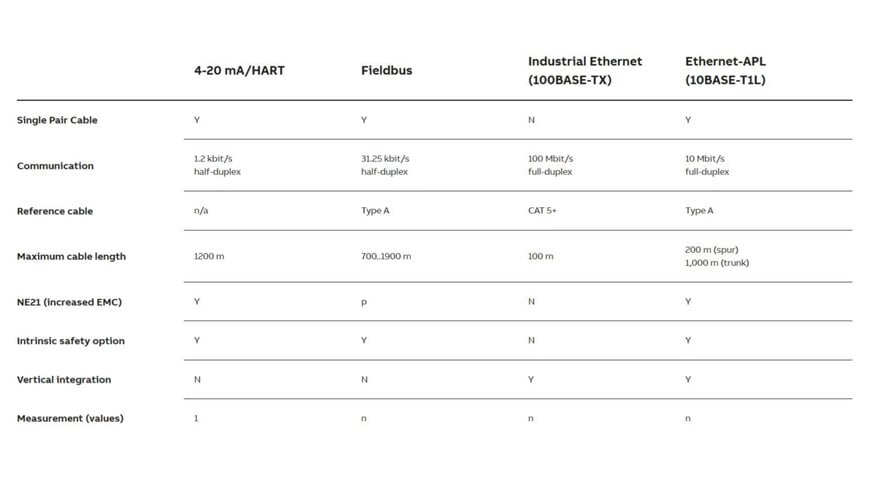
How the physical layer specifications of Ethernet-APL fulfil, and in most cases exceed, HART and other technologies.
In practice, Ethernet-APL supports trunk distances of up to 1 km and spur lengths of up to 200 m, while intrinsic safety port profiles keep energy within safe limits in explosive environments. The high bit-rate capabilities of the protocol ensure that the large amounts of multivariable data produced by flowmeters (and other field devices) distributed throughout a typical industrial plant can be managed effectively.
The technical standard that underpins Ethernet-APL is 2-Wire Intrinsically Safe Ethernet (2-WISE), also known as IEC 60079-47. 2-WISE enables safe, powered communication (also in explosive settings), allowing straightforward device connection with just a single twisted pair of wires, as the name suggests.
Because APL is protocol-agnostic, no protocol translators or gateways are needed at the field level. Device-level visibility can be achieved even when using existing PLC/DCS/SCADA ecosystems, thus simplifying engineering, accelerating factory and site acceptance tests and enabling remote verification, diagnostics and troubleshooting.
Ethernet-APL natively supports PROFINET, EtherNet/IP, OPC UA, Modbus TCP and other Ethernet protocols.
Safe – and secure
With so much data in play and the cost of losing access to it so high, ABB makes tight cyber security a key feature of its implementations. ABB’s strict cyber security measures are based on the IEC 62443 international standard series for securing industrial automation and control systems against cyber threats. IEC 62443 at the field layer applies role-based access control (RBAC), which enforces segmentation and virtual local area networks (VLANs), performs device hardening and embeds event logging directly into the advanced physical layer (APL) design. These measures help ensure that only authorized users can access devices, that networks are separated to reduce risk and that all activities are recorded for traceability.
This overall approach allows secure, real-time control and monitoring, supporting operational reliability and reducing risk. By using ABB’s cybersecurity practices − proven over many years and in many industrial settings − industries gain better protection against threats and unauthorized access, maintaining productivity and continuity while keeping operations safe and compliant with the latest standards.
Ethernet-APL makes plants faster, safer and smarter
The wealth of multivariable data delivered by ABB’s portfolio of flowmeters − including magnetic-, Coriolis-, vortex- and swirl-based devices − paired with Ex-safe Ethernet-APL allows fine-grained process control and instant diagnostics, thus improving accuracy while reducing maintenance effort. Operators can now start up more quickly, remain online for extended periods, reduce overall lifecycle costs and achieve greater reliability and productivity.
Making the connection
Ethernet-APL addresses all the concerns mentioned above, as well as others. The protocol is the result of a decade-long standardization effort to bring Ethernet to the field level of the process industries. Ethernet-APL is fully compatible with the IEEE 802.3 Ethernet standard and meets or exceeds specific criteria for the process industries, including intrinsic safety.
How the physical layer specifications of Ethernet-APL fulfil, and in most cases exceed, HART and other technologies.
In practice, Ethernet-APL supports trunk distances of up to 1 km and spur lengths of up to 200 m, while intrinsic safety port profiles keep energy within safe limits in explosive environments. The high bit-rate capabilities of the protocol ensure that the large amounts of multivariable data produced by flowmeters (and other field devices) distributed throughout a typical industrial plant can be managed effectively.
The technical standard that underpins Ethernet-APL is 2-Wire Intrinsically Safe Ethernet (2-WISE), also known as IEC 60079-47. 2-WISE enables safe, powered communication (also in explosive settings), allowing straightforward device connection with just a single twisted pair of wires, as the name suggests.
Because APL is protocol-agnostic, no protocol translators or gateways are needed at the field level. Device-level visibility can be achieved even when using existing PLC/DCS/SCADA ecosystems, thus simplifying engineering, accelerating factory and site acceptance tests and enabling remote verification, diagnostics and troubleshooting.
Ethernet-APL natively supports PROFINET, EtherNet/IP, OPC UA, Modbus TCP and other Ethernet protocols.
Safe – and secure
With so much data in play and the cost of losing access to it so high, ABB makes tight cyber security a key feature of its implementations. ABB’s strict cyber security measures are based on the IEC 62443 international standard series for securing industrial automation and control systems against cyber threats. IEC 62443 at the field layer applies role-based access control (RBAC), which enforces segmentation and virtual local area networks (VLANs), performs device hardening and embeds event logging directly into the advanced physical layer (APL) design. These measures help ensure that only authorized users can access devices, that networks are separated to reduce risk and that all activities are recorded for traceability.
This overall approach allows secure, real-time control and monitoring, supporting operational reliability and reducing risk. By using ABB’s cybersecurity practices − proven over many years and in many industrial settings − industries gain better protection against threats and unauthorized access, maintaining productivity and continuity while keeping operations safe and compliant with the latest standards.
Ethernet-APL makes plants faster, safer and smarter
The wealth of multivariable data delivered by ABB’s portfolio of flowmeters − including magnetic-, Coriolis-, vortex- and swirl-based devices − paired with Ex-safe Ethernet-APL allows fine-grained process control and instant diagnostics, thus improving accuracy while reducing maintenance effort. Operators can now start up more quickly, remain online for extended periods, reduce overall lifecycle costs and achieve greater reliability and productivity.
