
www.ptreview.co.uk
03
'26
Written on Modified on
Nexcom's Comprehensive Guide to the ISO 10218 Robot Safety Standard
The ISO 10218 robot safety standard provides one of the most important frameworks for reducing risks in industrial robot applications.
www.nexcom.com
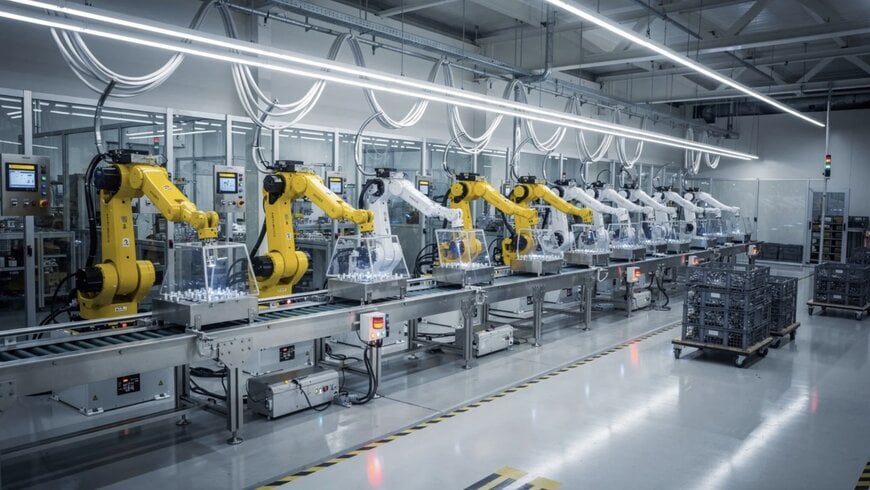
The ISO 10218 standard defines the international baseline for industrial robot safety across production environments like assembly, welding, and machine tending. Its 2025 revision formalizes a critical industry transition toward advanced collaborative robotics, unified functional safety, and cyber-physical security.
Scope and the Part 1 vs. Part 2 Division
The framework applies strictly to industrial automation, excluding service, medical, and personal care robots. Deploying a compliant system requires defining the Operational Design Domain (ODD), intended payloads, and misuse scenarios across two distinct domains of responsibility.
ISO 10218-1 places the compliance mandate on the Original Equipment Manufacturer (OEM). It treats the bare-metal manipulator and its controller as an incomplete machine, requiring factory-integrated safety-related control functions. OEMs must engineer inherent mechanical safety to limit kinetic transfer, implement IEC 60204-1 Category 0 and Category 1 safe stops, enforce kinematic boundaries such as Safely-Limited Speed and Position, provide fail-safe mode switching, and supply detailed residual risk documentation.
ISO 10218-2 shifts liability directly to system integrators and facility engineers responsible for turning that incomplete machine into a production asset. Integrators must execute comprehensive ISO 12100 risk assessments, design spatial topologies with clear operator access points, deploy deterministic physical guarding and optoelectronic monitoring, establish lifecycle protocols for maintenance and Lockout/Tagout, and validate that protective measures achieve the required Performance Level. Crucially, a compliant Part 1 arm does not guarantee a compliant workcell without rigorous Part 2 integration.
Key 2025 Updates
The latest revision incorporates ISO/TS 15066, elevating collaborative robotics specifications from technical guidance to mandatory requirements. It introduces a structural classification system—Class I for traditional fenced setups and Class II for collaborative systems—to align safety validation directly with kinematic hazards and human interaction levels.
Crucially, the standard tackles IT/OT convergence by tying functional safety to cybersecurity. Recognizing that a compromised network packet can trigger physical kinetic hazards, ISO 10218:2025 mandates that safety circuits remain insulated against cyber vulnerabilities through secure communication, access controls, and hardened edge platforms.
Four Collaborative Operational Modes
When humans and robots share space, the standard outlines four operational mechanisms:
Safety-Rated Monitored Standstill initiates a Category 2 safe stop, keeping drive power energized when a person breaches a safety volume and allowing instantaneous cycle resumption once cleared. Hand Guiding permits direct manual manipulation for programming and positioning, provided motion controls prevent unintended acceleration. Speed and Separation Monitoring dynamically scales robot velocity based on operator proximity, halting movement before contact occurs. Power and Force Limiting caps kinetic force, torque, and speed to minimize injury risk upon contact; however, this protection is immediately invalidated if integrators attach high-inertia, sharp, or thermally hazardous End-of-Arm Tooling (EOAT).
Risk Assessment and Integration Traps
Compliance hinges on treating the risk assessment as a living engineering document that must be re-validated after any change to workcell topology, payloads, EOAT, or controller firmware. Integrators frequently stumble by assuming a collaborative arm eliminates the need for cell-level risk assessments, neglecting tooling hazards, placing emergency stops in poor locations, skipping functional validation, or deploying safety logic on unhardened, unencrypted controllers.
NEXCOM Infrastructure
Real-time compliance requires deterministic computing to bridge physical mechanics and digital control without latency. NEXCOM addresses this demand with industrial edge controllers equipped with embedded TPM 2.0 and secure boot to satisfy the new cyber-physical mandates, dedicated processing for calculating dynamic Speed and Separation Monitoring routines, and flexible high-speed I/O to fuse safety laser scanners, light curtains, 3D vision, and PLCs into an integrated control architecture.
Edited by Romila DSilva, Induportals Editor, with AI assistance.
www.nexcom.com
