
www.ptreview.co.uk
07
'26
Written on Modified on
Industrial battery platforms link e-mobility and energy storage
Volvo Penta works with Fantuzzi Team Material Handling and TecnoGen to deploy a shared battery platform for electric material handling and mobile energy storage.
www.volvopenta.com
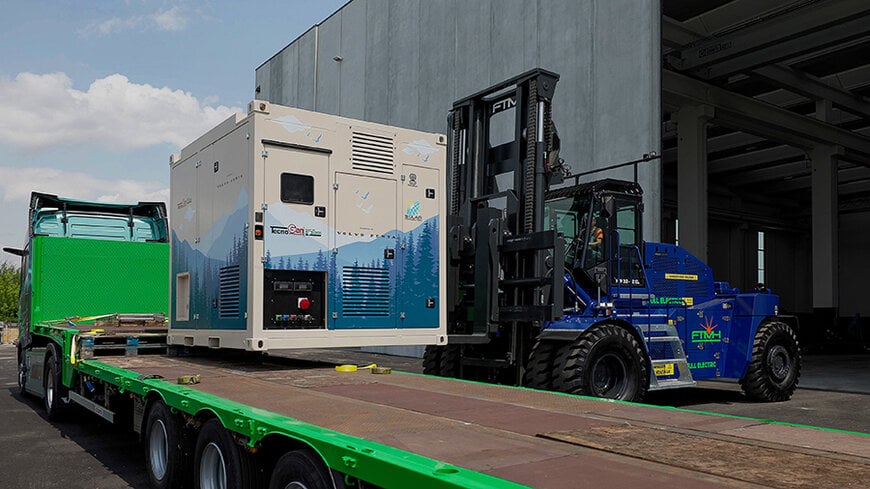
Volvo Penta is demonstrating how a common industrial battery platform can support both electric machinery and on-site energy infrastructure. In Italy, a joint implementation with Fantuzzi Team Material Handling (FTMH) and TecnoGen shows how the same battery technology can power an electric forklift while also supplying a battery energy storage system (BESS) used for charging and site power.
Context of the cooperation
Industrial electrification is driving demand for robust battery systems that can operate reliably across different applications, from heavy-duty mobile equipment to stationary or semi-mobile energy storage. Rather than developing isolated solutions, FTMH and TecnoGen pursued a shared platform approach in cooperation with Volvo Penta, aiming to simplify integration, reduce development effort, and support scalable electrification.
The collaboration addresses two parallel challenges: electrifying material handling equipment with demanding duty cycles, and providing flexible, emissions-free energy storage to support charging and power management.
Technical solution and responsibilities
Volvo Penta supplies a modular battery system originally developed for electric trucks and construction equipment, adapted for industrial e-mobility and BESS use. The battery packs feature high energy density, liquid cooling, IP67-rated protection, and shock-resistant mechanical design, enabling use in mobile and industrial environments.
FTMH worked with Volvo Penta engineers to develop a purpose-built electric driveline for its FTF 26-12 EL forklift. The system is designed to withstand intensive material-handling cycles while providing a pathway to electrify a broader range of forklifts and empty container handlers. Volvo Penta supported the integration with system-level engineering and validation, while its global service network was a factor in FTMH’s platform selection.
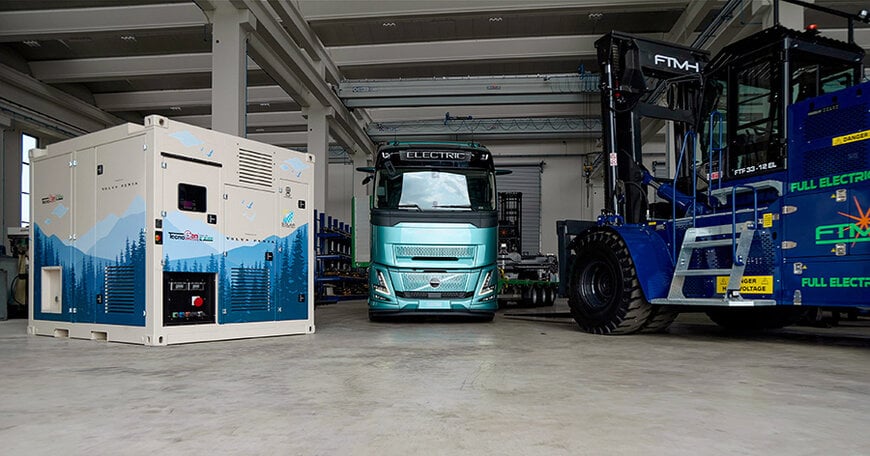
TecnoGen integrated the same Volvo Penta battery systems into its BESS solutions. These systems are designed to be modular and configurable, supporting applications such as charging infrastructure, peak shaving, and mobile power supply. TecnoGen focuses on system integration and customization of the energy platform around the battery subsystem.
Deployment and implementation
In the joint demonstration, TecnoGen’s BESS, powered by Volvo Penta batteries, supplies energy to charge FTMH’s electric forklift. This setup illustrates how a single battery platform can simultaneously support machine operation and site-level energy needs without dedicated, application-specific battery designs.
The approach reduces complexity by standardizing core battery components while allowing application-specific system integration at the driveline or energy management level.
Applications and expected impact
The cooperation targets industrial material handling, mobile equipment electrification, and distributed energy storage. Using a common battery foundation supports faster development cycles, shared service and support strategies, and flexibility to adapt systems as electrification requirements evolve.
By aligning e-mobility and energy storage on a single, industrial-grade battery platform, Volvo Penta, FTMH, and TecnoGen demonstrate a scalable model for electrification that links machine power and energy infrastructure within the same ecosystem.
www.volvopenta.com
