
www.ptreview.co.uk
07
'26
Written on Modified on
Mobile collaborative platform for automated automotive kitting applications
Roboverse Reply, Bosch Rexroth, and Joytek develop a semi-humanoid mobile system integrating autonomous mobility with dual seven-axis collaborative robotic arms.
www.boschrexroth.com
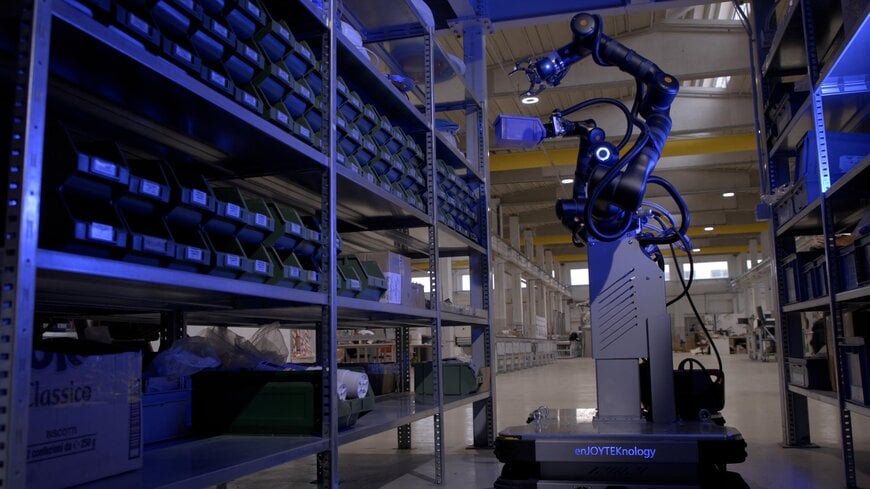
Roboverse Reply, Bosch Rexroth, and Joytek have collaborated to develop an advanced mobile robotics platform designed for industrial environments. The project originated as a research and development initiative by Roboverse Reply and focuses on the automotive sector. The primary objective is the optimization of kitting processes through the deployment of intelligent mobile robots capable of complex manipulation tasks. By combining the expertise of an integrator, a drive and control specialist, and a robotics systems manufacturer, the collaboration addresses the technical requirements of modern manufacturing logistics.
Technical architecture and coordinated operation
The system architecture utilizes an autonomous mobile robot base paired with two seven-axis collaborative robots from Kassow Robots, a subsidiary of Bosch Rexroth. While traditional industrial automation often treats mobility and manipulation as independent functions, this platform integrates both capabilities into a single coordinated control framework. This integration allows the unit to navigate alongside gravity-fed shelving systems, retrieve specific components autonomously, and assemble kits destined for production lines. The use of seven-axis kinematics is significant as it provides the dexterity necessary to operate in confined spaces where traditional six-axis robots may face singularity or reach limitations.
Operational hardware and industrial deployment
The physical platform, developed by Joytek, consists of an autonomous base equipped with an elevating column that supports the dual robotic arms. This column allows the system to access components at various heights, increasing the vertical storage density that the robot can service. The mobile base is engineered to maintain stability during high-precision picking operations while navigating complex industrial layouts. This design ensures that the system can adapt to existing factory floor configurations without requiring extensive infrastructure modifications, facilitating the transition toward automated kitting in dynamic production environments.
Edited by an industrial journalist, Lekshman Ramdas, with AI assistance.
www.boschrexroth.com
