
www.ptreview.co.uk
23
'26
Written on Modified on
High-Density Analog I/O for EtherCAT Systems
Beckhoff introduces a new generation of compact analog EtherCAT Terminals with higher channel density and 16-bit resolution.
www.beckhoff.com
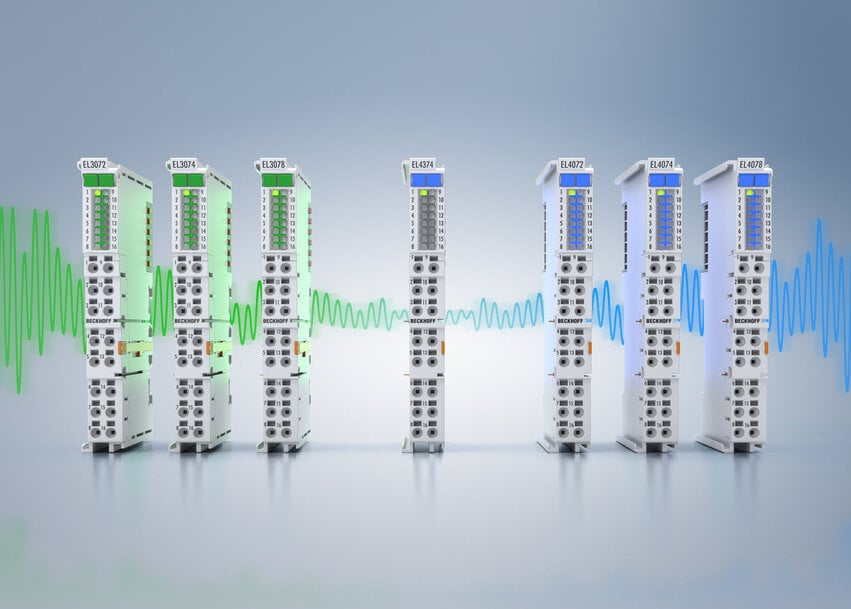
Beckhoff has expanded its EtherCAT Terminal portfolio with a new generation of analog input and output terminals in high-density housings, combining increased channel counts with 16-bit resolution for scalable and space-efficient industrial automation applications.
Higher channel density in compact form factors
The new analog EtherCAT Terminals are designed in compact high-density (HD) housings and support up to eight channels per terminal. This increases signal density at the I/O level and reduces cabinet space requirements, which is particularly relevant in modular machine designs and distributed automation architectures.
Across seven new terminals, the combination of multi-channel capability and 16-bit resolution enables more precise signal acquisition and output control while maintaining a consistent mechanical footprint. The terminals are intended for a broad range of measurement and control tasks in industrial automation systems where space efficiency and signal quality are critical.
Combined analog input/output functionality
The EL4374 is the first Beckhoff analog terminal to combine input and output functionality in a single module. It supports voltage and current signals (10 V / 20 mA or –20/0/+4 to +20 mA) and operates with a conversion rate of 2 ksps per channel.
The terminal provides two channels that can be individually parameterized as inputs or outputs via TwinCAT software using the CoE interface. This flexibility allows engineers to adapt channel usage at configuration level without hardware changes, supporting flexible I/O assignment in machine concepts.
With a technical measuring range of ±107% of the nominal value, the EL4374 supports commissioning scenarios involving sensor values outside the nominal range. This extended range enables evaluation in accordance with NAMUR NE43, which defines standardized signal levels for fault detection in analog process signals. On the output side, the terminal can supply up to 107% of the nominal value and supports loads of up to 750 Ω at 20 mA, enabled by its higher output power.
Upgraded analog input terminals
The EL3072 and EL3074 analog input terminals have been updated to offer 16-bit resolution, replacing the previous 12-bit architecture. Both terminals support 10 V / 20 mA universal inputs, with the EL3072 providing two channels and the EL3074 four channels, each individually parameterizable for voltage or current operation.
The new EL3078 further extends the input range by providing eight channels within the same HD housing. This higher channel count supports applications requiring dense sensor integration, such as test systems, process automation, or compact machine control panels.
Extended analog output portfolio
Equivalent enhancements are available on the output side with the EL4072, EL4074, and EL4078 terminals. These analog output terminals now also feature 16-bit resolution and offer two, four, or eight channels respectively, all within compact HD housings.
The consistent feature set across input, output, and combined I/O terminals simplifies system planning and supports uniform signal handling across EtherCAT-based automation systems.
Application context
The new generation of analog EtherCAT Terminals targets industrial automation environments where precise analog signal processing, compact I/O layouts, and flexible configuration are required. By combining higher resolution, increased channel density, and software-based parameterization, the terminals support scalable I/O architectures aligned with modern machine and plant design requirements.
www.beckhoff.com
