
www.ptreview.co.uk
05
'26
Written on Modified on
Beam Couplings Extend Misalignment & Torque Capability
Ruland Manufacturing expands its beam coupling portfolio with a six-beam design engineered for higher torsional stiffness, wider bore coverage, and increased misalignment tolerance in precision motion systems.
www.ruland.com
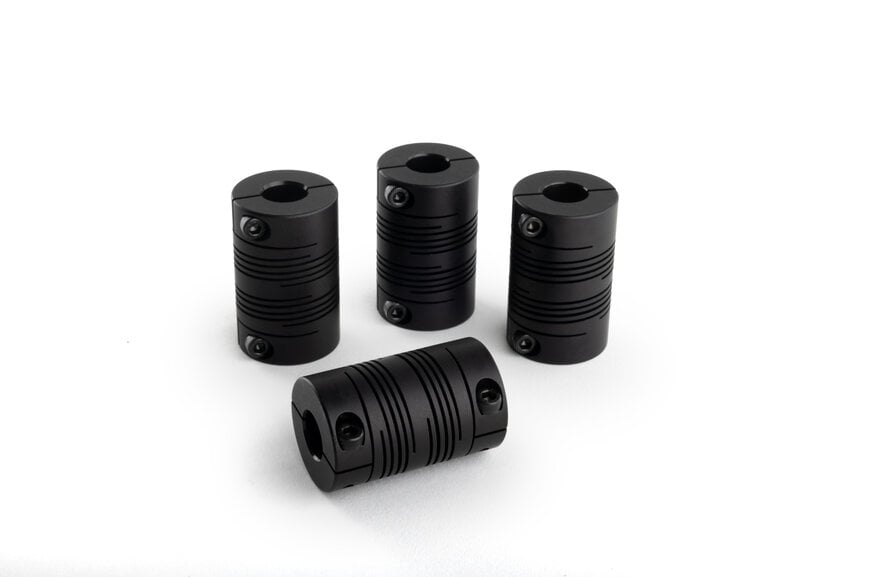
D-series beam couplings feature high misalignment, an anodized finish, and an expanded bore range.
Precision motion control, automation, robotics, and medical equipment rely on shaft couplings that balance torsional stiffness with the ability to accommodate misalignment without introducing backlash or excessive bearing loads. As systems grow more compact and mechanically constrained, coupling selection increasingly influences positioning accuracy, system reliability, and ease of integration.
Ruland Manufacturing has expanded its beam coupling offering with a new six-beam configuration designed to address these requirements in light- to medium-duty servo and motion control applications. The addition broadens the company’s standard beam coupling range, reducing the need for custom designs in applications with demanding alignment and spacing constraints.
Six-beam geometry for stiffness and flexibility
The new couplings use a six-beam architecture formed by two sets of three helical cuts separated by a wide slot. Compared with single- or four-beam designs, this geometry increases torsional stiffness while preserving the ability to compensate for angular, axial, and parallel misalignment. The design supports angular misalignment of up to 7 degrees, allowing shafts to remain connected without transmitting excessive reaction forces to bearings or encoders.
The helical cut pattern also enables high axial misalignment accommodation, making the coupling suitable for assemblies where shaft spacing varies due to thermal expansion, tolerance stack-up, or structural deflection.
Extended length and expanded bore range
Within Ruland’s beam coupling portfolio, the new series has the longest length for a given bore size. This extended length improves flexibility in applications with a larger distance between shaft ends, where shorter couplings may struggle to absorb axial or angular displacement without increasing stress.
The couplings are available with bore sizes from 5/32 in to 1 in (4 mm to 25 mm), expanding compatibility with larger motor and driven shaft diameters. An anodized surface finish improves corrosion resistance, supporting use in environments where humidity or cleaning agents are present.
Standard solution for servo and motion systems
By adding this six-beam option to its standard catalog, Ruland enables engineers to select an off-the-shelf coupling for a broader range of motion control designs. This approach simplifies mechanical design, shortens qualification cycles, and reduces procurement complexity compared with specifying custom couplings for higher misalignment or stiffness requirements.
The couplings are intended for use in applications such as encoders, positioning stages, robotics, medical devices, and automated equipment, where repeatable motion, low backlash, and consistent torque transmission are critical.
Manufacturing and material considerations
The couplings are manufactured in the United States from 2024-T51 aluminum bar stock. According to the manufacturer, proprietary machining and inspection processes are used to maintain dimensional consistency and repeatable performance across production batches—factors that are particularly important in precision motion systems with tight tolerance requirements.
By combining higher torsional stiffness, expanded bore sizes, and increased misalignment capability in a standard product format, the new beam coupling design addresses common mechanical challenges in modern motion control assemblies without introducing additional system complexity.
www.ruland.com
Precision motion control, automation, robotics, and medical equipment rely on shaft couplings that balance torsional stiffness with the ability to accommodate misalignment without introducing backlash or excessive bearing loads. As systems grow more compact and mechanically constrained, coupling selection increasingly influences positioning accuracy, system reliability, and ease of integration.
Ruland Manufacturing has expanded its beam coupling offering with a new six-beam configuration designed to address these requirements in light- to medium-duty servo and motion control applications. The addition broadens the company’s standard beam coupling range, reducing the need for custom designs in applications with demanding alignment and spacing constraints.
Six-beam geometry for stiffness and flexibility
The new couplings use a six-beam architecture formed by two sets of three helical cuts separated by a wide slot. Compared with single- or four-beam designs, this geometry increases torsional stiffness while preserving the ability to compensate for angular, axial, and parallel misalignment. The design supports angular misalignment of up to 7 degrees, allowing shafts to remain connected without transmitting excessive reaction forces to bearings or encoders.
The helical cut pattern also enables high axial misalignment accommodation, making the coupling suitable for assemblies where shaft spacing varies due to thermal expansion, tolerance stack-up, or structural deflection.
Extended length and expanded bore range
Within Ruland’s beam coupling portfolio, the new series has the longest length for a given bore size. This extended length improves flexibility in applications with a larger distance between shaft ends, where shorter couplings may struggle to absorb axial or angular displacement without increasing stress.
The couplings are available with bore sizes from 5/32 in to 1 in (4 mm to 25 mm), expanding compatibility with larger motor and driven shaft diameters. An anodized surface finish improves corrosion resistance, supporting use in environments where humidity or cleaning agents are present.
Standard solution for servo and motion systems
By adding this six-beam option to its standard catalog, Ruland enables engineers to select an off-the-shelf coupling for a broader range of motion control designs. This approach simplifies mechanical design, shortens qualification cycles, and reduces procurement complexity compared with specifying custom couplings for higher misalignment or stiffness requirements.
The couplings are intended for use in applications such as encoders, positioning stages, robotics, medical devices, and automated equipment, where repeatable motion, low backlash, and consistent torque transmission are critical.
Manufacturing and material considerations
The couplings are manufactured in the United States from 2024-T51 aluminum bar stock. According to the manufacturer, proprietary machining and inspection processes are used to maintain dimensional consistency and repeatable performance across production batches—factors that are particularly important in precision motion systems with tight tolerance requirements.
By combining higher torsional stiffness, expanded bore sizes, and increased misalignment capability in a standard product format, the new beam coupling design addresses common mechanical challenges in modern motion control assemblies without introducing additional system complexity.
www.ruland.com
