
Overview of Edge Computing Systems Recently Launched on the Market
A concise technical overview of embedded computing solutions for edge computing presented in recent months on Automation France.
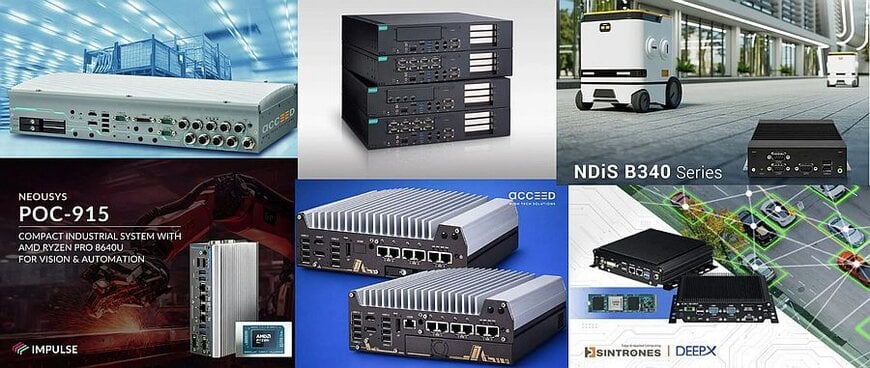
The growth of industrial applications integrating artificial intelligence is accompanied by a shift in data processing towards the network edge. This model, referred to as edge computing, involves executing computing, analysis and decision-making tasks locally, as close as possible to data sources (sensors, cameras, industrial equipment), rather than in remote data centres.
Edge computing: principles and technical constraints
In industrial environments, edge computing addresses several structural constraints. Latency must be controlled to enable real-time responses, particularly in vision systems, robotics or process control applications. The volume of data generated by sensors also makes systematic transfer to the cloud costly. Finally, certain applications require autonomous operation, including in situations where connectivity is limited.
These constraints call for architectures capable of combining local computing power, appropriate thermal management, extensive connectivity and integration within physically constrained environments.
Common features of the platforms analysed
Six systems presented in recent months on Automation Mag: the 19-inch rack-mounted GT-92GC system from Acceed, the Nuvo-11000 series embedded computer from Neousys, the compact POC-915 embedded system from Impulse Embedded, the NDiS B340 platform from Nexcom, the SBox edge computer series from Sintrones Technology and the rackmount industrial PC (IPC) RKP-C220 series from Moxa.
These solutions align with this approach and share several technical characteristics:
• Local AI processing: all platforms integrate inference capabilities, via GPU, NPU or dedicated accelerators, to process data streams locally (images, signals, events).
• Fanless design: the elimination of active cooling systems aims to limit mechanical failures, particularly in environments exposed to dust, vibration or temperature fluctuations.
• Extensive industrial connectivity: multiple network interfaces (Ethernet, PoE, sometimes 10 GbE), serial ports, digital I/O or industrial buses (CAN), enabling integration with field equipment.
• Operation under extended conditions: wide temperature ranges and continuous 24/7 operation.
• High-performance local storage: use of NVMe SSDs to handle significant data flows and ensure real-time processing.
• Modularity and scalability: PCIe slots, mini-PCIe or proprietary modules allowing systems to be adapted to evolving application requirements.
These elements reflect a convergence towards distributed architectures, in which each edge node combines computing, data acquisition and pre-processing.
Differentiation of hardware approaches
Despite this common foundation, each solution adopts a specific technical strategy.
The GT-92GC system from Acceed stands out through the integration of an NVIDIA RTX GPU in a fully passive 19-inch rack format. It targets high-density multi-camera applications, supporting up to twelve simultaneous streams, and relies on a heat pipe-based thermal architecture to dissipate CPU and GPU heat.
The Nuvo-11000 series from Neousys, distributed by Acceed, emphasises the integration of an NPU directly within the Intel Core Ultra processor. This approach promotes built-in AI acceleration, complemented by high memory capacity (up to 96 GB) and extended networking options, including 10 GbE.
The POC-915 from Impulse Embedded adopts a compact DIN-rail mountable format suited to distributed installations. It is based on an integrated AMD architecture (CPU, GPU, AI) and targets scenarios where footprint and integration into industrial cabinets are decisive factors.
The NDiS B340 from Nexcom favours a modular approach, with a low-power base system complemented by PCIe extensions. This design allows the system’s capabilities to be progressively adapted without complete hardware replacement.
The SBox series from Sintrones introduces a dedicated AI accelerator (Deepx DX-M1), separate from CPU/GPU resources. This separation of workloads helps optimise the performance-to-power ratio and maintain stable latency in energy-constrained environments.
Finally, the RKP-C220 IPC from Moxa adopts a rackmount architecture geared towards more intensive AI workloads, with support for full-length GPUs (up to 200 W) and a high density of I/O interfaces. It is also qualified for running language models, broadening its application scope.
Alignment with industrial edge computing requirements
These systems meet the requirements of industrial edge computing for several technical reasons. On the one hand, proximity of processing reduces latency and ensures real-time responses, which are essential in control, vision and safety applications.
On the other hand, the specialisation of computing architectures (GPU, NPU, dedicated ASICs) enables efficient execution of AI models without reliance on remote infrastructure, while keeping energy consumption under control.
In addition, fanless design and mechanical robustness address the environmental constraints of industrial sites, where systems must operate without frequent maintenance.
Finally, modularity and connectivity enable these platforms to be integrated into heterogeneous ecosystems while ensuring long-term scalability, which is essential in large-scale distributed deployments.
Summary prepared by Youssef Belgnaoui, editor specialising in industrial technologies.
