
www.ptreview.co.uk
10
'26
Written on Modified on
Strengthening Cyber Resilience in Mission-Critical Edge Computing
Sintrones is presenting new Edge AI systems aligned with IEC 62443-4-1 standards to ensure cybersecurity and operational reliability in industrial automation and autonomous mobility.
www.sintrones.com
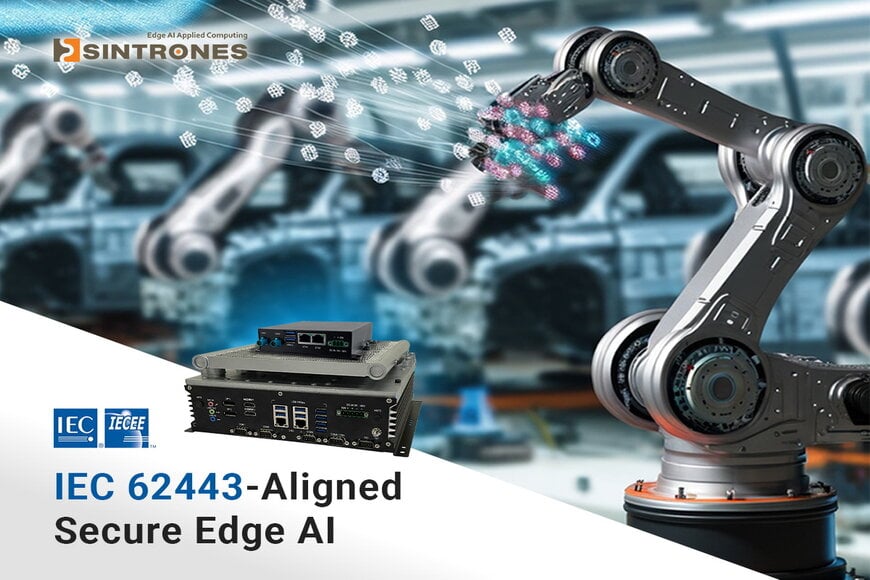
Edge AI computing enables real-time data processing and local decision-making, which are essential for safety-critical applications such as autonomous navigation and industrial threat detection. By shifting inference from the cloud to the device, these systems reduce latency and maintain functionality in environments with intermittent connectivity. At Embedded World 2026 technical demonstrations illustrated how hardware-level security and advanced thermal management support the integrity of the automotive data ecosystem.
Standardized Cybersecurity for Industrial Networks
As industrial and transportation infrastructures become increasingly connected, the risk of cyber threats to operational technology (OT) has grown. To address this, the product development lifecycle at Sintrones has been certified to the IEC 62443-4-1 standard. This framework specifies secure development requirements for products used in industrial automation and control systems, covering the entire lifecycle from initial design to end-of-life support.
This alignment ensures that security is an intrinsic part of the hardware architecture rather than an add-on. By following these certified processes, the systems provide a verified foundation for a secure digital supply chain, helping operators mitigate vulnerabilities in large-scale deployments across military, defense, and industrial sectors.
Passive Thermal Management via Phase-Change Technology
Continuous high-performance AI inference generates significant thermal loads that can lead to throttling or hardware failure in sealed, rugged environments. The ThermoSiphon Edge AI Computer (ABOX-5221) utilizes a patented self-circulating, phase-change cooling architecture to manage these temperatures without active components.
By eliminating fans and pumps, the system removes common mechanical points of failure and reduces maintenance requirements. This passive cooling mechanism allows the device to maintain stable performance levels during intensive processing tasks, making it suitable for long-term stationary use in harsh industrial environments where manual servicing is difficult.
Low-Mass Computing for Autonomous Mobility
Weight and power consumption are primary constraints for unmanned systems and mobile robotic platforms. The IBOX-604-G2 is a compact Edge AI system weighing 0.3kg, designed specifically for integration into autonomous vehicles. Built on the NVIDIA Jetson platform, it provides the computational density required for sensor fusion and vision-based perception.
In practical use cases, such as the detection of hazardous materials or weapons, these lightweight units process high-resolution video feeds locally. This on-device inference improves situational awareness and response times compared to cloud-dependent architectures. Furthermore, the company’s collaboration with Qualcomm Technologies integrates platforms like the Dragonwing IQ9 into its roadmap, ensuring scalability for future autonomous mobility requirements.
Edited by Industrial Journalist, Evgeny Churilov – AI Powered
www.sintrones.com
