
www.ptreview.co.uk
10
'26
Written on Modified on
Industrial Robotics Simulation Platform for Physical AI Deployment
ABB Robotics and NVIDIA collaborate to integrate Omniverse simulation libraries into RobotStudio to enable scalable industrial automation and AI-driven robotics training.
global.abb
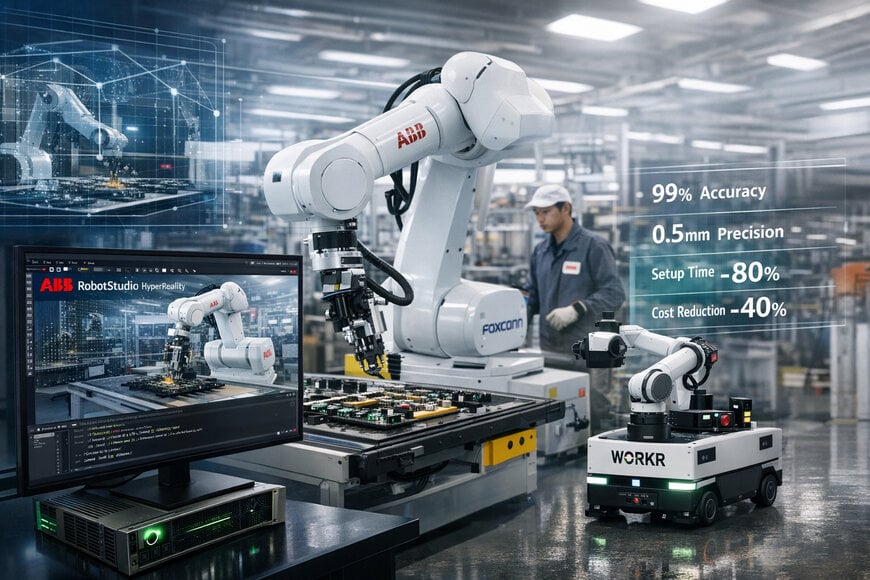
ABB Robotics and NVIDIA are collaborating to integrate NVIDIA Omniverse simulation libraries into ABB’s RobotStudio engineering environment to support the development and deployment of AI-driven industrial robots. The cooperation focuses on improving the reliability of robot training in digital environments and transferring those models into real manufacturing operations.
Context of the Cooperation
Industrial robots increasingly rely on artificial intelligence models trained in simulated environments before deployment on factory floors. However, discrepancies between simulated conditions and real-world environments commonly described as the “sim-to-real gap” have historically limited the reliability of virtual training.
ABB Robotics develops industrial robots and engineering software used in manufacturing automation. NVIDIA provides high-performance computing and simulation platforms used for artificial intelligence development. Their cooperation combines robotics engineering tools with advanced simulation infrastructure to support scalable industrial automation and physical AI applications.
The collaboration focuses on integrating NVIDIA Omniverse libraries into ABB’s RobotStudio software platform, enabling more physically accurate simulations of robotic cells, production lines, and factory environments.
Technical Solution and Responsibilities
ABB provides the RobotStudio engineering platform, which includes a virtual controller running the same firmware used in physical robots. This architecture allows robotic programs and control logic tested in simulation to operate identically on production equipment.
NVIDIA contributes Omniverse simulation libraries and accelerated computing technologies designed for physically accurate digital environments. These libraries simulate lighting, materials, textures, object geometry, and environmental conditions encountered in manufacturing facilities.
The combined system, referred to as RobotStudio HyperReality, allows engineers to generate large volumes of synthetic data for AI training. Robots can be trained in simulated production scenarios before deployment on physical systems.
ABB’s Absolute Accuracy technology further improves correlation between simulation and real operation by reducing positioning errors from approximately 8–15 mm to about 0.5 mm. Together with the shared firmware between virtual and physical controllers, this supports simulation-to-deployment accuracy levels reported at up to 99%.
Deployment and Implementation
RobotStudio HyperReality is scheduled for availability to ABB’s global RobotStudio user base in the second half of 2026. The platform integrates with existing ABB robot controllers and engineering workflows used in manufacturing facilities.
ABB is also assessing integration of the NVIDIA Jetson edge computing platform into its OmniCore robot controller architecture. Edge AI hardware would allow robots to perform real-time AI inference directly within production environments without relying on external computing infrastructure.
Applications and Use Cases
The system targets industries that require high-precision robotics and rapid production changes, including consumer electronics manufacturing, automotive assembly, and logistics automation.
Foxconn is piloting the platform in consumer electronics assembly. In this environment, robots must handle small components and support multiple product variants. Using simulated training data, robots can be trained to perform pick-and-place and assembly tasks across different production scenarios before deployment on the production line.
Another implementation is being demonstrated by WORKR, a U.S.-based robotics solutions provider, which uses the platform to deploy robotic manufacturing systems for small and medium-sized manufacturers.
Results and Expected Impact
The use of physically accurate simulation and synthetic training data allows manufacturers to design and validate robotic production systems before physical installation. According to ABB’s analysis, virtual commissioning can reduce setup and commissioning times by up to 80%, reduce development costs by up to 40% by minimizing physical prototypes, and accelerate production ramp-up for complex products.
By linking robotics engineering tools with high-fidelity simulation and AI training capabilities, the cooperation aims to support scalable deployment of intelligent robotic systems across global manufacturing environments.
Prepared with AI assistance and edited by Sucithra mani.
www.abb.com
