
www.ptreview.co.uk
20
'26
Written on Modified on
Alva integrates zero-cogging motors with inductive encoder control
System-level pairing of SlimTorq motors and FLUX encoders improves low-speed stability, resolution, and robustness in direct-drive applications.
www.alvaindustries.com
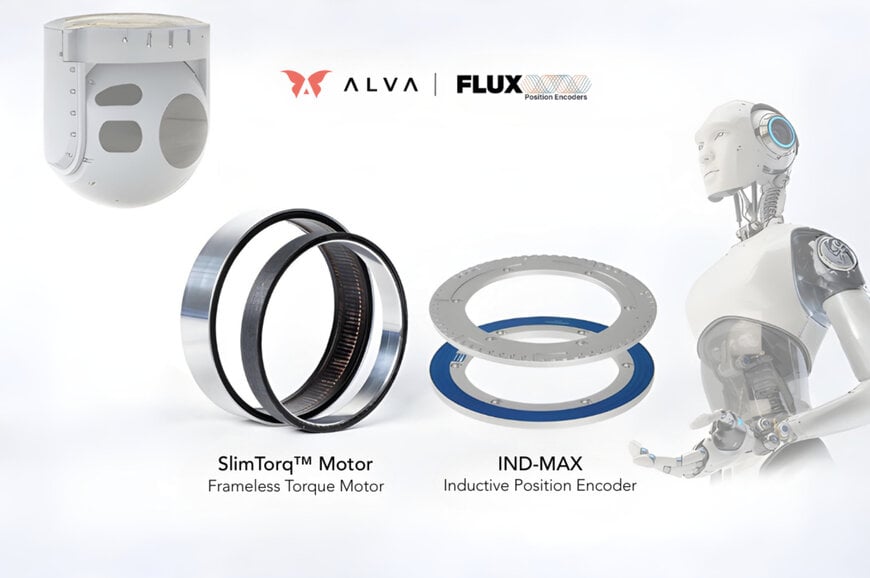
For robotics, precision motion systems, aerospace mechanisms, and direct-drive actuation, Alva Industries presents a system-level integration of SlimTorq™ zero-cogging motors with FLUX inductive encoders. The combination addresses key challenges in high-precision motion control, where encoder performance directly determines torque smoothness, stability, and low-speed accuracy.
By aligning motor and encoder characteristics at the system level, the solution targets applications requiring backlash-free motion, high stiffness, and reliable operation under demanding environmental conditions.
Encoder performance as a defining factor in zero-cogging systems
In frameless direct-drive architectures, encoders provide real-time angular position feedback for commutation and control loops. When paired with slotless, zero-cogging motors such as SlimTorq™, mechanical disturbances from the motor are minimized. As a result, encoder resolution, accuracy, and signal stability become the dominant factors influencing motion quality.
Any cyclic error, latency, or signal noise in the encoder directly affects torque ripple and velocity control, particularly at low speeds. This makes encoder selection a system-level design decision rather than a secondary component choice.
Integration constraints in compact direct-drive assemblies
Combining frameless motors and encoders introduces multiple engineering constraints. Mechanically, air-gap tolerances, rotor eccentricity, and limited axial space can affect alignment and commutation accuracy. Electrically, feedback latency and resolution impact control bandwidth and responsiveness.
Environmental factors further complicate integration. Applications such as UAV payloads, stabilized gimbals, and robotic joints expose components to vibration, shock, temperature variation, and contamination. Encoder technologies sensitive to magnetic interference, dust, or moisture may degrade under these conditions, reducing long-term system reliability.
Inductive encoder technology for stable feedback
FLUX inductive encoders use contactless sensing principles that are inherently resistant to environmental disturbances. Unlike optical or magnetic encoders, inductive systems maintain stable performance under shock, vibration, condensation, and external magnetic fields.
The encoders support operating temperatures from −20 to +85°C, with extended variants covering −45 to +105°C, and offer IP67/IP68 protection with pressure resistance up to 200 bar. This robustness makes them suitable for harsh industrial and outdoor environments where consistent feedback is required.
Mechanical compatibility and reduced integration risk
The encoder design supports practical integration with SlimTorq™ motors through defined air-gap tolerances, including 0.50 mm nominal (±0.30 mm) and a higher-accuracy option of 0.35 mm (±0.15 mm). These tolerances reduce sensitivity to assembly variations in compact systems with large through-holes and limited axial space.
Holistic scanning techniques limit eccentricity-induced errors to approximately ±5–8 arcseconds at a 10 µm offset. The flat encoder geometry aligns with the compact axial structure of SlimTorq™ motors, supporting efficient packaging without imposing tight mechanical constraints.
High resolution and stable angle tracking
The combination of high pole-count motors and high-resolution encoders enables precise angle tracking. For example, a 36-pole motor paired with a 22-bit encoder provides 4,194,304 discrete steps per revolution, corresponding to a mechanical resolution of approximately 0.000086° (≈0.31 arcseconds).
This results in over 230,000 discrete steps per electrical cycle, supporting smooth velocity control and minimizing torque ripple. High-resolution feedback is particularly important in low-speed applications where even small positional errors can affect system performance.
*Accuracy values are size- and tolerance-dependent; stated values reflect datasheet achievable accuracy at nominal air gap.
Interface compatibility and control performance
The encoders support multiple communication protocols, including BiSS-C, SSI, ABZ, UART, and SPI, enabling integration with modern servo drives and real-time control systems. Absolute position feedback eliminates the need for homing procedures, which is critical in applications with limited motion range.
High-speed digital interfaces, such as BiSS-C operating up to 10 MHz, reduce latency in the control loop. This allows the motor to respond quickly to disturbances while maintaining control stability and phase margin in high-bandwidth applications.
Enabling high-performance direct-drive applications
The combined system is suited for applications requiring low noise, high precision, and long-term reliability, including stabilized gimbals, robotic joints, precision pointing systems, and direct-drive actuators.
By aligning mechanical design, sensing technology, and control interfaces, the integration of SlimTorq™ motors with FLUX inductive encoders enables motion performance that reflects the capabilities of zero-cogging motor architectures.
European manufacturing and supply continuity
FLUX, headquartered in Braunau am Inn, Austria, provides encoder solutions supported by long-term availability and established manufacturing processes. Alva Industries, based in Trondheim, Norway, develops electric motors using its FiberPrinting™ manufacturing technology, enabling high torque density and controlled production quality.
For OEMs developing long-life systems, the combination offers both performance consistency and supply chain reliability across European manufacturing networks.
Edited by Industrial Journalist Natania Lyngdoh — Adapted by AI.
www.alvaindustries.com
