
www.ptreview.co.uk
22
'26
Written on Modified on
Magnetic Tactile Sensing for Robotic Manipulation
Melexis and OYMotion integrate tactile sensing modules to improve robotic hand interaction through scalable sensor integration and system-level optimization.
www.melexis.com
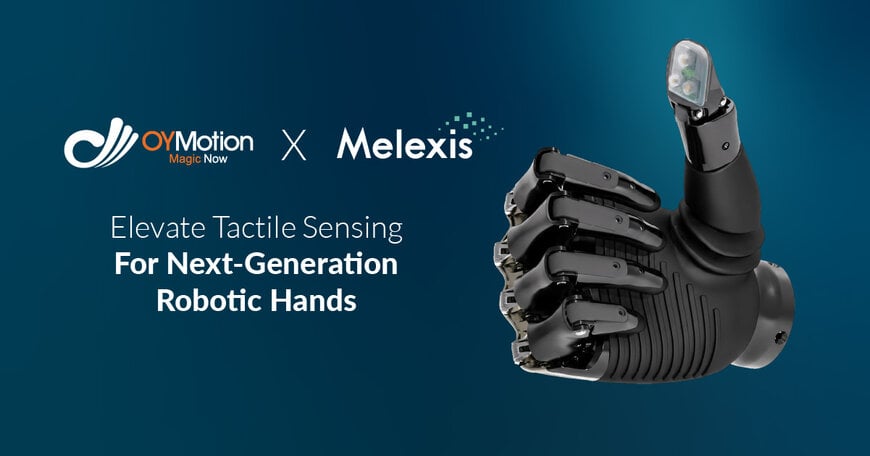
Melexis and OYMotion are collaborating to integrate magnetic-based tactile sensing into robotic hands, addressing limitations in physical interaction within industrial automation and advanced robotics applications.
Context of the Cooperation
Melexis, a Belgium-based developer of semiconductor sensors and driver ICs, and OYMotion, a Chinese robotics company specializing in dexterous robotic systems, have formed a technical collaboration to enhance tactile perception in robotic hands.
A key challenge in robotics remains the limited ability to detect and interpret physical contact with sufficient precision. While vision systems and actuation have advanced significantly, tactile feedback critical for controlled manipulation has lagged due to integration complexity and sensor limitations.
The cooperation combines Melexis’ expertise in magnetic sensing and embedded modules with OYMotion’s capabilities in robotic hand design and control systems, enabling a more integrated approach to solving this constraint.
Technical Solution and Responsibilities
The collaboration centers on Melexis’ Tactaxis technology, a magnetic-based tactile sensing system capable of three-dimensional detection of force vectors, position, and contact events. The system translates mechanical interaction into real-time digital signals, enabling closed-loop control in robotic manipulation.
Melexis provides application-ready fingertip modules that integrate sensing elements, signal processing, and interface electronics. These modules are designed to reduce system integration effort for robotics OEMs by standardizing mechanical and electrical interfaces.
OYMotion is responsible for integrating these modules into its robotic hand platform, including mechanical embedding, calibration, and system-level optimization. The integration process spans hardware design, firmware adaptation, and control algorithm tuning to ensure compatibility with robotic actuation systems.
The sensing approach supports continuous force measurement and spatial resolution at the contact surface, enabling more stable grasping and adaptive interaction. This contributes to improved control fidelity in tasks requiring variable force application.
Deployment and Implementation
The jointly developed robotic hand system is being demonstrated at Hannover Messe in Germany, serving as a validation platform for the integrated solution.
The implementation includes full-stack integration, from sensor placement within fingertips to data processing within the robotic control architecture. The modules are designed for compatibility with scalable manufacturing processes, supporting transition from prototype systems to production-ready platforms.
Both companies contributed to rapid development cycles, coordinating across mechanical, electronic, and software domains to meet integration timelines.
Applications and Use Cases
The solution targets applications in industrial automation, service robotics, and prosthetics, where controlled interaction with objects is required.
Use cases include precision gripping in assembly lines, handling of fragile components, and adaptive manipulation in unstructured environments. The availability of real-time tactile data enables improved process stability, reduced error rates, and enhanced safety in human-robot interaction scenarios.
Results and Expected Impact
By embedding tactile sensing into standardized modules, the cooperation reduces integration complexity and supports scalability for robotics manufacturers.
The system enables measurable improvements in manipulation accuracy through continuous feedback of force and contact parameters. Additionally, modularization facilitates maintainability and reduces development time for OEMs adopting tactile sensing technologies.
The collaboration demonstrates a pathway toward industrialized deployment of tactile sensing, aligning sensor performance with the requirements of production-scale robotic systems.
Edited by an industrial journalist Sucithra Mani with AI assistance.
www.melexis.com
