
www.ptreview.co.uk
24
'26
Written on Modified on
Vision Components Introduces Edge AI Camera Modules
New embedded vision systems combine onboard processing, high-resolution sensors, and MIPI interfaces for machine vision, edge analytics, and industrial imaging applications.
www.vision-components.com
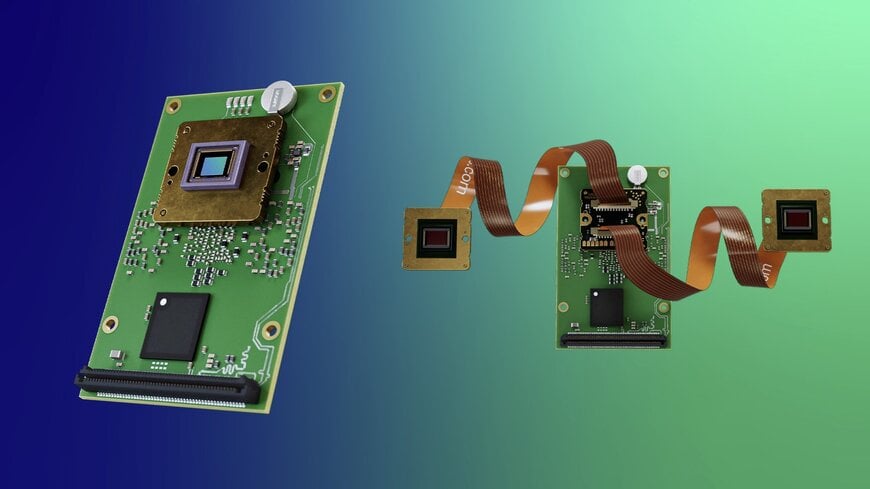
Embedded vision systems are increasingly shifting toward compact, integrated designs that combine sensing and processing at the edge, reducing latency and system complexity in industrial and AI-driven applications. In this context, Vision Components will present the VC EvoCam and two new MIPI camera modules at the Embedded Vision Summit 2026, scheduled for May 11–13 in Santa Clara, California.
Integrated processing and imaging in a compact footprint
The VC EvoCam is a board-level embedded vision system designed to consolidate image acquisition and processing within a 65 × 40 mm form factor. It integrates the MediaTek Genio 510 processor, enabling on-device computation for edge AI workloads without requiring external processing hardware.
The system supports multiple configurations, including onboard image sensors or up to two remote-head cameras connected via cable. Initial configurations include the Sony IMX900 global shutter sensor with 3.2 MP resolution. The embedded processor architecture combines two ARM Cortex-A78 cores and four Cortex-A55 cores, supported by an ARM Mali GPU and a neural processing unit delivering 3.2 TOPS of AI performance.
Memory and storage capabilities include up to 2 GB RAM and 16 GB flash, with SD 3.0 expansion, supporting continuous image processing and data logging. The platform operates on a customized Debian Linux environment, with pre-integrated image processing functions and demonstration applications for rapid deployment.
For system integration, the VC EvoCam provides a 100-pin board-to-board connector exposing interfaces such as I/O, I²C, USB, Ethernet, Video DSI, and PCIe. A minimal interface board with power supply, trigger, flash control, USB, and LAN connectivity is scheduled alongside volume production in Q3 2026, followed by a more extensive development kit supporting full signal breakout for prototyping.
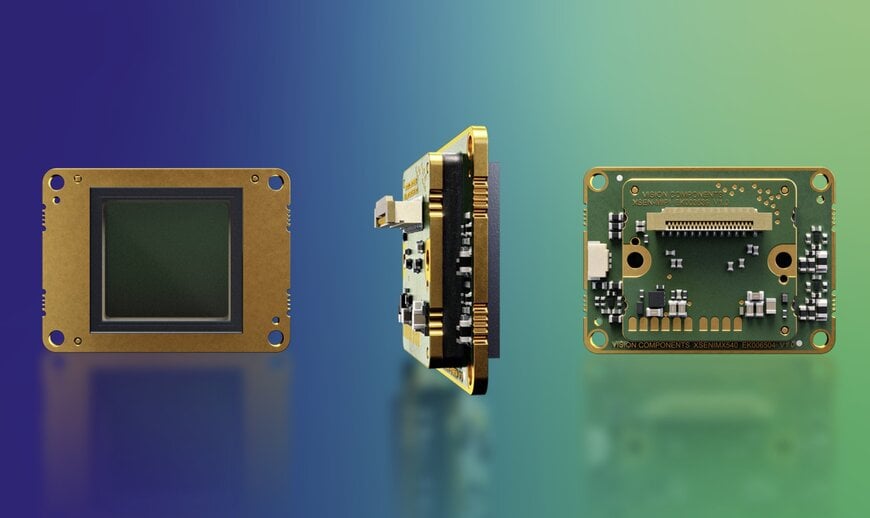
The new VC MIPI IMX540 global shutter camera module offers a resolution of 24.5 megapixels and is suitable for a wide range of applications in machine vision and AI.
Expanding MIPI camera options for edge AI systems
Alongside the EvoCam, Vision Components will also present two MIPI camera modules targeting high-resolution imaging and edge processing applications within an automotive data ecosystem and industrial vision pipelines.
The VC MIPI AR2020 is the company’s first module based on an Onsemi sensor, incorporating the AR2020 from the Hyperlux LP family. This rolling shutter sensor provides 20 MP resolution (5,120 × 3,840 pixels) at up to 24 frames per second in 10-bit mode. Its sensitivity extends into the near-infrared (NIR) spectrum, making it suitable for inspection, monitoring, and AI-based detection tasks under variable lighting conditions. The module is available in both monochrome and color variants and is designed for low-power operation in embedded and IoT deployments.
The VC MIPI IMX540 module uses a Sony Pregius S global shutter sensor with a 1.2-inch optical format and 2.74 µm pixel size. It delivers 24.5 MP resolution (5,328 × 4,608 pixels) at 22 frames per second in 8-bit mode. The global shutter architecture enables distortion-free capture of fast-moving objects, supporting applications such as robotics, quality inspection, and people detection in AI-enabled systems.
Modular ecosystem for prototyping and deployment
Both new MIPI cameras integrate into the existing VC MIPI ecosystem, which includes more than 50 supported image sensors and a standardized development framework. The company provides source code drivers for all modules, allowing integration across embedded platforms.
The VC MIPI Bricks system extends this ecosystem with accessories for system design and deployment. These include micro-coax and GMSL2 cable options supporting transmission distances up to 10 meters, as well as FPGA-based accelerators that can be inserted directly into the MIPI data stream for preprocessing tasks. Custom camera configurations, including optics and calibration, are also supported for application-specific requirements.
Positioning within embedded vision and edge AI workflows
The combination of onboard AI processing in the VC EvoCam and high-resolution MIPI camera modules reflects a broader shift toward distributed intelligence in embedded vision systems. By reducing reliance on centralized compute infrastructure, such systems enable faster decision-making in applications ranging from industrial automation and robotics to smart surveillance and IoT-based inspection.
The planned presentation of these platforms at the Embedded Vision Summit highlights ongoing efforts to standardize modular hardware and software stacks for scalable deployment in edge AI environments.
Edited by Aishwarya Mambet, Induportals Editor, with AI assistance.
www.vision-components.com
