
www.ptreview.co.uk
01
'26
Written on Modified on
Fives Launches Landis TTG 3000 Twin Turret Grinder for Precision Manufacturing
Fives introduces a patented twin-turret platform designed to integrate multiple grinding processes and achieve micron-level accuracy in a single setup.
www.fivesgroup.com
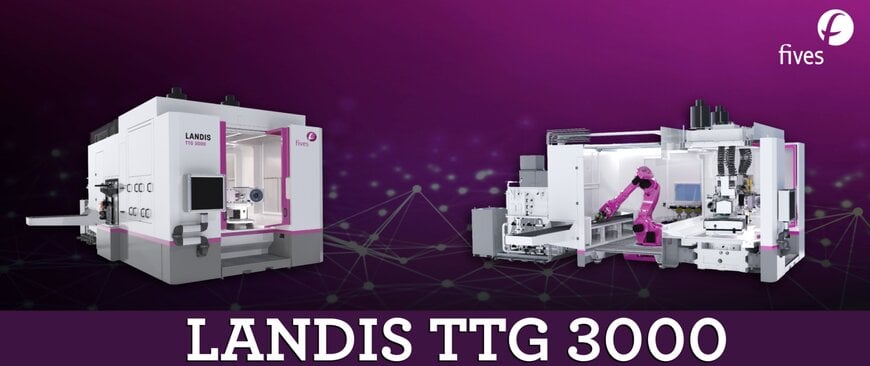
Fives has introduced the Landis TTG 3000 Twin Turret Grinder, a technology platform developed to address requirements for precision and flexibility in modern manufacturing. The system integrates multiple grinding processes into a single machine to provide stability and control for sectors including aerospace, medical, optics, energy, and bearings.
Integrated Multi-Surface Machining
The Landis TTG 3000 utilizes a patented twin-turret architecture to enable multi-surface machining within a single setup. In this configuration, one turret carries the grinding wheel while the opposing turret supports the workpiece. This design provides access to complex geometries without the need for repositioning, which reduces cumulative errors associated with traditional grinding methods that require multiple machines or repeated re-clamping.
Process Control and Adaptability
By combining global expertise from the UK and USA, Fives engineered the TTG 3000 to deliver consistent accuracy across variable batch sizes and materials. The reduction in process steps facilitates more efficient transitions between components and enhances overall process control. This adaptability is intended to meet evolving production demands where components are increasingly complex and tolerances are tighter.
Additional Context
The introduction of twin-turret architecture in grinding technology represents a significant departure from conventional sequential machining. In standard grinding workflows, moving a workpiece between different machines or setups introduces mechanical variability, as even microscopic misalignments during re-clamping can compromise final tolerances. By maintaining a single setup for multiple surfaces, the Landis TTG 3000 minimizes these geometric deviations.
Technically, the "twin-turret" approach allows for simultaneous or highly integrated operations that would typically require separate cylindrical and surface grinders. This is particularly critical for high-value industries like aerospace and medical, where components often feature intricate profiles that must maintain perfect concentricity or parallelism. The stability of the dual-turret design also likely aids in thermal management and vibration dampening—key factors when striving for micron-level precision in hardened materials or exotic alloys.
Edited by Romila DSilva, Induportals Editor, with AI assistance.
www.fivesgroup.com
