
www.ptreview.co.uk
22
'26
Written on Modified on
Polymer Ball Bearings for Cleanroom Automation Systems
igus introduces cleanroom-oriented polymer ball bearings for semiconductor and battery manufacturing, targeting low-particle motion systems in contamination-sensitive automation environments.
www.igus.eu
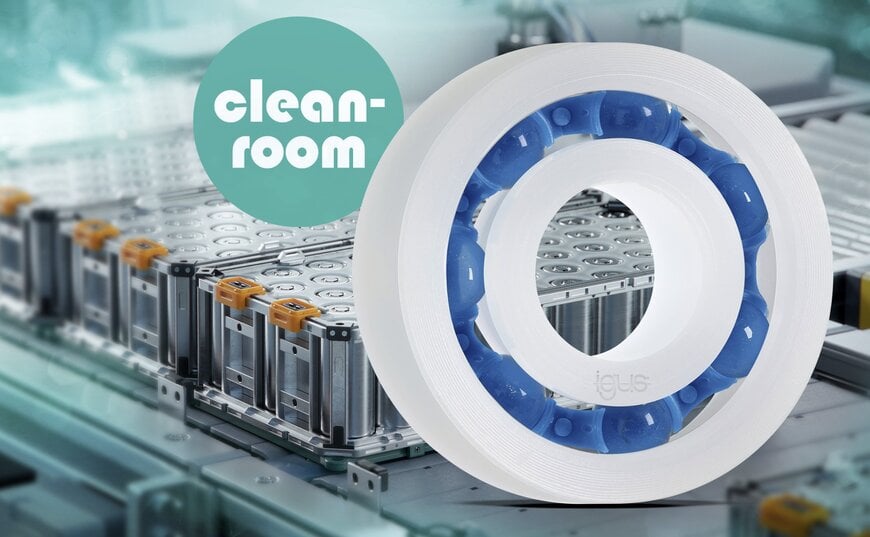
igus has expanded its cleanroom motion component portfolio with polymer ball bearings designed for contamination-sensitive industrial automation applications. The new bearings target semiconductor fabrication and battery manufacturing environments, where particulate generation from mechanical components can disrupt process stability, reduce yield, or compromise product quality.
Cleanroom Bearing Requirements in Semiconductor and Battery Manufacturing
Cleanroom manufacturing environments impose stricter mechanical component requirements than conventional industrial settings. Semiconductor fabrication, in particular, operates under particulate control conditions where airborne contamination must be minimized because modern microelectronic circuit structures are measured in nanometers, making them vulnerable to microscopic debris.
In these environments, moving components such as conveyor rollers, transport mechanisms, and automated handling systems must maintain mechanical performance while limiting wear-related particle generation. Conventional metallic bearings can introduce contamination risks through lubricant degradation, corrosion, or mechanical wear, particularly if maintenance intervals are not tightly controlled.
As battery manufacturing and semiconductor production continue to scale, low-maintenance motion components have become increasingly relevant within the broader digital supply chain supporting electronics manufacturing.
Polymer Bearing Design and Material Architecture
igus has introduced a new xiros polymer ball bearing series specifically developed for cleanroom use. The design replaces conventional metallic bearing materials with engineered polymers intended to reduce friction-related contamination while eliminating the need for external lubrication.
The inner and outer bearing rings are manufactured from xirodur C161, an injection-molded high-performance polymer, while the cage retaining the glass rolling elements is produced from xirodur A161. According to igus, both materials were selected for wear resistance and chemical stability, characteristics relevant in controlled manufacturing environments where exposure to cleaning agents or process chemicals may occur.
The use of glass balls rather than conventional steel rolling elements further differentiates the bearing architecture from standard industrial bearing designs.
Cleanroom Qualification and Particle Emission Performance
igus states that the new bearings are undergoing internal validation in a laboratory developed in collaboration with the Fraunhofer Institute IPA, an organization known for cleanroom certification and contamination control testing.
Of six planned qualification tests, the company reports that three have already achieved the highest cleanroom classification threshold under the relevant internal test conditions, with a maximum of ten airborne particles measuring at least 0.1µm per cubic meter and no particles exceeding 0.2µm. Based on these results, the bearings are being prepared for formal IPA certification.
These metrics are relevant because airborne particle generation is a primary qualification parameter for moving mechanical components used in semiconductor wafer handling and other contamination-sensitive automation systems.
Mechanical Performance and Maintenance Characteristics
The polymer bearings are positioned for medium-speed, light-load applications rather than high-load industrial power transmission.
For the 6000 bearing size, igus specifies a maximum rotational speed of 1,700rpm, static load capacity of 60N, and dynamic load capacity of 65N. The material system provides bending strength of 27MPa at 20°C, while the maximum long-term operating temperature is specified at 60°C.
Because the bearings operate without external lubrication, maintenance requirements are reduced compared with lubricated metal bearing systems. In cleanroom applications, eliminating grease or oil can also remove a contamination source, particularly in automated systems where service access is constrained.
This operating profile makes the bearings suitable for guided transport rollers, light conveyor assemblies, and positioning mechanisms in clean automation equipment rather than heavy mechanical drive systems.
Cleanroom Motion System Applications
Potential deployment areas include semiconductor wafer transport systems, battery cell handling equipment, compact conveyor rollers, robotic transfer mechanisms, and other automated motion assemblies where particulate control is a design constraint.
The bearings may also be relevant in electronics assembly systems where maintenance-free operation reduces intervention frequency and contamination exposure risk.
Their combination of chemical resistance, lubrication-free operation, and controlled particulate behavior aligns with applications requiring repeatable motion under tightly regulated environmental conditions.
Additional Context
This section details technical specifications and competitive benchmarking not included in the original news release.
Cleanroom-compatible bearings are an established product category, with comparable offerings from suppliers including SKF, NSK, and specialty ceramic bearing manufacturers. Benchmark comparisons in this segment typically focus on particulate emission behavior, lubrication requirements, rotational speed, load capacity, corrosion resistance, and cleanroom certification standards.
igus differentiates its approach through full polymer construction combined with glass rolling elements, whereas many competing cleanroom bearing solutions rely on stainless steel or hybrid ceramic architectures with cleanroom-compatible lubrication systems. Hybrid ceramic bearings generally offer higher rotational speed and load performance but may still require lubrication management depending on configuration.
The specified 1,700rpm maximum speed and 65N dynamic load capacity position the igus bearings in the light-duty automation category rather than high-load bearing segments. Their competitive distinction lies less in mechanical throughput and more in contamination control, maintenance elimination, and material compatibility for clean manufacturing environments.
Edited by Aishwarya Mambet, Induportals Editor, with AI assistance.
www.igus.com
