
www.ptreview.co.uk
25
'26
Written on Modified on
Industrial Edge Computers for AI and Automation
Darveen introduces an x86 industrial computing platform for edge AI, machine automation, and transport systems requiring modular expansion and GPU acceleration.
www.darveen.com
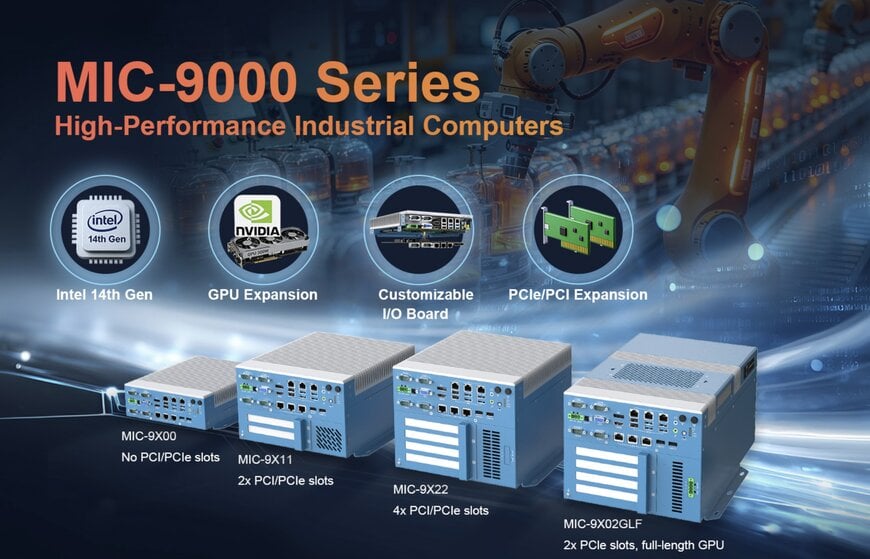
Darveen has introduced the MIC-9000 Series industrial computers, a modular edge computing platform built for industrial automation, machine vision, and edge AI workloads. The systems combine Intel 14th-, 13th-, and 12th-generation Core processors with configurable PCIe/PCI expansion, GPU support, and industrial I/O intended for compute-intensive deployment environments.
Edge Computing Architecture for Industrial Workloads
Industrial computing platforms increasingly need to process machine data locally rather than transferring all workloads to centralized infrastructure, particularly in latency-sensitive applications such as automated optical inspection, robotics control, and intelligent transportation. In this context, edge AI platforms require a combination of CPU performance, expansion flexibility, and support for accelerator hardware.
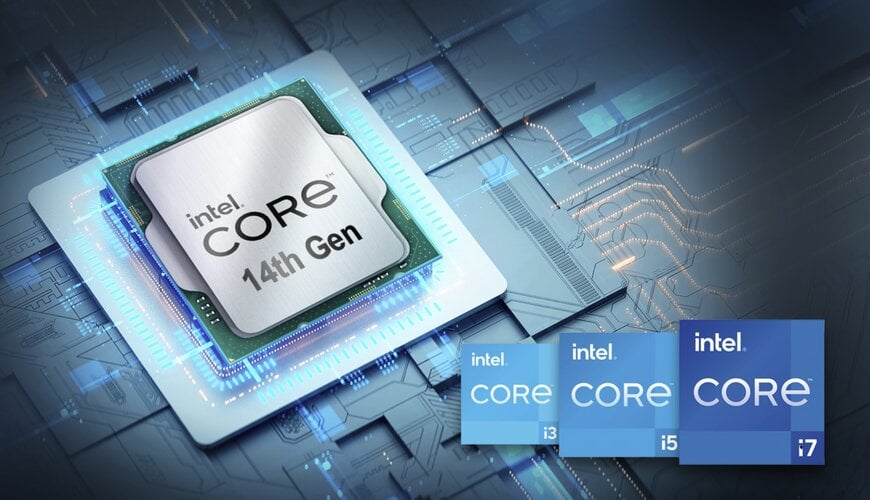
Darveen’s MIC-9000 Series is positioned as a modular industrial PC family for these deployment scenarios. The platform uses Intel desktop-class Core i7, i5, and i3 processors across the 14th, 13th, and 12th generations, based on Intel’s hybrid CPU architecture combining Performance-cores and Efficient-cores for workload distribution between compute-intensive and background tasks.
The systems support up to 64 GB of DDR5 memory, enabling higher memory bandwidth than DDR4-based industrial platforms, which is relevant for machine vision inference, industrial analytics, and multitasking workloads.
Modular PCIe Expansion for Industrial Integration
A key architectural feature of the MIC-9000 Series is configurable expansion capacity for industrial peripherals.
The MIC-9X00 variants are designed without PCIe/PCI expansion slots for deployments where compactness is prioritized over modularity. For installations requiring add-in hardware, the MIC-9X11 models support two PCIe/PCI slots, while the MIC-9X22 variants support up to four slots.
This configuration supports integration of specialized industrial hardware such as motion control cards, frame grabbers, fieldbus interface cards, and data acquisition modules. Such expandability remains relevant in factory automation environments where legacy PCI hardware and newer PCIe peripherals often coexist.
A cableless internal architecture reduces internal connection points that can be vulnerable to vibration-induced failures in industrial environments.
GPU Acceleration for Edge AI Inference
Selected systems in the series support discrete GPU integration for compute-intensive inference and vision processing.
The MIC-9X22G and MIC-9X02GLF variants support GPU cards with power consumption up to 300 W. The MIC-9X02GLF additionally supports full-length GPU cards up to 330 mm.
This capability is relevant for edge AI deployments involving convolutional neural network inference, high-throughput image analysis, and real-time video analytics, where CPU-only execution may be insufficient. Application examples identified by Darveen include automated optical inspection, machine vision, industrial robotics, and intelligent transportation systems.
Local GPU acceleration can reduce inference latency by processing visual or sensor data on-site rather than routing workloads to centralized compute infrastructure, which is particularly relevant in deterministic industrial control environments.
Industrial I/O Configuration and Product Segmentation
Darveen has divided the product family into three configurations based on connectivity requirements.
The MIC-9000 provides a baseline configuration, while the MIC-9100 increases serial communication capacity to as many as six COM ports for industrial device connectivity. The MIC-9400 expands network capacity to as many as six Gigabit Ethernet ports for systems requiring multiple networked endpoints, segmented industrial communications, or camera connectivity.
Across the family, the systems include three independent display outputs through DisplayPort, VGA, and HDMI interfaces, along with M.2 expansion and optional wireless connectivity.
These connectivity options align with industrial deployments where legacy serial equipment, Ethernet-based automation networks, and multiple operator displays remain common.
Application Relevance in Industrial Automation
The platform targets industries where real-time local computing is operationally necessary rather than optional.
In automated optical inspection, GPU acceleration can support image classification and defect detection at production speed. In industrial robotics, PCIe expansion enables integration with motion control hardware while local compute resources support machine coordination. In intelligent transportation systems, multiple Ethernet interfaces and edge AI processing can support traffic monitoring, vision analytics, and distributed decision-making.
The combination of modular expansion and desktop-class x86 compute also supports system integrators that require adaptable hardware lifecycles rather than fixed embedded architectures.
Additional Context
This section details technical specifications and competitive benchmarking not included in the original news release.
The industrial edge computing segment includes comparable modular platforms from vendors such as Advantech and ASUS IoT, particularly in edge AI and machine vision deployments. Benchmark criteria in this category typically include processor generation, memory support, GPU integration capacity, expansion slot availability, network I/O density, and environmental ruggedization.
Darveen’s published specifications indicate support for Intel 14th-generation Core processors, up to four PCIe/PCI slots, 64 GB DDR5 memory, and GPU integration up to 300 W. Comparable industrial edge AI platforms from Advantech support similar expansion-focused deployments, including systems with up to four PCIe slots and discrete GPU integration for machine vision and industrial AI workloads.
Edited by Aishwarya Mambet, Induportals Editor, with AI assistance.
www.darveen.com
