
www.ptreview.co.uk
29
'26
Written on Modified on
Flexible Automation Technologies for Adaptive Manufacturing
Beckhoff UK showcases cabinet-free machine architectures and advanced transport systems designed to improve manufacturing flexibility and scalability.
www.beckhoff.com
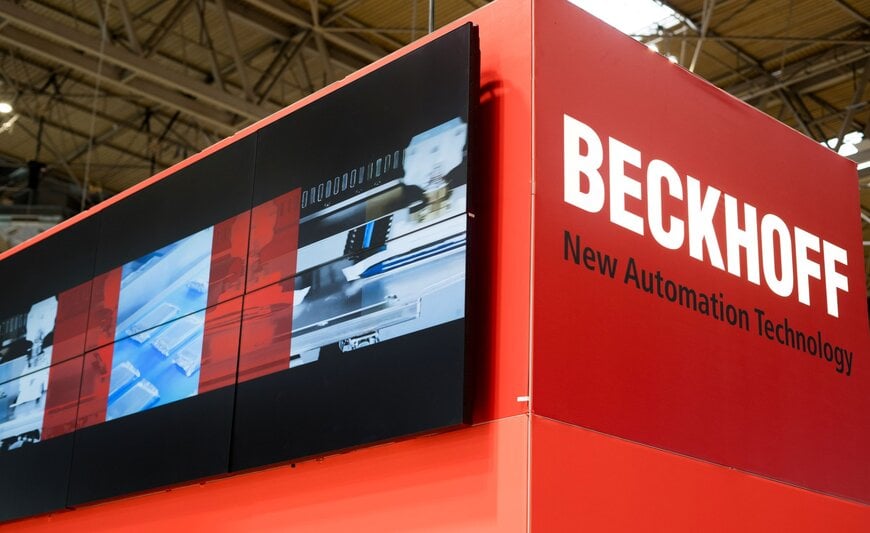
Manufacturers are increasingly seeking automation platforms that can support product variation, faster changeovers, and simplified machine integration without increasing engineering complexity. At Smart Manufacturing Week 2026, Beckhoff UK will demonstrate technologies focused on modular machine design, integrated motion control, and flexible material handling for industrial automation applications.
The company's exhibition will target machine builders, system integrators, and manufacturers evaluating new production equipment, retrofit projects, and digital supply chain initiatives. Demonstrations will focus on how PC-based control architectures, EtherCAT communication, and software-integrated motion technologies can support more adaptable production systems.
Smart Manufacturing Week Showcases Advanced Automation Technologies
Beckhoff UK will exhibit at Smart Manufacturing Week, taking place at the National Exhibition Centre (NEC) in Birmingham, United Kingdom, from June 3–4, 2026. As a platinum partner of the event, the company will present its latest automation technologies on stand M140.
Smart Manufacturing Week brings together equipment suppliers, manufacturers, engineers, and technology developers to explore developments in industrial automation, digital manufacturing, robotics, connectivity, and production efficiency. Within this context, Beckhoff's demonstrations will focus on reducing machine complexity while improving flexibility and scalability.
Cabinet-Free Machine Design Using Modular Automation Architecture
A central feature of the exhibition will be the MX-System, Beckhoff's modular automation platform designed to eliminate the need for conventional control cabinets in many machine architectures.
The system integrates industrial PCs, I/O modules, drive technology, power distribution, and system components into a modular baseplate structure that can be mounted directly onto machinery. By relocating automation components from traditional electrical cabinets to the machine itself, the architecture aims to reduce cabinet engineering, wiring complexity, installation time, and machine footprint.
This approach can be particularly relevant for OEMs seeking standardized machine platforms, reduced commissioning effort, and simplified maintenance procedures. Direct integration of automation hardware may also support modular production concepts increasingly used within modern manufacturing environments.
Integrated Transport Technologies for Flexible Product Handling
Beckhoff will also demonstrate two of its advanced transport technologies: the XTS linear transport system and a compact two-tile XPlanar installation.
The XTS system combines transport functionality and intelligent product movement within a single control platform. Independent movers can be controlled individually, allowing products to follow different production paths, synchronize with process stations, or adapt to varying production requirements without mechanical changeover.
The XPlanar system uses electromagnetic levitation technology to move planar movers contactlessly across a tiled surface. Because movers are not mechanically constrained by conventional conveyors, the system can support highly flexible production processes requiring variable routing, positioning accuracy, and contamination-sensitive handling.
Together, these technologies illustrate how manufacturers can implement flexible material-flow architectures within a unified automation ecosystem based on integrated control and communication technologies.
PC-Based Control and EtherCAT Communication Infrastructure
Underlying the demonstrations is Beckhoff's PC-based control architecture and EtherCAT industrial Ethernet technology. EtherCAT enables deterministic communication between controllers, drives, sensors, and distributed I/O devices while supporting high-speed synchronization requirements.
Combining machine control, motion control, safety functions, and communication within a common architecture can reduce integration complexity compared with systems that rely on multiple independent control platforms.
For machine builders, this unified approach can simplify software development, commissioning, diagnostics, and lifecycle support while enabling future expansion as production requirements evolve.
Condition Monitoring and Engineering Analytics Demonstration
In addition to its industrial automation technologies, Beckhoff will sponsor a robot participating in FightFest, a live robot combat competition located adjacent to the company's exhibition stand.
The robot will be monitored using a condition monitoring and interaction system developed by Beckhoff engineer Dominika Stachowska. The monitoring platform will collect temperature measurements before and after each match to evaluate operational stress. The system will also incorporate machine vision technology to compare physical changes to the robot's structure and detect visible damage.
Audio monitoring capabilities will additionally be used to visualize audience reactions throughout the competition. While developed as an event demonstration, the project highlights practical condition-monitoring principles that are increasingly used in predictive maintenance and industrial asset-management applications.
Flexible Manufacturing and Retrofit Opportunities
The technologies being demonstrated address a common challenge in modern manufacturing: balancing production flexibility with engineering simplicity. As manufacturers introduce greater product variation and shorter production runs, automation systems must support rapid adaptation without extensive mechanical redesign.
Cabinet-free automation, intelligent transport systems, integrated motion control, and condition-monitoring technologies can contribute to more adaptable manufacturing environments. These capabilities are becoming increasingly important for companies pursuing digital transformation initiatives and more responsive production strategies.
By combining machine control, transport, monitoring, and communication technologies within a common automation architecture, Beckhoff aims to demonstrate how manufacturing systems can be designed for both scalability and operational flexibility.
The combination of cabinet-free automation, EtherCAT-based communication, integrated motion control, and intelligent transport systems positions Beckhoff's technology portfolio within a broader industry trend toward modular manufacturing architectures capable of supporting flexible production and digitally connected factory operations.
Edited by Aishwarya Mambet, Induportals Editor, with AI assistance.
www.beckhoff.com
