
www.ptreview.co.uk
02
'26
Written on Modified on
GaN Power Electronics Development Platform
Rutronik introduces a Gallium Nitride evaluation system designed to accelerate motor control and power conversion development across high-efficiency applications.
www.rutronik.com
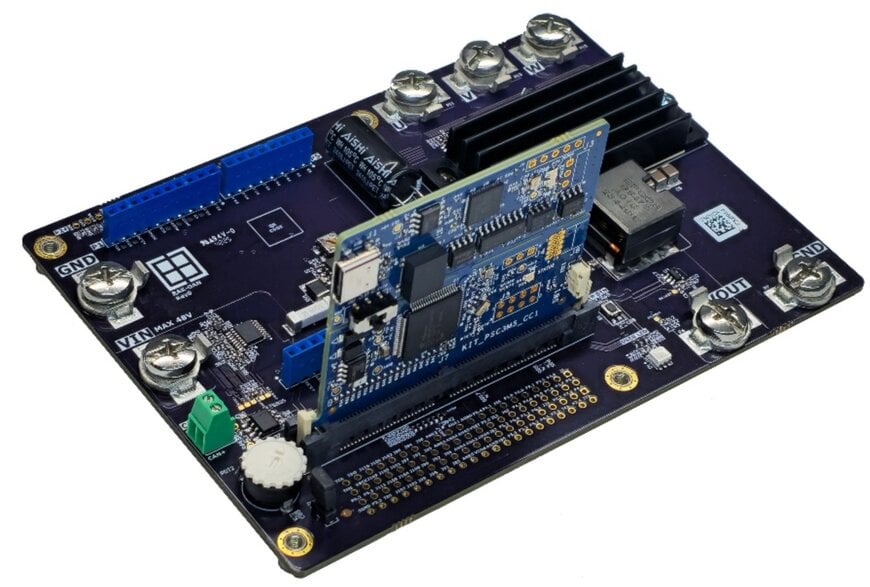
Rutronik has expanded its power electronics portfolio with a new evaluation platform designed to support the development of Gallium Nitride (GaN)-based motor drives and power conversion systems. The platform combines advanced microcontroller technology, GaN semiconductors, sensing components, and protection features into a single development environment aimed at applications where efficiency, power density, and system integration are critical.
GaN Semiconductors in Modern Power Electronics
Gallium Nitride High Electron Mobility Transistors (GaN HEMTs) are increasingly being adopted in power electronics because of their material characteristics, which enable higher switching frequencies than conventional silicon MOSFETs.
The technology benefits from high electron mobility, low gate charge, and reduced parasitic capacitance. These characteristics reduce switching losses and heat generation while allowing the use of smaller inductors, capacitors, and cooling systems. As a result, engineers can design more compact power converters with higher power density and improved energy efficiency.
Although GaN devices typically have a higher component cost than silicon-based alternatives, system-level economics often favor their adoption. Reduced cooling requirements, lower passive component usage, and simplified system architectures can offset the higher semiconductor cost and contribute to lower total system costs.
Digital Control Architecture for High-Frequency Switching
The evaluation platform is built around the PSOC Control microcontroller family based on the Arm Cortex-M33 architecture. The controller is optimized for digital power conversion and motor control applications that require fast response times and deterministic control behavior.
Key performance specifications include high-resolution pulse-width modulation (PWM) with timing precision below 100 picoseconds, analog-to-digital converters operating at up to 12 million samples per second, and integrated high-speed comparators with response times below 10 nanoseconds.
The platform also incorporates hardware accelerators such as CORDIC processing and a low-latency trigger architecture. These features support advanced control algorithms that must operate reliably at elevated switching frequencies commonly associated with GaN-based power systems.
Support for Motor Drives and DC-DC Conversion
The development kit supports multiple power conversion topologies. These include 48 V three-phase BLDC and PMSM motor drive systems as well as DC-DC buck converter applications.
The combination of fast digital control and integrated GaN HEMTs enables the evaluation of high-frequency switching architectures that can improve conversion efficiency while reducing the size of magnetic components.
Such capabilities are particularly relevant in industrial automation systems, electric mobility platforms, renewable energy equipment, and telecommunications power infrastructure, where efficiency and compact system design are increasingly important design objectives.
Integrated Protection and Current Measurement Functions
The platform incorporates several protection mechanisms intended to simplify development and improve system reliability.
These include inrush current protection, hardware-based overcurrent detection, and current measurement using tunnel magnetoresistance (TMR) sensing technology from Infineon Technologies.
Accurate current sensing and rapid fault detection are important requirements in high-frequency power systems because switching events occur within extremely short time intervals. Integrated protection features help engineers validate designs while reducing development complexity.
System-Level Development and Rapid Prototyping
The platform follows a system-level development approach by integrating multiple technologies from suppliers within Rutronik's component portfolio. The design includes measurement interfaces, expansion capabilities, and compatibility with Arduino-based development boards.
This architecture allows engineers to evaluate hardware configurations, validate control algorithms, and test application-specific designs before moving to production hardware.
The approach reflects a broader trend in power electronics development, where evaluation platforms increasingly provide complete reference environments rather than focusing on individual semiconductor devices.
Applications in Industrial Automation and Energy Systems
The platform targets several application sectors where power efficiency and compact design are becoming key performance requirements.
Industrial automation applications include servo drives, robotics systems, and automated guided vehicles (AGVs). Renewable energy use cases include solar inverters, battery energy storage systems, and electric vehicle charging infrastructure. Additional target markets include 48 V e-mobility systems, server power supplies, telecommunications infrastructure, smart home equipment, and household appliances.
The growing demand for energy-efficient electrical systems across these sectors has increased interest in wide-bandgap semiconductor technologies capable of delivering higher performance than traditional silicon-based power devices.
Additional Context
This section details technical specifications and competitive benchmarking not included in the original news release.
GaN-based development platforms are increasingly offered by semiconductor suppliers and ecosystem partners including Texas Instruments, STMicroelectronics, Infineon Technologies, Navitas Semiconductor, and EPC. Common benchmarking criteria include switching frequency capability, power density, efficiency, gate-drive integration, sensing functionality, and digital control performance.
The platform's sub-100 ps PWM resolution, 12 MSPS analog-to-digital conversion capability, and comparator response times below 10 ns position it within the high-performance category of digital power control platforms. Comparable development environments often combine GaN devices with digital controllers but may require additional external sensing and protection circuitry.
In motor control and power conversion applications, GaN technology is frequently evaluated against silicon MOSFET and silicon carbide (SiC) solutions. While SiC devices generally dominate higher-voltage applications above several hundred volts, GaN devices are often favored in low- to medium-voltage systems because of their ability to operate at higher switching frequencies, enabling smaller passive components and greater power density.
As industrial automation, renewable energy infrastructure, and data center power systems continue to demand higher efficiency, GaN-based power electronics platforms are becoming an important tool for accelerating the development of next-generation power conversion architectures.
Edited by Aishwarya Mambet, Induportals Editor, with AI assistance.
www.rutronik.com
