
www.ptreview.co.uk
04
'26
Written on Modified on
Control System Upgrades for Critical Power Infrastructure
Russelectric expands upgrade options for critical power equipment to improve reliability, monitoring capabilities, and equipment lifecycle management.
www.siemens.com
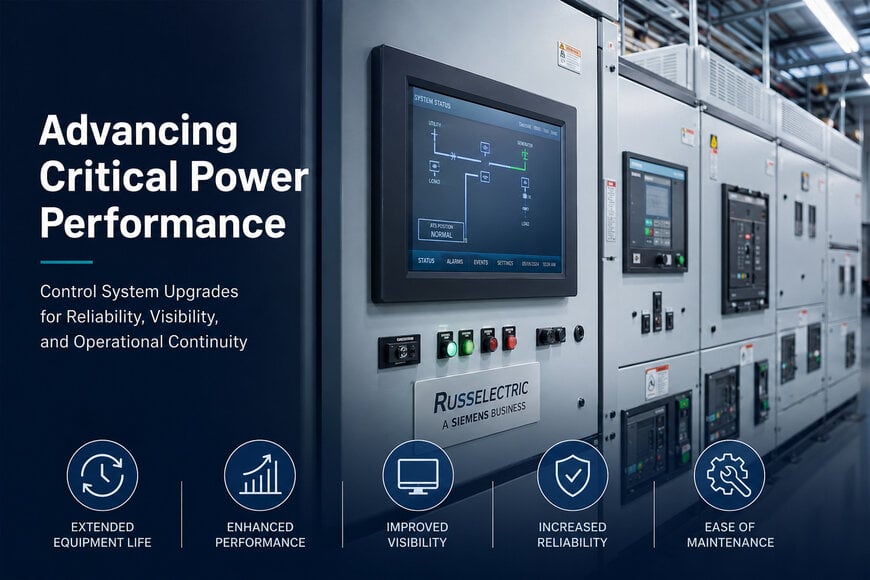
Organizations operating mission-critical electrical infrastructure can extend the operational life of existing power control systems through control and breaker modernization programs offered by Russelectric. The upgrades are designed for applications in healthcare, data centers, telecommunications, water treatment, and renewable energy facilities where uninterrupted power availability is essential.
Modernization as an Alternative to Equipment Replacement
Many facilities continue to rely on power control equipment installed years or decades ago. While the primary electrical infrastructure may remain mechanically sound, control components, communication interfaces, and programmable controllers can become obsolete, creating maintenance challenges and limiting operational visibility.
Russelectric has introduced a portfolio of system control upgrades intended to modernize existing equipment without requiring complete replacement. The approach aims to improve operational performance, simplify maintenance, and introduce contemporary monitoring and communication capabilities while reducing the downtime typically associated with large-scale replacement projects.
The upgrade programs are performed by Russelectric field engineers and are covered by the company’s warranty program.
Automatic Transfer Switch Control System Modernization
Automatic transfer switches (ATS) play a critical role in ensuring continuity of power supply by transferring loads between utility and backup power sources. Russelectric offers control system upgrades for ATS and bypass-isolation switch installations during planned shutdown periods.
The modernization process replaces aging control, monitoring, and communication components with current-generation technologies. This reduces dependence on legacy hardware while improving switching accuracy, operational functionality, and long-term serviceability.
Enhanced Operator Interface and Communication Functions
A significant component of the upgrade strategy involves replacing older operator interfaces with contemporary graphical monitoring platforms.
The updated systems provide dynamic one-line diagrams displaying real-time equipment status, alarm conditions, and event histories. These capabilities support faster fault identification and troubleshooting while improving visibility across the electrical distribution network.
Optional features include remote system access and reporting functions designed to support compliance requirements in regulated sectors such as healthcare. Enhanced communication capabilities also facilitate integration with broader facility management and digital infrastructure platforms.
PLC Architecture Upgrades for Long-Term Maintainability
Many existing critical power installations utilize programmable logic controller (PLC) architectures that are approaching end-of-support status.
Russelectric's PLC modernization program upgrades these systems to current-generation platforms while minimizing software modifications. The approach is intended to preserve operational continuity while improving processing performance and enabling advanced communication protocols.
In many cases, the upgrades can be completed without interrupting critical loads, and drop-in replacement options are available to simplify implementation.
Circuit Breaker Retrofits and Protection Enhancements
The company also offers retrofit solutions for obsolete or unsupported power circuit breakers. Existing breakers and accessories can be replaced with OEM-supplied alternatives designed to match the original form, fit, and functional requirements.
Modern circuit breaker technology enables additional protection capabilities, including arc reduction modes and Zone Selective Interlocking (ZSI). ZSI allows protective devices to communicate during fault conditions, enabling the breaker closest to a fault to operate first while maintaining coordination across the electrical distribution system. This can reduce fault-clearing times and limit stress on electrical equipment.
Upgrading breakers also addresses spare-parts availability concerns associated with aging equipment and can improve overcurrent selectivity across the electrical network.
Applications in Critical Power Environments
The modernization programs are intended for facilities where power interruptions can affect safety, operational continuity, or regulatory compliance. Typical deployment environments include hospitals, data centers, telecommunications facilities, water treatment plants, and renewable energy installations.
By upgrading control systems, communications infrastructure, PLC platforms, and protection devices, operators can extend equipment service life while adopting technologies commonly associated with new installations.
Additional Context: Technical Specifications and Competitive Benchmarking Not Included in the Original Product Announcement
Control system modernization has become a common strategy within the critical power sector as operators seek to extend the useful life of installed electrical infrastructure. Comparable retrofit and lifecycle-extension programs are available from major power distribution suppliers including Siemens, ABB, Schneider Electric, Eaton, and other switchgear manufacturers.
One benchmark increasingly used when evaluating breaker modernization projects is the implementation of Zone Selective Interlocking. According to industry documentation from Siemens, Schneider Electric, ABB, and Eaton, ZSI can reduce fault-clearing times by allowing the protective device nearest the fault to trip without intentional delay while maintaining system selectivity. This approach can lower thermal and mechanical stress on switchgear compared with conventional time-delayed coordination schemes.
Another industry trend is the replacement of legacy PLC and human-machine interface platforms with systems supporting remote diagnostics, event logging, and integration with facility-wide monitoring architectures. These capabilities are increasingly important in data centers and healthcare facilities where operational visibility and maintenance planning directly affect uptime performance.
Edited by Sucithra Mani, Induportals editor – adapted by AI.
www.russelectric.com
