
www.ptreview.co.uk
05
'26
Written on Modified on
NCSIMUL Update Features GPU-Accelerated Selective Simulation
Hexagon’s latest NCSIMUL release strengthens integrated NC program verification and optimisation in one digital twin environment.
hexagon.com
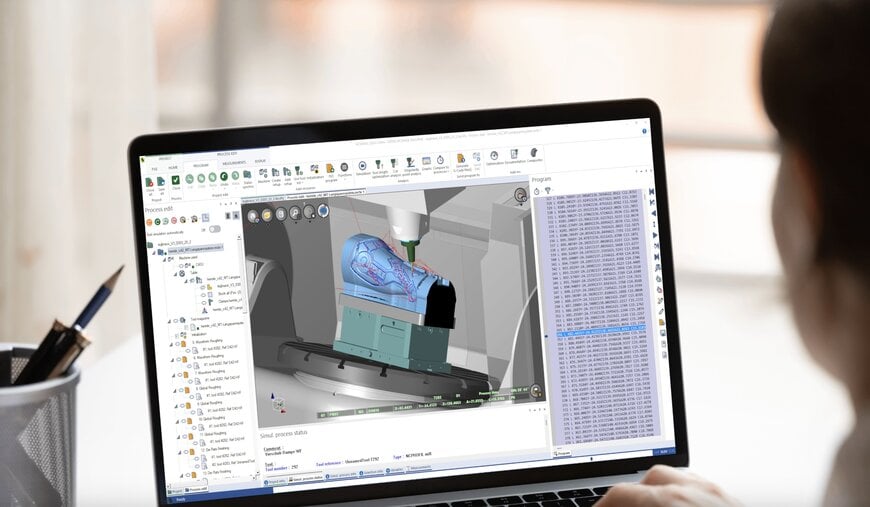
Hexagon’s Production Software Division has introduced a selective simulation capability within its NCSIMUL software platforms to optimize G-code verification and CNC machine tool simulation.
The latest release of NCSIMUL integrates G-code verification, CNC simulation, and toolpath optimization inside a unified digital twin environment. The software is developed to enable manufacturers to validate numerical control (NC) programs, maximize machining efficiency, and minimize physical prove-out procedures on production machine tools.
Mitigating Production Risk in High-Value Machining
As manufacturing and programming workflows experience compressed schedules, software-based verification allows operators to increase throughput while mitigating operational risks. This process validation is relevant for high-value manufacturing environments where individual NC programs encompass multi-hour machine cycles, multi-axis operations, and complex machining stages requiring precise engineering oversight.
Acceleration of Long-Cycle Program Navigation
The integrated software introduces Selective Simulation, a patent-pending capability designed to expedite how programmers navigate extensive NC files. The architecture applies graphics processing unit (GPU) acceleration to calculate intermediate Rest Stock Previews during the initial NC decoding phase, rendering the part's geometric evolution before running a linear simulation sequence.
In a technical field evaluation conducted by an American athletic footwear corporation on a long-cycle mold application, an NC program featuring a 47-hour machine cycle required 48 minutes of conventional sequential simulation before the operator could analyze a targeted mid-program operation. Utilizing the Selective Simulation feature, the system generated the intermediate Rest Stock Previews in less than two minutes.
Operational Workflow and Final Verification Verification
Programmers can employ these intermediate previews to inspect geometric development at discrete manufacturing stages, isolate visual defects early in the iteration cycle, and navigate directly to critical toolpath operations. The Rest Stock Previews are engineered to support early-stage review and rapid iteration. Comprehensive NC code simulation—encompassing full machine tool kinematics, exhaustive collision detection, and material removal verification—continues to serve as the benchmark requirement for final operational sign-off prior to releasing programs to the production floor.
Additional Context
This section details technical specifications and competitive benchmarking not included in the original news release.
Comparative Technology Analysis
Computer-aided manufacturing (CAM) verification software traditionally decodes numerical control (NC) bi-directional text files, commonly called G-code, via a linear, sequential processor. In traditional software environments, the system must calculate every line of text from the beginning of the program to the desired checkpoint. This means the time required to view an operation near the end of a file is directly proportional to the total length of the toolpath, introducing significant processing bottlenecks for long-cycle multi-axis machining.
To address these computing delays, standard industry platforms rely on central processing unit (CPU) instruction speeds coupled with step-skipping algorithms or cutting-history saving mechanisms. While these methods allow users to jump ahead, they remain bound to sequential step processing or require massive computer memory storage to save discrete file checkpoints. The transition to a dedicated GPU-accelerated decoding architecture decoupled from linear time constraints represents a technical shift, computing cross-sectional rest stock geometry models on the graphics processor parallel to text parsing.
Benchmark Criteria and Specifications
Evaluating industrial G-code verification and simulation software rests on key performance criteria including decoding architecture, inspection access time for long-cycle programs, collision detection fidelity, and host hardware utilization.
In terms of processing architecture, conventional industrial standards rely on sequential CPU processing, which requires linear computation of the entire toolpath sequence. For long-cycle programs, such as a 47-hour machining block, traditional sequential software requires up to 48 minutes of continuous calculation to reach mid-program operations. In contrast, the NCSIMUL implementation utilizes non-linear, GPU-accelerated decoding to compress this state-generation interval down to under two minutes for identical file lengths.
Regarding verification scope, standard CAM-embedded tools often check basic toolpath geometry but lack full kinematic machine cell simulation, whereas dedicated high-end validation platforms deliver full digital twin collision detection between machine components, workholding fixtures, tools, and stock. The updated NCSIMUL framework establishes a dual-phase workflow: it delivers fast, non-linear geometric previews for early iteration, while maintaining full kinematic component verification and exhaustive collision detection for final workshop sign-off.
Edited by Romila DSilva, Induportals Editor, with AI assistance.
www.hexagon.com
