
www.ptreview.co.uk
05
'26
Written on Modified on
Automated Semiconductor Reliability Testing
Infineon adopts Beckhoff control technology to improve measurement accuracy, increase test throughput, and automate power semiconductor evaluation processes.
www.beckhoff.com
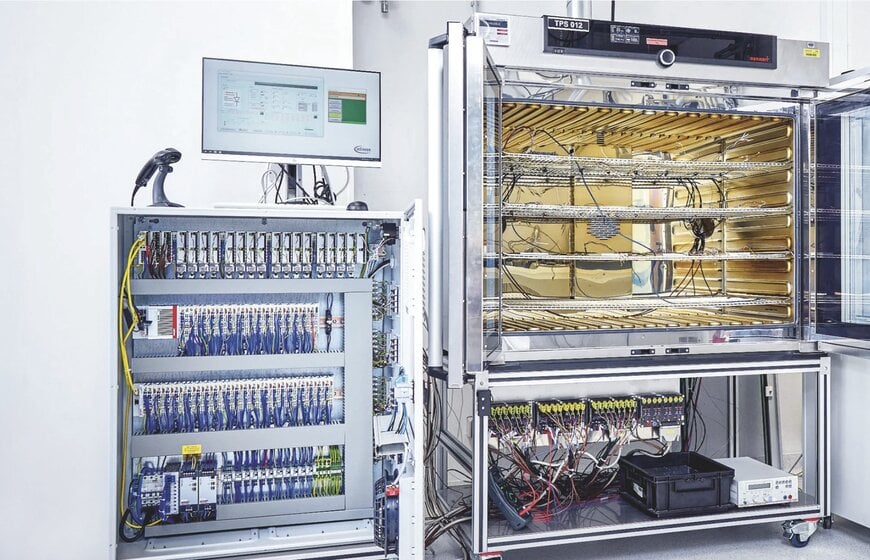
Power semiconductor testing is a critical activity in the automotive, renewable energy, industrial drive, and rail transportation sectors. At its Warstein manufacturing and development facility in Germany, Infineon Technologies implemented an automated test bench based on PC-based control and EtherCAT measurement technology to improve the efficiency and accuracy of junction temperature calibration, a key step in power cycling reliability testing.
Power Semiconductor Manufacturing and Reliability Evaluation
Infineon Technologies develops and manufactures power semiconductors ranging from a few amperes to 3,000 A at its Warstein site in Germany. The facility serves as a major research, development, and production center for frame power modules (FPMs), which are used in electric vehicle inverters, industrial drives, railway traction systems, wind turbines, and solar energy installations.
Reliability testing is a critical requirement for these applications because power semiconductors are repeatedly exposed to thermal and electrical stress during operation. Power cycling tests are used to evaluate how components perform under repeated load conditions and to predict long-term reliability.
A fundamental requirement of these tests is the accurate determination of junction temperature. To achieve this, engineers must first establish calibration curves that correlate electrical measurements with semiconductor temperature.
Challenges with Manual Calibration Processes
Before automation, Infineon's calibration procedure relied heavily on manual intervention. Engineers manually configured measurement currents and gate voltages before recording voltage values from semiconductor modules using a calibrated recorder.
The process presented several operational challenges. The recording equipment lacked automatic fault detection and notification capabilities, requiring continuous operator oversight. Since the recorder was not connected to a network, measurement data had to be transferred manually using SD cards or USB storage devices before analysis could begin on a separate computer.
According to the test laboratory team, the process depended significantly on operator expertise and consumed valuable test bench time. Given the high investment and infrastructure costs associated with power cycling test benches, maximizing utilization became a priority.
Selecting an Automated Test Bench Architecture
Around 2023, Infineon began evaluating options to automate the calibration process. The company selected a solution based on Beckhoff's PC-based control platform, TwinCAT automation software, and EtherCAT measurement technology.
The decision was driven by several technical requirements. The system needed to support multiple semiconductor technologies, integrate with existing laboratory software, provide high measurement precision, and reduce manual setup activities.
The resulting test bench uses the Beckhoff CX5140 embedded PC and TwinCAT 3 software to control all measurement and environmental parameters. The platform is integrated with existing LabVIEW measurement software, allowing real-time management of settings, data acquisition, and test execution.
High-Precision Measurement for Junction Temperature Calibration
The automated system can calibrate a wide range of semiconductor devices, including diodes, insulated-gate bipolar transistors (IGBTs), and silicon carbide (SiC) MOSFETs.
Up to 32 semiconductor modules can be installed simultaneously inside the test furnace. Measurement currents are controlled through TCP/IP communication and TwinCAT software, while the ELM3102-0100 EtherCAT measurement terminal records module contact voltages once the required temperature is reached.
The measurement terminal provides 24-bit resolution and measurement accuracy of 0.01%, supporting the generation of highly reliable calibration curves. During system validation, the laboratory reported that voltage readings from the EtherCAT measurement terminal matched calibration standards to six decimal places.
Measurement current generation was also implemented using standard EtherCAT terminals. By combining LED control terminals, analog input terminals, and power supply terminals, the laboratory achieved current control from 10 mA to 500 mA with an accuracy of 0.1 mA while maintaining channel isolation.
Deployment and Laboratory Integration
The automated solution was designed to minimize operational complexity for laboratory personnel. Operators only need to enter the identification number of the module being tested.
After initialization, TwinCAT automatically manages furnace temperature control, measurement current generation, gate voltage configuration, data acquisition, and calibration curve generation. This significantly reduces manual interaction throughout the testing process.
The seamless integration with existing laboratory infrastructure enabled deployment without replacing established measurement software workflows, reducing implementation complexity and operator training requirements.
Results: Higher Throughput and Improved Equipment Utilization
The introduction of automated test bench control reduced startup time for each test by approximately one hour. The combination of automated setup and high-precision measurement improved both measurement consistency and overall reliability of the calibration process.
Automation also enabled unattended overnight operation, allowing the laboratory to perform two complete tests per day. In addition, automatic furnace door opening controlled through TwinCAT reduced cooling times and accelerated preparation for subsequent tests.
These improvements increased test throughput and contributed directly to higher overall equipment effectiveness (OEE), helping the laboratory meet demanding development schedules while making more efficient use of expensive testing infrastructure.
Expansion to Additional Facilities
Following the successful deployment at the Warstein facility, Infineon plans to implement similar systems at two additional locations. One of these installations is scheduled for the company's manufacturing site in Hungary.
The company is also working toward further automation by linking module identification data with a centralized database. The objective is to automatically retrieve calibration curve information based on module IDs, further reducing manual intervention and improving laboratory efficiency.
The project demonstrates how industrial automation, EtherCAT measurement technology, and digital test bench integration can improve the efficiency of semiconductor reliability testing while increasing the utilization of high-value laboratory assets.
Edited by Aishwarya Mambet, Induportals Editor, with AI assistance.
www.beckhoff.com
