
www.ptreview.co.uk
09
'26
Written on Modified on
Cost-Effective VFD Boosts Low-Demand Applications with High Flexibility
Beckhoff introduces the compact, EtherCAT-integrated AF1000 variable frequency drive series optimized for cost-effective basic industrial drive applications.
www.beckhoff.com
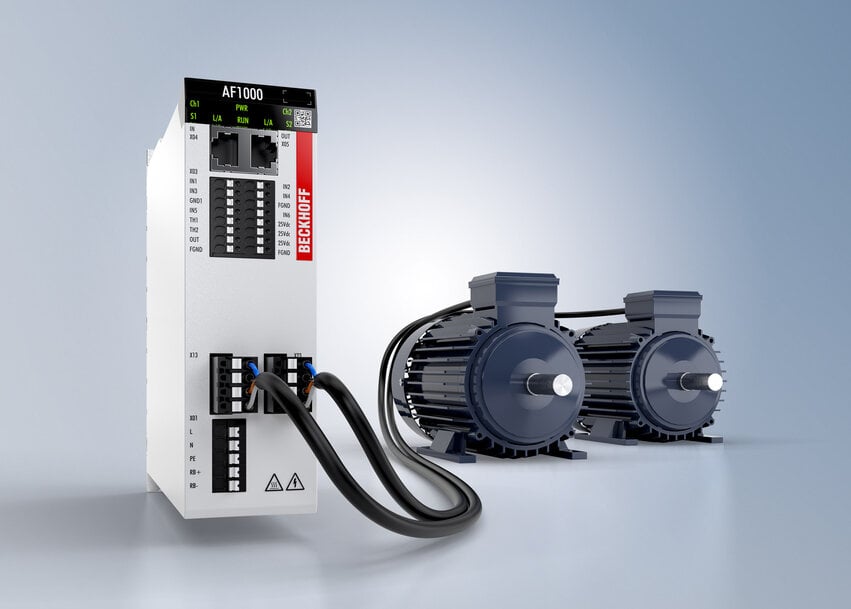
Beckhoff has introduced the AF1000 variable frequency drive (VFD), a cost-effective solution designed for basic drive applications across multiple industrial sectors, including conveyor systems, pumps, and fans. The drive series features full integration into the TwinCAT automation system via EtherCAT, delivering the standardized commissioning workflows and built-in diagnostics used in the company’s servo drive technologies.
Electrical Infrastructure and Module Layout
The AF1000 VFD line is manufactured in two separate power supply versions to match varying industrial electrical configurations:
- Single-Phase Platform: Engineered for a single-phase supply of 240 V AC, covering an operational power range from 0.37 kW (0.5 HP) to 1.5 kW (2 HP).
- Three-Phase Platform: Developed for a three-phase supply up to 480 V AC, supporting a higher power range from 0.37 kW (0.5 HP) up to 5.5 kW (7 HP).
Despite its small mechanical dimensions and gap-free side-by-side cabinet installation, the hardware design incorporates an integrated control power supply unit, DC link capacitors, and a dedicated ballast circuit. The 24 V DC internal control voltage is generated directly by the integrated power supply utilizing the internal DC link voltage.
Both voltage variants are available as either a single-axis drive module or a high-density 2-axis module. The dual-axis option lowers hardware costs while reducing the overall physical footprint and spatial requirements within the control cabinet.
Motor Compatibility and Engineering Software
The drive platform supports several motor configurations, including synchronous servomotors, asynchronous motors, and reluctance motors. It operates these systems without requiring external feedback sensors, executing control via standard U/f (voltage/frequency) mode or through specialized vector control profiles.
For software commissioning and axis parameterization, the series utilizes TwinCAT Drive Manager 2. This unified software approach eliminates the need for existing operators to learn or deploy a new engineering tool environment.
Additional Context
This section details technical specifications not included in the original news release.
Variable frequency drives designed for sensorless (feedbackless) motor control utilize mathematical models of the connected motor to estimate rotor position and magnetic flux links without relying on physical encoders or resolvers. In U/f control mode, the VFD maintains a constant ratio between the output voltage and frequency to keep the stator flux constant, making it suitable for quadratic torque loads like centrifugal pumps and fans.
For applications requiring high dynamic response and torque at low rotational velocities, sensorless vector control (field-oriented control) decouples the stator current into torque-producing and flux-producing vector components. This calculations-heavy method allows the drive to manage independent current loops, providing precise speed regulation and high starting torque even under varying load conditions on asynchronous and synchronous reluctance motors.
Communication between the VFD and the central programmable logic controller (PLC) utilizes the CANopen over EtherCAT (CoE) protocol, conforming strictly to the CiA 402 drive profile according to standard IEC 61800-7-201. This protocol maps operational data—such as target velocity, actual velocity, control words, and status words—into cyclic process data objects (PDOs) refreshed at sub-millisecond intervals.
To satisfy industrial machinery safety directives, the VFD incorporates optional TwinSAFE technology to execute hardware-implemented safe drive functions according to IEC 61800-5-2. These functions include:
Both voltage variants are available as either a single-axis drive module or a high-density 2-axis module. The dual-axis option lowers hardware costs while reducing the overall physical footprint and spatial requirements within the control cabinet.
Motor Compatibility and Engineering Software
The drive platform supports several motor configurations, including synchronous servomotors, asynchronous motors, and reluctance motors. It operates these systems without requiring external feedback sensors, executing control via standard U/f (voltage/frequency) mode or through specialized vector control profiles.
For software commissioning and axis parameterization, the series utilizes TwinCAT Drive Manager 2. This unified software approach eliminates the need for existing operators to learn or deploy a new engineering tool environment.
Additional Context
This section details technical specifications not included in the original news release.
Variable frequency drives designed for sensorless (feedbackless) motor control utilize mathematical models of the connected motor to estimate rotor position and magnetic flux links without relying on physical encoders or resolvers. In U/f control mode, the VFD maintains a constant ratio between the output voltage and frequency to keep the stator flux constant, making it suitable for quadratic torque loads like centrifugal pumps and fans.
For applications requiring high dynamic response and torque at low rotational velocities, sensorless vector control (field-oriented control) decouples the stator current into torque-producing and flux-producing vector components. This calculations-heavy method allows the drive to manage independent current loops, providing precise speed regulation and high starting torque even under varying load conditions on asynchronous and synchronous reluctance motors.
Communication between the VFD and the central programmable logic controller (PLC) utilizes the CANopen over EtherCAT (CoE) protocol, conforming strictly to the CiA 402 drive profile according to standard IEC 61800-7-201. This protocol maps operational data—such as target velocity, actual velocity, control words, and status words—into cyclic process data objects (PDOs) refreshed at sub-millisecond intervals.
To satisfy industrial machinery safety directives, the VFD incorporates optional TwinSAFE technology to execute hardware-implemented safe drive functions according to IEC 61800-5-2. These functions include:
- Safe Torque Off (STO): PVD gates are electronically unpowered to stop torque generation while the motor coasts to a halt.
- Safe Stop 1 (SS1): The drive actively decelerates the motor along a controlled ramp before executing the STO safety function.
These safety protocols achieve certification up to EN ISO 13849-1 (Category 4, Performance Level e) and EN 61508 (SIL 3) standards.
Edited by Romila DSilva, Induportals Editor, with AI assistance.
Edited by Romila DSilva, Induportals Editor, with AI assistance.
