
www.ptreview.co.uk
16
'26
Written on Modified on
Beckhoff Launches AX1000 Economy Servo Drive Series
Beckhoff introduces the system-integrated, compact AX1000 series engineered to supply advanced motion control features for low- to mid-range power thresholds.
www.beckhoff.com
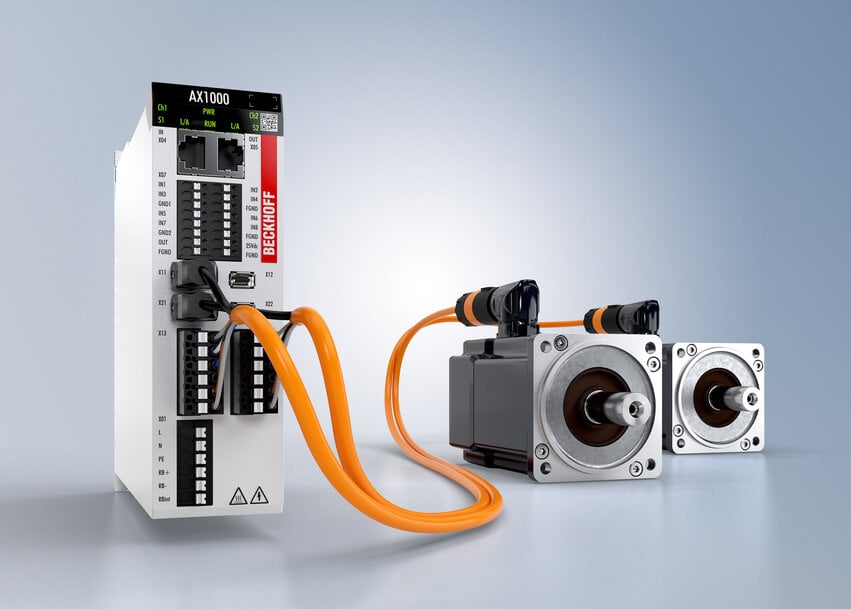
Beckhoff has launched the AX1000 economy servo drive series, an optimized motion control solution designed for basic to advanced drive applications across various industrial sectors. Fully integrated into the TwinCAT automation platform via EtherCAT, the drive line offers the same standardized commissioning workflows, software features, and built-in diagnostics utilized in the company’s higher-end AX series.
Electrical Infrastructure and Module Layout
The AX1000 power platform is manufactured in two sphares of voltage supply options to address differing machine layouts and factory power requirements:
- Low-Power Version: Rated for a single-phase supply of 1 x 240 V AC, targeting compact or low-voltage application boundaries.
- Higher-Power Version: Developed for a three-phase supply of 3 x 480 V AC, supporting operating currents ranging from 1.65 A up to 12 A.
Despite its small physical scale and gap-free side-by-side cabinet installation layout, the internal hardware includes an integrated control power supply unit, DC link capacitors, a ballast circuit, and—in most product variants—a dedicated ballast resistor. The internal control voltage required by the electronics is generated directly by the integrated power supply utilizing the internal DC link voltage. Both models can be specified as either a single-axis drive module or a dual-axis module to optimize control cabinet space efficiency.
Motor Compatibility and Automation Software Tools
The servo drive platform supports broad motor interfacing capabilities. This compatibility extends to AM8000 synchronous servomotors featuring One Cable Technology (OCT), which combines power and feedback signals into a single physical cable harness. Additionally, the drive operates asynchronous motors and reluctance motors, accommodating configurations with or without external encoder feedback loops.
For parameterization, system deployment, and operational analysis, the series links with TwinCAT automation software. Engineers can fully leverage the identical engineering ecosystem used for the larger AX5000 and AX8000 drive lines. This includes compatibility with TwinCAT Drive Manager 2, automated Autotuning software routines, Bode Plot frequency analysis, and dedicated cogging compensation tools to minimize velocity ripple and maximize axis positioning smooth motion.
Additional Context
This section details technical specifications not included in the original news release.
Servo drive architectures designed for advanced fieldbus integration rely on synchronized clock protocols to orchestrate multi-axis coordination. The EtherCAT network utilizes a Distributed Clocks (DC) mechanism where the master clock continuously measures and compensates for propagation delays across the serial network topology. This time-stamping synchronization achieves synchronization precision below 1 microsecond, ensuring that position loop updates across adjacent single-axis and dual-axis drive modules execute simultaneously. This tight timeline tracking is required for complex applications like interpolated CNC profile paths, multi-axis gantry electronic gearing, and high-speed flying cut-off systems.
The generation of localized internal control voltages via the main DC link circuit leverages a step-down switched-mode power supply configuration. In industrial drive systems, isolating the logic board power supply from separate external 24 VDC auxiliary links improves system resilience against localized voltage drops or external electrical disturbances. During short-term input mains power sagging or total power disruptions, the drive utilizes the residual kinetic and potential energy stored within the main DC link capacitor bank to keep the microprocessors and the fieldbus communication stack online. This configuration allows the drive to register the fault, transmit immediate diagnostic telemetry back to the PLC, and execute a controlled, safe emergency stop sequence before the internal logic completely powers down.
Motor feedback loop topologies are enhanced via digital single-cable interfaces like One Cable Technology (OCT). Traditional servomotors require two separate cables: a heavy-duty shielded cable for the three-phase AC stator currents and a separate, low-signal twisted-pair cable for the encoder signals (such as EnDat, BiSS, or resolver outputs). OCT merges these two paths by superimposing high-frequency bidirectional digital telemetry directly onto extra signal wires embedded within the main motor power cable. This digital data modulation uses robust frequency-shift keying or specialized serialization layers to protect the position data from electromagnetic noise generated by the adjacent pulse-width modulation (PWM) inverter lines, minimizing hardware cost and wiring bulk.
Edited by Romila DSilva, Induportals Editor, with AI assistance.
Motor Compatibility and Automation Software Tools
The servo drive platform supports broad motor interfacing capabilities. This compatibility extends to AM8000 synchronous servomotors featuring One Cable Technology (OCT), which combines power and feedback signals into a single physical cable harness. Additionally, the drive operates asynchronous motors and reluctance motors, accommodating configurations with or without external encoder feedback loops.
For parameterization, system deployment, and operational analysis, the series links with TwinCAT automation software. Engineers can fully leverage the identical engineering ecosystem used for the larger AX5000 and AX8000 drive lines. This includes compatibility with TwinCAT Drive Manager 2, automated Autotuning software routines, Bode Plot frequency analysis, and dedicated cogging compensation tools to minimize velocity ripple and maximize axis positioning smooth motion.
Additional Context
This section details technical specifications not included in the original news release.
Servo drive architectures designed for advanced fieldbus integration rely on synchronized clock protocols to orchestrate multi-axis coordination. The EtherCAT network utilizes a Distributed Clocks (DC) mechanism where the master clock continuously measures and compensates for propagation delays across the serial network topology. This time-stamping synchronization achieves synchronization precision below 1 microsecond, ensuring that position loop updates across adjacent single-axis and dual-axis drive modules execute simultaneously. This tight timeline tracking is required for complex applications like interpolated CNC profile paths, multi-axis gantry electronic gearing, and high-speed flying cut-off systems.
The generation of localized internal control voltages via the main DC link circuit leverages a step-down switched-mode power supply configuration. In industrial drive systems, isolating the logic board power supply from separate external 24 VDC auxiliary links improves system resilience against localized voltage drops or external electrical disturbances. During short-term input mains power sagging or total power disruptions, the drive utilizes the residual kinetic and potential energy stored within the main DC link capacitor bank to keep the microprocessors and the fieldbus communication stack online. This configuration allows the drive to register the fault, transmit immediate diagnostic telemetry back to the PLC, and execute a controlled, safe emergency stop sequence before the internal logic completely powers down.
Motor feedback loop topologies are enhanced via digital single-cable interfaces like One Cable Technology (OCT). Traditional servomotors require two separate cables: a heavy-duty shielded cable for the three-phase AC stator currents and a separate, low-signal twisted-pair cable for the encoder signals (such as EnDat, BiSS, or resolver outputs). OCT merges these two paths by superimposing high-frequency bidirectional digital telemetry directly onto extra signal wires embedded within the main motor power cable. This digital data modulation uses robust frequency-shift keying or specialized serialization layers to protect the position data from electromagnetic noise generated by the adjacent pulse-width modulation (PWM) inverter lines, minimizing hardware cost and wiring bulk.
Edited by Romila DSilva, Induportals Editor, with AI assistance.
