
www.ptreview.co.uk
17
'26
Written on Modified on
Focus-Stable SWIR Imaging for Machine Vision
Excelitas expands automated inspection capabilities with optics designed for extended infrared sensing and larger-format imagers.
www.excelitas.com
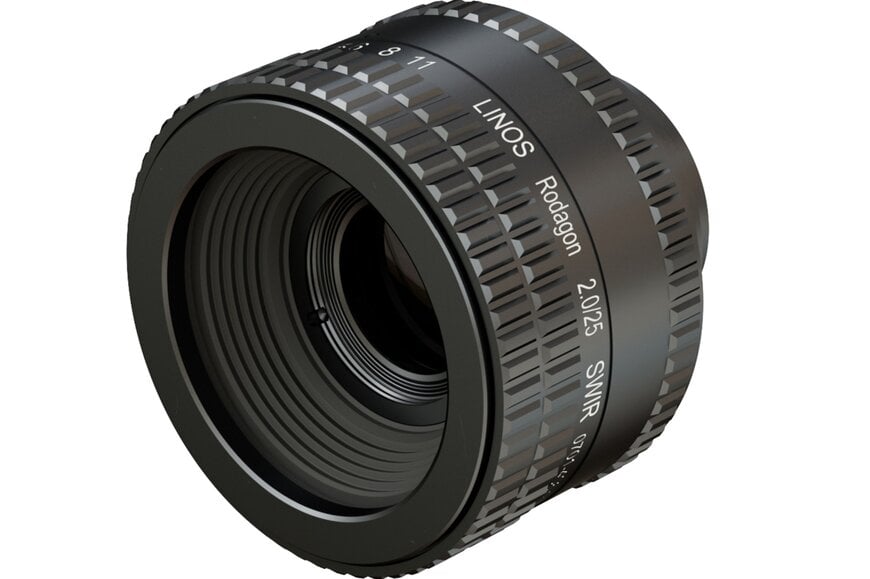
Excelitas is releasing the LINOS Rodagon 2.0/25 SWIR, a short-wave infrared optical component built for 1.1-inch sensors. This hardware provides focus-stable imaging from 840 to 1900 nm, directly targeting high-precision requirements in semiconductor manufacturing, automated sorting, pharmaceutical inspection, and smart farming.
Mitigating Focal Shift in Extended Spectra
Standard optics often require mechanical refocusing when shifting between specific wavelengths due to chromatic aberration. The LINOS Rodagon 2.0/25 SWIR eliminates this requirement across the entire 840 to 1900 nm band. By utilizing specialized glass materials and coatings, the optical design maintains a stable focal plane throughout the operational spectrum. This capability is highly relevant for hyperspectral and multispectral imaging, where consecutive captures across varying wavelengths must maintain exact spatial alignment for accurate data analysis without mechanical intervention.
The hardware is built to cover a large 18 mm image circle, satisfying the physical requirements of modern 1.1-inch sensor arrays. Traditional lenses often vignette or lose edge sharpness on sensors of this physical scale, but this unit is engineered to project uniform resolution and high contrast from the center to the extreme edges of the field of view.
Hardware Integration and Optical Specifications
In high-speed automated machine vision environments, lighting can be strictly constrained by rapid conveyor speeds or enclosed inspection chambers. The lens features a fast f/2.0 aperture, maximizing photon collection and permitting shorter exposure times during continuous manufacturing processes.
Designed for compatibility with the existing LINOS Modular Focus System, the lens incorporates a robust mechanical housing and an integrated filter thread. This modularity allows integrators to deploy the optics securely within vibrating or physically demanding production environments.
Tim Ulmer, a project manager at Excelitas, indicated that the optic provides edge-to-edge sharpness and focus-stable imaging for 1.1-inch sensors, exceeding the capabilities of standard short-wave infrared alternatives. He added that this architecture allows system designers to expand their automated inspection protocols beyond the visible spectrum while maintaining precise performance and straightforward integration.
Excelitas will showcase the LINOS Rodagon 2.0/25 SWIR in a live demonstration at Booth #1481 during the Automate Show, taking place June 22–25, 2026.
Additional Context
This section details technical specifications and competitive benchmarking not included in the original news release.
Commercial SWIR imaging systems rely predominantly on Indium Gallium Arsenide sensors, which typically have a spectral response peaking between 900 and 1700 nm. However, recent material advancements in extended-InGaAs technology have pushed sensitivity up to 1900 nm to capture specific moisture, plastic, or chemical signatures. The LINOS Rodagon 2.0/25 SWIR aligns precisely with these extended sensor bandwidths.
When benchmarked against widely deployed industrial SWIR alternatives, the primary differentiator is the combination of the 18 mm image circle and the 1900 nm upper limit. Typical industrial SWIR lenses operate between 900 and 1700 nm, support smaller 2/3-inch to 1-inch sensor formats with 11 mm to 16 mm image circles, and generally feature slower or equivalent apertures. Furthermore, while standard lenses are achromatic and frequently require refocusing at spectral extremes, the Excelitas optic provides apochromatic correction over the full extended band.
Because standard 1-inch format lenses physically cannot cover 1.1-inch sensor diagonals without heavy mechanical vignetting, engineers are often forced to use smaller, lower-resolution imagers. By supporting the larger 18 mm circle, this lens permits the integration of higher-megapixel extended-SWIR arrays, increasing the spatial resolution available for detecting micro-defects in complex quality assurance tasks like solar cell and semiconductor manufacturing.
Edited by Aishwarya Mambet, Induportals Editor, with AI assistance.
www.excelitas.com
