
www.ptreview.co.uk
18
'26
Written on Modified on
OMRON Launches VHV5-SRV for Inline Barcode Verification
New system enables ISO-compliant 100% barcode inspection at production speeds up to 1,200 parts per minute.
industrial.omron.eu
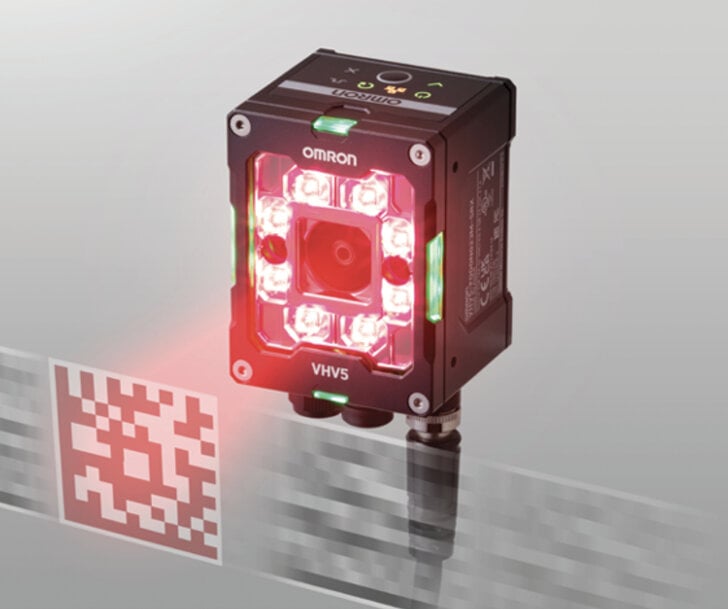
OMRON Automation has released its VHV5-SRV Barcode Verification System, an inline solution designed for real-time quality control of 1D and 2D codes within the life sciences, pharmaceutical, food, automotive, and aerospace manufacturing industries. The system monitors barcode quality directly on the conveyor line, providing continuous inspection to detect degradation, unreadable marks, or non-compliant formatting immediately during the manufacturing process.
Transition from Interval Sampling to Continuous Quality Monitoring
In industrial manufacturing, barcode quality control has traditionally relied on manual, offline sample checks conducted at the beginning or end of a production run. This methodology frequently leaves gradual printing degradation, unreadable codes, or non-compliant marks undetected until after an entire batch has been processed, shipped, or rejected by downstream logistics operations.
The VHV5-SRV shifts this quality control mechanism directly into the active production sequence. Every marking is analyzed immediately after it is printed or applied to the component. This allows quality engineering teams to detect variations in mark quality instantly and adjust marking parameters before defective products advance through the facility. For industries subject to strict regulatory compliance, this approach provides the necessary data continuity for part and packaging history.
Technical Validation and International Standardization
To ensure reproducible readability throughout the digital supply chain, code quality is evaluated based on defined international standards. The system validates linear 1D barcodes according to the ISO/IEC 15416 standard and two-dimensional 2D matrix codes under ISO/IEC 15415. For markings applied directly to components, such as those found in automotive data ecosystems and aerospace assembly, the system applies the grading criteria of ISO/IEC TR 29158 for Direct Part Marking (DPM).
Beyond geometric and optical analysis, the device validates data structures and syntax against global GS1 requirements, preventing formatting errors before shipment. To maintain compliance with ISO/IEC verification standards, the system is calibrated using an external third-party calibration card, providing an objective, standardized grade rather than an uncalibrated software estimate.
High-Speed Inspection and Optical Adaptation
The camera system is engineered to perform verification at throughput speeds of up to 1,200 parts per minute, preventing quality inspection from becoming a bottleneck on the line. To mitigate variations caused by complex surface geometries, the hardware supports both internal and external lighting configurations. This flexibility enables high-contrast imaging on highly reflective, curved, or irregular surfaces typical of metallic automotive parts or flexible food packaging. By housing both decoding and certified verification capabilities in a single unit, the system can directly replace existing barcode readers during factory modernization.
Additional Context:
This section details technical specifications and competitive benchmarking not included in the original product announcement
In the industrial inline barcode verification market, this system competes directly with established solutions such as the Cognex DataMan 475V series. Both platforms support the core international standards—ISO/IEC 15415, 15416, and TR 29158—for printed labels and direct part marks.
A primary technical differentiator lies in the optical architecture and processing pipeline. While the Cognex platform utilizes a fixed four-quadrant lighting configuration at a 45-degree angle to strictly meet the physical layout criteria of ISO standards, OMRON utilizes integrated transformation software for surface correction alongside Flat Field Correction. This digital approach dynamically compensates for lighting and pixel variations across the entire field of view on irregular surfaces.
In terms of operational throughput, the VHV5 platform achieves up to 4,000 parts per minute for standard decoding via its multi-core processors, while fully certified inline verification to ISO criteria is rated up to 1,200 parts per minute. This high verification threshold positions the system for rapid packaging and assembly lines where 100% inspection is required without introducing mechanical latency.
Edited by Natania Lyngdoh, Induportals editor, assisted by AI.
www.automation.omron.com
