
www.ptreview.co.uk
19
'26
Written on Modified on
Edge AI embedded systems standardize real-time factory floor intelligence
SINTRONES Technology announced rugged hardware configurations to execute localized machine vision and automated equipment management.
www.sintrones.com
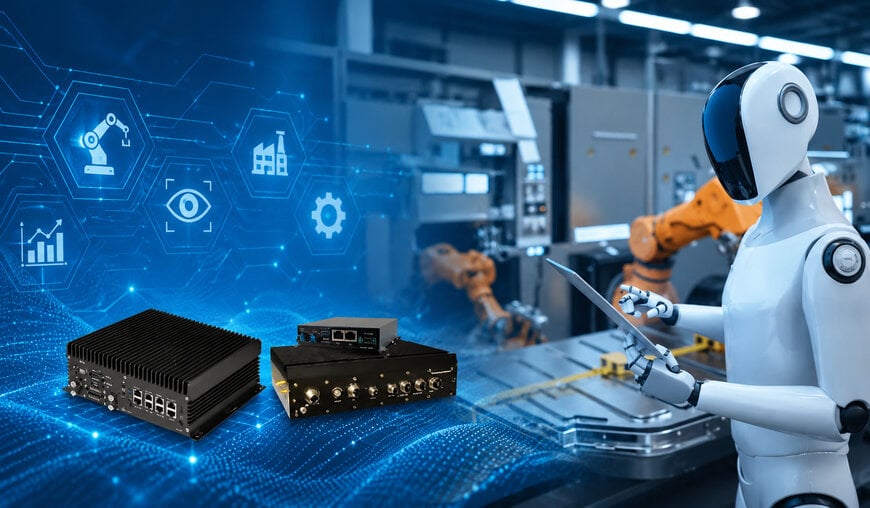
How do modern manufacturing facilities address the need for real-time intelligence at the edge? To minimize data latency, reduce equipment downtime, and optimize quality control metrics across smart manufacturing and electronics assembly sectors, computational workflows are moving from centralized cloud architectures directly to machine interfaces. The primary technical requirement centers on deploying robust processing hardware capable of executing continuous machine learning inference and synchronizing multi-axis equipment control within space-constrained, structurally demanding environments. To demonstrate these solutions, a technical presentation was scheduled for the Automate trade show from June 22 to 25, 2026, at McCormick Place in Chicago.
Integration of low-power control and high-performance vision hardware
To address distinct operational layers within the digital supply chain, specific hardware configurations target standalone machine management and intensive data analysis respectively. For real-time equipment control, process synchronization, and factory connectivity, ultra-compact embedded units utilize Intel Processor N-series architectures to deliver low-power, fanless operation inside tight control cabinets. This hardware deployment standardizes high-speed connectivity and flexible expansion to stabilize production workflows and maximize equipment uptime.
For high-throughput analytical tasks such as visual inspection and defect detection at the edge, high-performance platforms combine 14th Gen Intel Core processors with discrete NVIDIA RTX graphics processing units. This specific computing infrastructure accelerates automated optical inspection workflows within semiconductor fabrication and precision verification lines. The hardware architecture incorporates specialized PCIe expansion slots to integrate industrial frame grabbers and vision accelerator cards, allowing the system to identify process anomalies, improve inspection yield, and eliminate manual intervention during high-speed assembly.
Cybersecurity frameworks and industrial standardization
Because increased factory connectivity heightens operational technology vulnerability, security protocols must be embedded directly into the hardware lifecycle. Operational framework resilience is achieved by adhering strictly to the IEC 62443-4-1 Secure Product Development Lifecycle standard. This framework integrates cybersecurity verification throughout the initial design, development, system testing, and long-term maintenance phases. Implementing these standardized cryptographic and structural defenses allows industrial operators to scale artificial intelligence automation across factory floors while preventing unauthorized network intrusion.
Additional Context: This section details technical specifications and competitive benchmarking not included in the original product announcement
The deployment of edge computing hardware within industrial automation requires careful evaluation of thermal management, power efficiency, and processing throughput. The ultra-compact control unit utilizes x86 architecture processors operating within a thermal design power envelope of 6 to 15 watts, optimizing it for fanless deployment in sealed IP40 or IP50 enclosures where ambient temperatures reach up to 60 degrees Celsius. In contrast, the high-performance vision platform leverages a hybrid CPU architecture combined with discrete graphics processing units, which typically operate at a thermal design power scaling from 35 to over 150 watts. This requires advanced active or heat-pipe passive cooling mechanisms to prevent thermal throttling during continuous matrix multiplication operations during image processing.
When benchmarked against alternative industrial edge computing platforms, such as ARM-based tensor processing modules or dedicated application-specific integrated circuits, the x86 and discrete GPU combination provides broader compatibility with established machine vision libraries like OpenCV and proprietary industrial automation software stacks. While specialized neural processing units demonstrate higher power efficiency per tera-operation per second for specific deep learning models, the high-performance Intel and NVIDIA architecture provides the high sequential processing speeds and raw double-precision floating-point performance necessary to simultaneously handle real-time PCIe frame grabbing, deterministic input-output control loops, and multi-stream convolutional neural network inference without frame drops.
Edited by Sucithra Mani, Induportals editor – adapted by AI.
www.sintrones.com
