
www.ptreview.co.uk
22
'26
Written on Modified on
NEURA Robotics Showcases Full-Stack Cognitive Robotics Platform at Automate 2026
Company highlights Neuraverse ecosystem, humanoid robots and industrial automation solutions following record $1.4 billion funding round.
neura-robotics.com
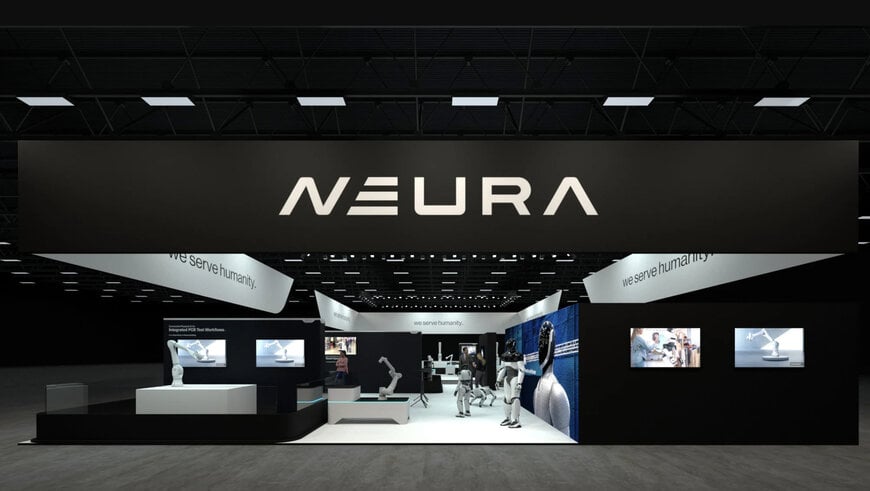
NEURA Robotics is showcasing its comprehensive cognitive robotics portfolio and cloud-based Neuraverse platform at the Automate 2026 trade show to address operational gaps in the automotive data ecosystem and general manufacturing sectors. The exhibition highlights the integration of physical artificial intelligence across various form factors, including collaborative robots and mobile autonomous transports, to validate real-world industrial applications.
Cloud-Based Validation for Physical Artificial Intelligence
The core methodology behind the exhibited technology asserts that physical artificial intelligence requires continuous validation within physical environments rather than relying exclusively on simulation data. Central to this architecture is the Neuraverse, an open cloud framework that aggregates telemetry and operational data from deployed units globally. Each operational cycle generates measurable intelligence that propagates across the network, optimizing subsequent tasks. Furthermore, physical testing environments designated as NEURA Gyms combine physical execution with high-fidelity digital twins. This dual-validation mechanism generates empirical data that directly updates the Neuraverse, mitigating adoption risks and accelerating the deployment of autonomous systems within the digital supply chain.
Industrial Use Cases in Material Handling and Precision Assembly
The platform demonstrations at Automate 2026, taking place June 22-25 at McCormick Place in Chicago, feature a variety of cognitive systems engineered for targeted industrial applications. Operational exhibits include the MAIRA robotic system executing bin picking and precision manufacturing tasks, alongside the LARA robotic arm performing palletizing operations and printed circuit board (PCB) handling. The display also incorporates the MAV+ mobile autonomous transport system for intra-logistics and multiple humanoid configurations, including the flagship 4NE1 and the compact 4NE1 Mini. These units operate within shared workflows developed with industrial partners, illustrating measurable operational efficiencies.
Strategic Infrastructure Funding and Ecosystem Partnerships
The expansion of these hardware and software ecosystems is supported by a $1.4 billion Series C financing round, recognized as the highest capital acquisition by a full-stack robotics manufacturer. This financial capitalization includes global technology stakeholders such as Tether, Qualcomm Technologies, Inc., Amazon, NVIDIA, imec.xpand, Bosch, Schaeffler, the European Investment Bank, Lingotto Horizon, and InterAlpen Partners. This capital allocates resources toward global manufacturing expansion, highlighted by a co-development partnership with Qualcomm and a formalized strategic collaboration with AWS. Measurable commercial traction is evident through an active deployment pipeline exceeding $1 billion. Additionally, David Reger will present analytical insights regarding physical artificial intelligence scaling at the Humanoid Robot Forum on June 23.
Additional Context:
This section details technical specifications and competitive benchmarking not included in the original product announcement
The NEURA Robotics 4NE1 humanoid operates within the advanced industrial robotics sector alongside competitive platforms such as the Figure 02 and the Boston Dynamics Atlas. Objective specifications indicate that the 4NE1 features a maximum lifting capacity of 100 kilograms and provides 6 to 8 hours of continuous runtime utilizing a dual hot-swappable battery system. In comparison, the Figure 02 offers a 25-kilogram payload capacity with an 8-hour battery life, while the electric Boston Dynamics Atlas provides a 50-kilogram instantaneous payload capability. The integration of the Neuraverse fleet intelligence system functions similarly to centralized fleet learning architectures utilized by these competing manufacturers, allowing computational skills acquired by a single unit to mathematically propagate across the entire connected robotic network to improve operational precision and cycle times.
Edited by Natania Lyngdoh, Induportals editor, assisted by AI.
www.neura-robotics.com
