
www.ptreview.co.uk
22
'26
Written on Modified on
Automated CNC Machining Systems for the Digital Supply Chain
SW North America integrates collaborative robotics with multi-spindle horizontal architecture to increase throughput across high-mix production environments.
sw-machines.com
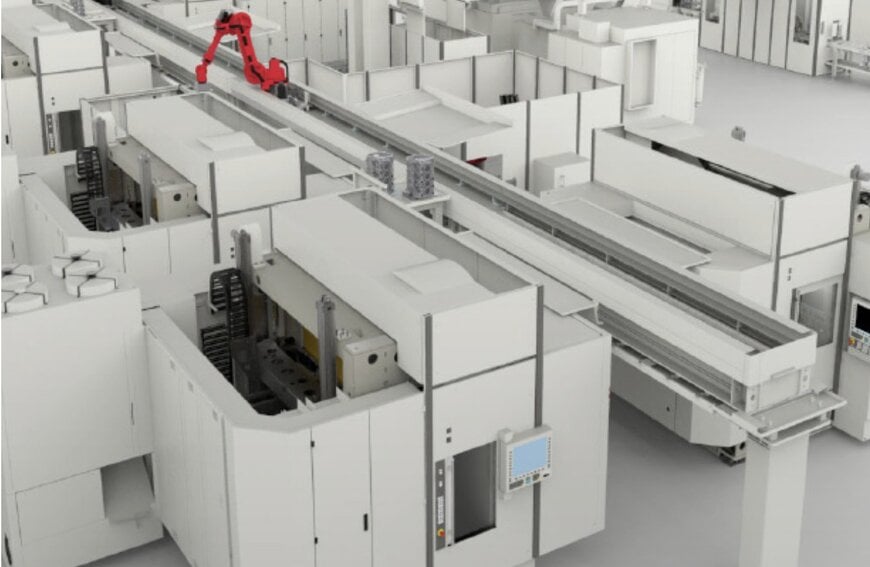
SW North America is showcasing integrated manufacturing cells that combine horizontal CNC machining with collaborative robot automation for the aerospace sector and the broader digital supply chain. By pairing intelligent vision systems with dual-spindle platforms, this hardware architecture enables predictable component execution while reducing manual intervention in complex production cycles.
Integration of Collaborative Robotics and Digital Twins
At the International Manufacturing Technology Show (IMTS), scheduled for September 14–19, 2026, at McCormick Place in Chicago, the company will demonstrate the operational integration of flexible machining systems. A primary configuration pairs the BA 322 dual-table, dual-spindle CNC machining center with a collaborative robot (cobot) designed to operate safely alongside human personnel using integrated sensing and intelligent motion technology. The system utilizes independent Z-axes and a ball-screw-driven platform to maintain rigidity during operation, while the automated cobot manages the loading of raw materials and the unloading of finished components. This hardware configuration relies on intelligent vision technology to coordinate machine-tending tasks, blurring the lines between standalone machining and continuous automated production.
Furthermore, the deployment incorporates Digital Twin technology to create a virtual representation of the physical machining process. This digital simulation allows machine operators to validate process changes and optimize performance parameters in a virtual environment before implementing adjustments on the physical shop floor, thereby mitigating operational risk and minimizing material waste.
Aerospace Component Manufacturing and Tool Pre-Setting
For critical aerospace applications requiring tight dimensional tolerances, the execution architecture includes the BA W06-22 machining center configured specifically for producing complex bladed disk (blisk) components. The manufacturing of these complex geometries requires high-performance material removal rates and strict process reliability. To achieve this, the system integrates a localized pre-setter and balancing station. This tooling infrastructure ensures precision and machining consistency by physically verifying tool geometry and rotational balance prior to material engagement, addressing the stringent dimensional requirements characteristic of aerospace manufacturing.
Zero-Point Fixture Exchange for High-Mix Environments
To address the demands of low-volume, high-mix production operations, the system utilizes zero-point fixture change technology manipulated directly by the collaborative robot. This automated fixture exchange platform reduces machine downtime between different production runs by facilitating rapid and precise workholding changeovers. The zero-point clamping mechanism ensures high positioning repeatability, allowing manufacturers to maintain tight dimensional control while increasing manufacturing agility. According to Andrew Rowley, General Sales Manager at SW North America, this integration of automated physical execution and deterministic CNC machining establishes a more adaptable production environment capable of meeting evolving industrial requirements.
Additional Context
This section details technical specifications and competitive benchmarking not included in the original news release.
In the horizontal multi-spindle CNC machining market, this architecture competes with platforms such as the Grob G-series and the Makino a-series horizontal machining centers. Benchmarking for these high-production systems typically evaluates rapid traverse rates, chip-to-chip tool change times, and volumetric positioning accuracy. While single-spindle systems like the Makino models focus on maximum spindle rigidity for machining hard metal aerospace alloys, dual-spindle architectures such as those from SW North America and Grob are evaluated on the thermal stability between the independent Z-axes and the synchronized spindle spacing. A critical performance metric for these automated cells is the integration latency between the machine's programmable logic controller (PLC) and the collaborative robot's vision system, which dictates the overall cycle time efficiency in automated, high-mix production scenarios.
Edited by Aishwarya Mambet, Induportals Editor, with AI assistance.
www.sw-machines.com
