
www.ptreview.co.uk
23
'26
Written on Modified on
Automated Sheet Metal Processing and Robotic Palletizing Systems
Lantek and TECOI integrate modular cutting architectures with adaptive robotics to enable continuous unloading and sorting within industrial automation workflows.
www.lantek.com
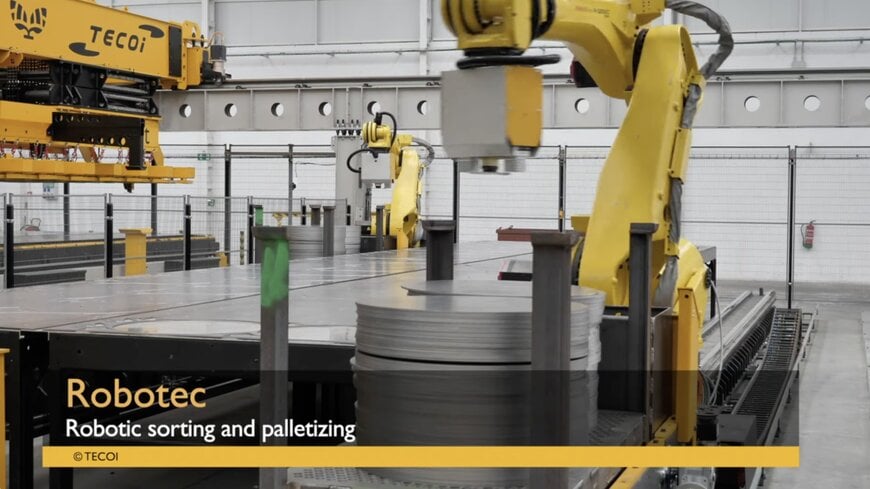
Lantek and TECOI are collaborating to deploy an automated robotic unloading and palletizing system for the sheet metal manufacturing industry. This joint development integrates computer-aided manufacturing software with multi-head cutting machinery to manage large-scale material handling operations.
Partners and Operational Challenge
Lantek develops software solutions for the sheet metal sector, while TECOI manufactures heavy-duty sheet metal cutting machinery. The primary operational challenge addressed by this partnership is the production downtime typically caused by manual or sequential part sorting and unloading. Developing a continuous-flow production system required combining TECOI's hardware engineering with Lantek's geometric algorithms to synchronize cutting and handling processes at scale.
Applications and Operational Benefits
The target application area is high-throughput sheet metal fabrication and downstream industrial logistics. Concrete technical use cases involve the continuous cutting, extraction, and sorting of multi-part steel sheets. By eliminating the need to pause cutting operations for part extraction, the system ensures process stability, increases machine utilization rates, and maintains full traceability of individual components from the cutting bed to the final pallet.
Technical Solution and Responsibilities
The integrated system utilizes TECOI’s CF modular cutting architecture, designed for multi-head cutting processes. TECOI is responsible for the physical handling hardware, which includes a servo-automated crane equipped with liftable magnets to transfer cut material to an intermediate staging zone. Here, robotic units utilizing adaptive gripping technology retrieve the parts. Lantek provides the control logic via its computer-aided design and manufacturing instructions. The software organizes parts based on specific geometry and angular orientation, instructing the robotics to stack identical parts together, thereby optimizing pallet stability.
Deployment and Implementation
Deployed as part of the broader Sortec framework, the system is designed to automate production lines from initial processing to final palletizing. The architecture utilizes a collaborative robot-based framework that integrates with existing floor layouts. The modular design allows engineers to deploy additional robotic units to work in synchronization, scaling the unloading capacity for high-throughput facilities without requiring complete system overhauls.
Results and Expected Impact
The primary measurable mechanism of this integration is the parallel execution of cutting and palletizing. Because part handling is offloaded to an intermediate zone managed by synchronized robotics, the cutting heads maintain continuous operation. This parallel processing architecture reduces machine idle time and increases overall production throughput, adapting to both lower-demand facilities and large-scale manufacturing operations without compromising precision.
Edited by Aishwarya Mambet, Induportals Editor, with AI assistance.
www.lantek.com
