
www.ptreview.co.uk
23
'26
Written on Modified on
Edge AI Computing Frameworks for Scalable Industrial Robotics Deployment
Vecow exhibits high-bandwidth edge AI computing platforms designed to accelerate the deployment of autonomous industrial robotics ecosystems.
www.vecow.com
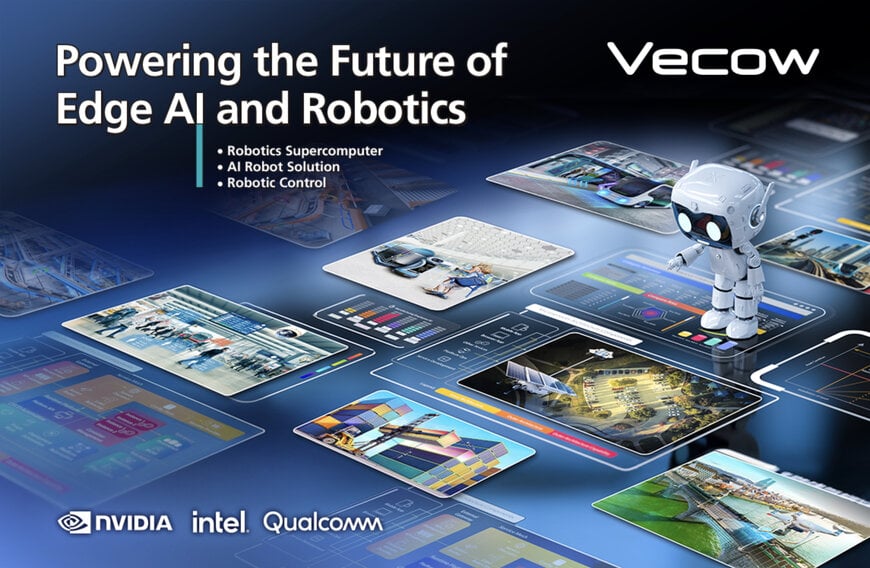
Vecow is presenting its latest edge AI computing platforms and sensor integration hardware for industrial AI robots at the AUTOMATE 2026 exhibition in Chicago, taking place from June 22 to 25. The technological showcase focuses on scalable processing architectures and multi-sensor data pipelines intended to support advanced perception workloads in autonomous mobile robots, humanoid systems, and intelligent industrial automation environments.
Transitioning from Standalone Automation to AI-Native Frameworks
As industrial robotics systems move beyond pre-programmed automation, hardware requirements for real-world deployment increasingly prioritize high-speed sensor integration and scalable AI computation. Joseph Huang, Executive Vice President of Vecow, noted that robotics deployment is shifting toward AI-native ecosystems that integrate compute, perception, and software workflows. By providing scalable edge AI platforms, the hardware is designed to support multi-modal data processing and reduce the latency of perception pipelines within an industrial data ecosystem.
High-Bandwidth Sensor Fusion and Robotics Supercomputing
To support humanoid robotics and omni-perception applications, Vecow is demonstrating the EAC-7000 Series, an edge AI system powered by the NVIDIA Jetson Thor module. This architecture handles advanced perception and physical AI workloads by processing high volumes of sensor data locally. Accompanying the compute node is the HSP-1000 Sensor Fusion Pivot platform. This hardware integrates the NVIDIA Holoscan Sensor Bridge to establish multi-sensor connectivity with minimal latency, allowing the central processing unit to synchronize visual and spatial data necessary for real-time robotic decision-making.
Development Kits for Autonomous Mobile Robots
For the development of autonomous mobility solutions, the company is exhibiting the VTK AMR Dev Kit EDR-1000 Series. Built around the NVIDIA Jetson AGX Orin platform, the hardware is optimized to run the NVIDIA Isaac ROS software framework. This development kit provides a standardized computational foundation that simplifies the integration of navigation, mapping, and obstacle avoidance algorithms, thereby accelerating the deployment of autonomous systems in logistics and manufacturing facilities.
Software-Defined Integration for Robotic Motion Control
The exhibition also includes a live demonstration of AI-native robotics execution using the ECX-3100 PEG platform equipped with an NVIDIA RTX PRO graphics processing unit. Developed in collaboration with Holon Robotics and featuring a FANUC robotic arm, the system integrates computer vision with mechanical motion control. This setup illustrates how software-defined robotics and AI-assisted operational workflows can streamline the integration of intelligent automation into existing industrial infrastructures, reducing the complexity of synchronizing visual inputs with precise mechanical outputs.
Additional Context:
This section details technical specifications and competitive benchmarking not included in the original product announcement
The Vecow EAC-7000 Series utilizes the NVIDIA Jetson Thor architecture, which delivers up to 2,070 teraflops of FP4 AI processing capability and includes up to 128 gigabytes of shared memory. This hardware represents a computational increase over previous iterations such as the Jetson AGX Orin, which peaked at 275 tera-operations per second. Within the physical AI computing sector, Intel offers alternative platforms such as the Panther Lake series, which rely on dedicated hardware neural processing units. Comparative testing indicates that while the Intel processors generally maintain lower overall system power draw during standby and reactive states, the NVIDIA Jetson Thor hardware provides significantly higher raw computational throughput. This high memory bandwidth and processing volume allow the system to execute large language models and multi-camera vision tasks concurrently without dropping visual frame rates below the acceptable limits required for operational safety. Furthermore, the integration of up to 16 GMSL automotive camera inputs on the Vecow hardware eliminates the need for separate capture cards, consolidating the external sensor footprint required for omnidirectional robotic vision.
Edited by Natania Lyngdoh, Induportals editor, assisted by AI.
www.vecow.com
