
www.ptreview.co.uk
09
'26
Written on Modified on
Edge AI Computing Architectures for Industrial Automation Systems
ASRock Industrial integrates advanced processor architectures and specialized neural processing units to facilitate deterministic real-time control within the industrial IoT edge ecosystem.
www.asrockind.com
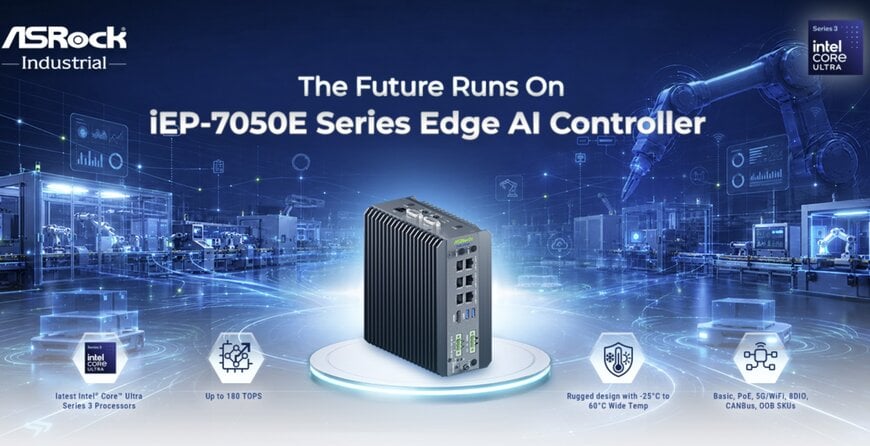
ASRock Industrial is releasing the iEP-7050E Series Industrial IoT Controller, a specialized edge platform designed to process machine vision and control data locally. This hardware deployment addresses the latency and reliability requirements of intelligent automation, robotics, and autonomous systems by executing high-density computing workloads directly at the operational source.
Processor Architecture and Neural Workload Processing
The processing framework of the iEP-7050E relies on Intel Core Ultra Series 3 Processors, utilizing the Panther Lake architecture. This configuration integrates a central processing unit, graphics processing unit, and a dedicated neural processing unit to handle on-device artificial intelligence inference. The combined architecture yields up to 180 total platform tera operations per second (TOPS), providing the computational bandwidth required for complex computer vision and predictive maintenance tasks without relying on cloud connectivity. To support high-throughput data processing and prevent data corruption during mission-critical operations, the system accommodates up to 128GB of DDR5 memory operating at 7200 MHz, supplemented by Intel In-Band Error Correction Code (ECC).
Real-Time Control and Industrial Connectivity
For robotics and automated manufacturing, deterministic network performance is critical. The platform incorporates Intel Time Coordinated Computing (TCC) and Time-Sensitive Networking (TSN) to ensure synchronized, low-latency data transmission. The physical interface array includes three Intel i266-IT LAN ports—one supporting Intel vPro—and three Intel i210-IT LAN ports. Physical integration is managed through modular SKUs that alter the baseline dimensions of 60x170x150mm. Specific configurations expand the chassis to 78x170x150mm to accommodate additional hardware, such as Power over Ethernet (IEEE 802.3af) or 5G connectivity modules via M.2 Key B slots.
Signal control is facilitated by configurable digital input/output interfaces, scaling from standard 4DI/4DO arrays to an 8DIO configuration featuring 3KV sink/source isolation for electrical protection. The integration of dual CANBus interfaces and Single Pair Ethernet (SPE) connectors for T1S connectivity enables direct communication with legacy and next-generation industrial sensors.
Environmental Durability and Power Regulation
Industrial edge controllers are routinely subjected to environmental extremes. The iEP-7050E utilizes a fanless chassis designed to operate continuously across a temperature range of -25°C to 60°C. To manage fluctuating facility power, the power delivery network accepts a dual wide-range direct current input spanning 9V/19V to 36V. The circuitry includes embedded protection mechanisms against overvoltage, undervoltage, and overcurrent scenarios, alongside an 80V surge defense system. To assist systems integrators in matching specific controller SKUs and AI accelerators to precise deployment environments, engineers can utilize the AI Pathfinder software tool to validate hardware configurations prior to installation.
Additional Context
This section details technical specifications and competitive benchmarking not included in the original news release.
In the industrial edge computing market, controllers are typically categorized by their inference capabilities and thermal design power. Traditional x86-based industrial PCs often rely on discrete graphics cards to achieve AI acceleration exceeding 100 TOPS, which drastically increases the physical footprint, thermal output, and power consumption of the unit. Alternatively, ARM-based systems utilizing Nvidia Jetson Orin NX modules provide around 100 TOPS in a compact form factor but require software translation layers for legacy x86 industrial automation software. By utilizing the Panther Lake architecture with an integrated NPU reaching 180 TOPS, this system offers a highly competitive benchmark. It matches the upper-midrange computational output of dedicated ARM-based AI accelerators while maintaining native x86 compatibility, allowing facilities to deploy heavy AI workloads within a compact, passively cooled enclosure.
Edited by Aishwarya Mambet, Induportals Editor, with AI assistance.
www.asrockind.com
