
www.ptreview.co.uk
15
'26
Written on Modified on
High-Speed Switches Preserve Signal Integrity at 64 GT/s
Toshiba targets advanced data interfaces with wider bandwidth and robust performance across demanding industrial environments.
www.global.toshiba
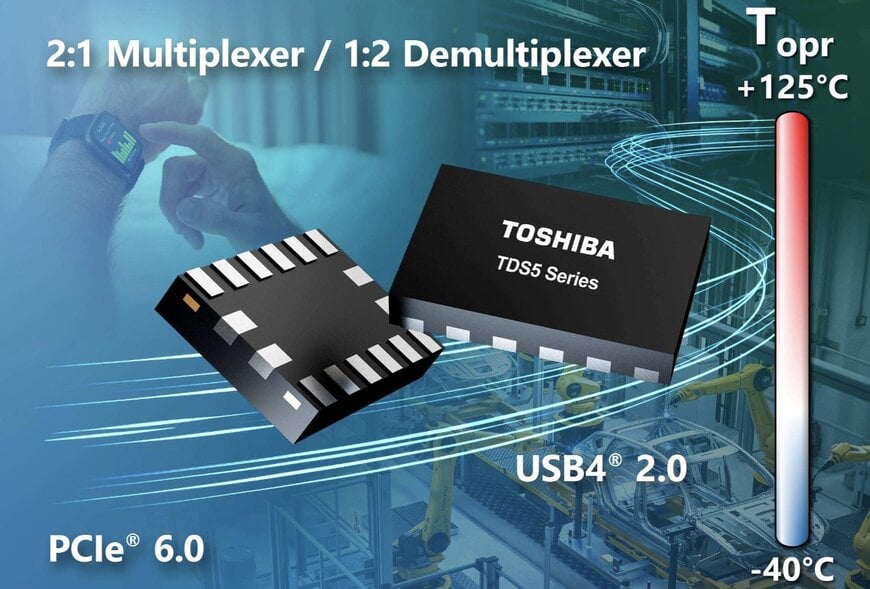
Toshiba has introduced the TDS5B212MX and TDS5C212MX, two high-speed multiplexer and demultiplexer switches engineered for digital infrastructure and industrial applications. These components facilitate stable signal integrity for enterprise servers, robotic systems, and industrial testers operating under extreme thermal conditions.
Application Areas and Operational Context
As data processing requirements increase across the industrial supply chain, maintaining signal integrity at high frequencies has become a primary engineering constraint. The newly released routing switches are designed to support rapid data rates up to 64 gigatransfers per second. This capability is critical for hardware engineers developing enterprise servers, automated industrial testers, and robotic control systems that rely on high-bandwidth communication protocols. By enabling the dynamic switching of signal paths, the components allow multiple downstream devices to share a single high-speed interface, optimizing board-level architecture in connected devices and high-density computing arrays.
Technical Specifications and Signal Routing Mechanisms
The multiplexer switches utilize a proprietary silicon-on-insulator manufacturing process, designated as TarfSOI, to achieve high-frequency performance. The TDS5B212MX delivers a typical differential bandwidth of 29 gigahertz at a -3 decibel threshold, while the TDS5C212MX reaches 34 gigahertz. These bandwidth parameters directly minimize signal distortion and reduce transmission losses during data transfer. The physical architecture of the TDS5C212MX includes an optimized pin layout that shortens the internal signal path, which mathematically reduces reflections and preserves signal integrity when utilizing advanced differential interfaces such as PCIe 6.0, USB4 version 2.0, CXL 3.x, Thunderbolt 5, and DisplayPort 2.0. The switches also maintain backward compatibility with previous iterations of these interface standards.
Physical Implementation and Environmental Tolerance
For physical deployment, both components are configured as 2-input/1-output multiplexers or 1-input/2-output demultiplexers and housed in a compact XQFN16 package measuring 2.4 by 1.6 by 0.4 millimeters. This form factor addresses the spatial constraints typical of high-density printed circuit board designs found in mobile electronics and industrial sensors. Furthermore, the operational temperature rating spans from -40 degrees to +125 degrees Celsius, allowing implementation in harsh industrial environments where thermal management and heat dissipation are significant design factors.
Additional Context
This section details technical specifications and competitive benchmarking not included in the original news release.
In the high-speed differential switch market, the transition to PCIe 6.0 and USB4 version 2.0 requires components capable of handling Pulse Amplitude Modulation 4-level signaling without inducing severe insertion loss. The 34 gigahertz bandwidth of the TDS5C212MX positions it directly alongside advanced switching solutions from competitors such as Texas Instruments and Diodes Incorporated, which offer similar multiplexers targeting the 64 gigatransfers per second threshold. While standard multiplexers often exhibit significant insertion loss at frequencies above 20 gigahertz, utilizing a silicon-on-insulator process helps maintain linear performance and low parasitic capacitance across the extended -40 to +125 degrees Celsius industrial temperature range.
Edited by Aishwarya Mambet, Induportals Editor, with AI assistance.
www.toshiba.com
