
www.ptreview.co.uk
16
'26
Written on Modified on
AI Enhances Industrial Robot Performance
Mitsubishi Electric integrates predictive maintenance, deterministic networking, and machine vision to advance connected manufacturing.
www.mitsubishielectric.com
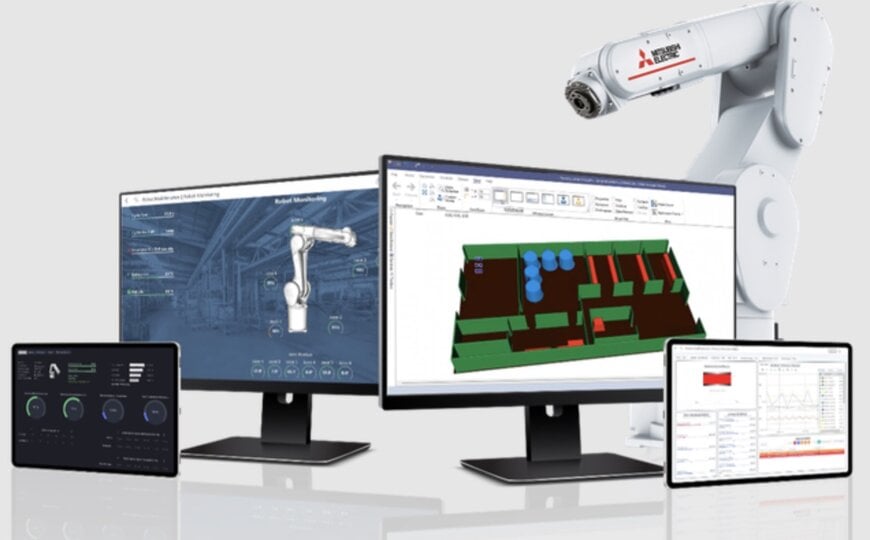
Mitsubishi Electric has released the MELFA E4 update for its industrial robot platform, introducing standardized artificial intelligence and deterministic network capabilities. This system upgrade targets connected manufacturing facilities that require precise synchronization and predictive maintenance across automated production lines.
Standardizing Artificial Intelligence and Maintenance Mechanisms
The system update integrates previously optional functionalities directly into the core robotic controller. By embedding predictive maintenance protocols and wear simulation tools, the platform monitors joint health and predicts mechanical failures before they interrupt industrial automation processes. The integration includes artificial intelligence-driven force control optimization and thermal compensation algorithms, which dynamically adjust the robot's kinematics to maintain spatial accuracy despite temperature fluctuations during continuous operation. These embedded features reduce the total cost of ownership by eliminating the need for external processing hardware while improving the baseline quality of precision-dependent manufacturing tasks.
Deterministic Communication and Axis Synchronization
To support high-speed digital manufacturing frameworks, the CR800-D robot controller features native support for CC-Link IE TSN networks. This protocol enables deterministic, time-sensitive communication, allowing the precise synchronization of robotic arms with other automation hardware across the factory floor. Additionally, the platform supports the integration of MR-J5-B servodrives as synchronized external axes. This architecture utilizes motors with battery-less absolute encoders, decreasing ongoing maintenance overhead. It also allows engineers to configure specific torque limits on these external axes and utilize safety communications that comply with the ISO 10218 standard for industrial robot safety.
Dynamic Tracking for Machine Vision Applications
For applications requiring continuous spatial adaptation, the update introduces a dedicated command for dynamic tracking and monitoring via machine vision. The newly implemented architecture allows the controller to capture encoder values directly from signals generated by external, third-party vision systems. This standardized signal processing simplifies the integration of external cameras and optical sensors, broadening the hardware compatibility for highly automated tracking applications on moving conveyor belts or assembly lines.
Additional Context
This section details technical specifications and competitive benchmarking not included in the original news release.
Within the industrial robotics sector, controller architectures are increasingly judged on native network determinism and embedded analytics. Comparable platforms, such as the ABB OmniCore and the FANUC R-30iB Plus controllers, also offer integrated predictive maintenance and advanced force control. However, the integration of CC-Link IE TSN distinguishes this specific architecture. While competitors often rely on EtherCAT or PROFINET IRT for synchronized motion control, Time-Sensitive Networking (TSN) provides a standardized Ethernet layer that allows both high-speed IT data and deterministic operational technology control data to share the same network infrastructure without packet collision or latency degradation. Furthermore, the transition to battery-less absolute encoders across auxiliary axes represents a measurable reduction in hazardous waste and routine maintenance downtime compared to legacy battery-backed encoder systems.
Edited by Aishwarya Mambet, Induportals Editor, with AI assistance.
www.mitsubishielectric.com
