
www.ptreview.co.uk
16
'26
Written on Modified on
Energy-Efficient IoT Tracking Systems for Industrial Asset Localization
Rosenberger presents a comprehensive development approach for autonomous telematics platforms for resource monitoring in logistics, industry, and construction.
osi.rosenberger.com
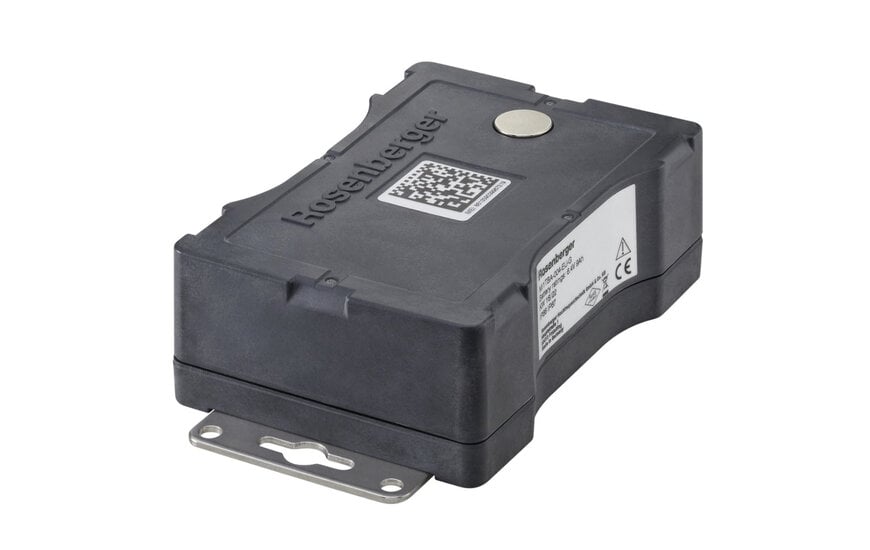
The implementation of intelligent algorithms in cellular tracking modules enables the continuous monitoring of equipment over large areas. This systemic approach integrates hardware, software, and connectivity for demanding environmental conditions in airport ground handling, transport logistics, and manufacturing.
Algorithm-Based Motion Analysis and Energy Management
The acquisition of location data requires precise control of energy consumption for off-grid devices. The telematics platform utilizes the Movement Pattern Detection process, which applies statistical methods and linear algebra to evaluate typical movement patterns directly at the hardware level. Irrelevant mechanical influences are filtered out, while anomalous events such as unauthorized location changes or operating errors are transmitted to the backend. Through this dynamic adjustment of transmission intervals, the modules achieve a battery life of up to ten years. The configuration of system parameters is carried out instantaneously, without the need for physical interventions on the hardware or manual software updates.
Cryptography, Network Connectivity, and System Integration
In critical infrastructures, networked systems are subject to strict security requirements. Data transmission is secured by end-to-end encryption as well as role-based access rights at the architectural level. For global communication, the devices use multi-band LTE modules that cover the LTE-M, NB-IoT, and EGPRS transmission standards, combined with multi-provider roaming for continuous network coverage. Positioning is achieved via a dual system of GPS and cell location. The recorded operational and object data is transferred directly to higher-level planning software such as SAP via open programming interfaces, thereby synchronizing process chains in construction logistics and industrial manufacturing.
"With AI-supported energy optimization, high cyber security, and a structured rollout, Rosenberger accompanies companies holistically as a reliable partner for individual IoT use cases," says Kai-Uwe Müller, Director of Smart Engineering at Rosenberger.
Additional Context
This section details technical specifications and competitive benchmarking not included in the original product announcement
In the market for industrial asset tracking, telematics platforms with integrated data preprocessing compete with conventional GPS data loggers from manufacturers such as Samsara, Geotab, and Bosch. A central technological difference lies in the edge computing capability of the end devices. While standardized trackers send raw data from acceleration sensors to cloud servers at fixed time intervals, Rosenberger's system evaluates linear vector data locally to minimize the energy consumption for radio transmission. Furthermore, compared to conventional 4G modules, the combination of the cellular standards LTE-M and NB-IoT offers measurable advantages in signal penetration in reinforced concrete buildings or expansive industrial facilities. The hardware-level implementation of end-to-end encryption protocols also represents a specific criterion for use in KRITIS-certified (critical infrastructure) environments, where unencrypted data streams are excluded by regulations.
Edited by Maria Brueva, Induportals editor – adapted by AI.
www.rosenberger.com
