
www.ptreview.co.uk
24
'26
Written on Modified on
Modular Edge Computing Expansion Platform for Duro Edge Series
Nexcom developed the DockInfinity platform to provide modular PCIe and storage hardware expansion for Duro Edge industrial computers across automated manufacturing, machine vision, and logistics operations.
www.nexcom.com
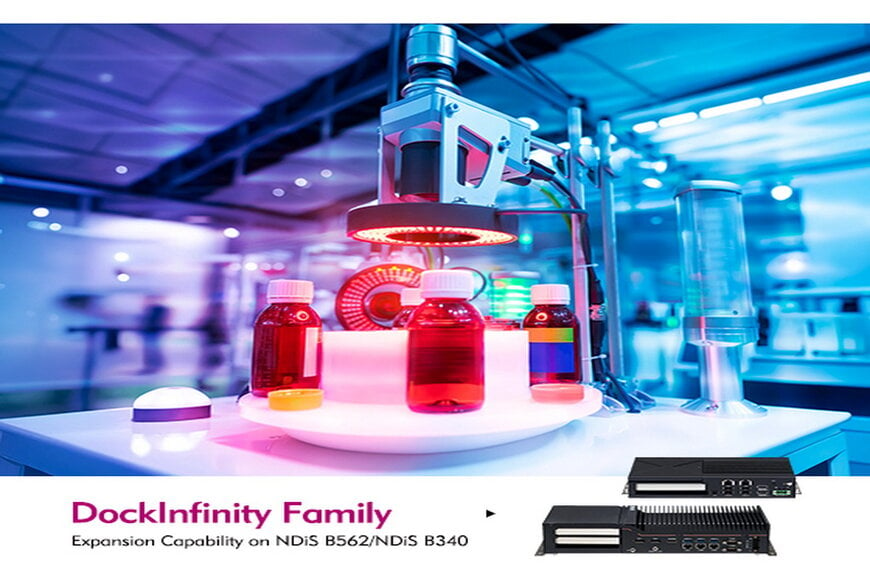
The cooperation addresses the demand for adaptable edge computing architectures through a side-panel expansion mechanism for box PCs. This technical approach allows industrial operators to scale processing, networking, and storage capabilities without replacing core computer hardware in applications including automated optical inspection, autonomous mobile robots, and smart warehouse equipment.
Technical Mechanisms of Side-Panel System Expansion
Industrial edge computers deployed in automated optical inspection (AOI) and autonomous mobile robot (AMR) systems face shifting computational workloads driven by evolving artificial intelligence and machine vision algorithms. The DockInfinity expansion platform attaches directly to the side aluminum panels of compatible Nexcom Duro Edge chassis, converting compact box PCs into multi-slot industrial computing systems. By utilizing existing structural enclosures, the system eliminates full chassis retrofits and minimizes hardware hardware displacement when updating capabilities.
The platform relies on standard PCIe 4.0 connectivity interfaces to integrate specialized add-in cards. Backwards compatibility supports PCIe x1, x4, x8, and x16 form factors. For thermal management during intensive AI inference tasks, active cooling configurations integrate dedicated chassis ventilation openings and internal cooling fans to dissipate thermal energy generated by high-power graphics processing units.
Hardware Configurations and Interface Specifications
The expansion ecosystem comprises four distinct physical modules designed for specific functional integrations:
- DockInfinity-2R8: Provides connectivity for either a single PCIe 4.0 x16 expansion card or dual PCIe 4.0 x8 cards. The dual x8 configuration targets redundant array of independent disks (RAID) controllers, high-density local area network (LAN) interfaces, multi-port USB buses, HDMI output cards, and frame grabbers.
- DockInfinity-R16F: Designed with dual-slot mechanical spacing and an integrated cooling fan to accommodate single PCIe 4.0 x16 high-performance graphics accelerators. Active airflow prevents thermal throttling during heavy parallel processing workloads.
- DockInfinity-E4X1: Offers a single PCIe 4.0 x4 slot intended for entry-level edge gateway expansion, including Power over Ethernet (PoE) add-in cards, image capture cards, and specialized industrial I/O.
- DockInfinity-2S: Functions as a dedicated dual solid-state drive (SSD) expansion kit. It features two standard 7-pin SATA connectors along with dedicated SATA power interfaces, supporting hardware RAID 0 and RAID 1 operational modes for data redundancy or accelerated throughput.
Industrial System Integration and Target Workloads
Pairing specific Duro Edge base units with matching expansion modules provides targeted operational performance based on deployed industrial environments.
The NDiS B562 industrial system, powered by Intel Core processors, pairs with the DockInfinity-R16F module to execute high-throughput AI inference and continuous image processing in automated optical inspection setups. The additional PCIe 4.0 x16 throughput and dedicated active cooling sustain the high data transfer rates required by high-resolution frame grabbers and graphics processing units.
For light edge processing and IoT gateway tasks, the NDiS B340 system pairs with the DockInfinity-E4X1 module. This combination provides the additional connectivity required for autonomous mobile robots and warehouse management equipment, enabling direct interfacing with multi-camera vision sensors, fieldbus networks, and localized storage devices without increasing the base system footprint significantly.
Additional Context
This section details technical specifications and competitive benchmarking not included in the original product announcement.
Industrial edge expansion platforms are benchmarked primarily by bus bandwidth, signal latency, thermal dissipation capacity, and mechanical integration efficiency. Standard PCI Express 4.0 specifications deliver a transfer rate of 16 gigatransfers per second (GT/s) per lane, yielding a total bidirectional bandwidth of approximately 31.5 gigabytes per second (GB/s) on a standard x16 interface.
In industrial automation environments, hardware expansion is typically implemented through direct panel-attach modules, external PCIe expansion chassis connected via optical or Thunderbolt interfaces, or stackable bus architectures such as PCIe/104.
Direct side-panel mounting, as utilized by the DockInfinity design, provides a native PCIe 4.0 connection directly to the system motherboard, maintaining full bus bandwidth and sub-microsecond latency without requiring interface bridge chips or external cabling. By contrast, external expansion enclosures often rely on Thunderbolt 4 or bridged PCIe links, which cap data transfer rates closer to 5.0 GB/s and introduce additional signal overhead.
While stackable bus architectures like PCIe/104 offer low-latency board-to-board interconnectivity, they generally operate on older PCIe generations and rely on passive conduction or shared system airflow, limiting their thermal capacity. Direct chassis-mount expansion modules with dedicated active cooling fans accommodate higher thermal power dissipation limits — typically supporting add-in cards drawing 75W or more — which is essential for sustaining continuous workloads on modern edge AI graphics accelerators.
Edited by Evgeny Churilov, Induportals Media - Adapted by AI
www.nexcom.com
Pairing specific Duro Edge base units with matching expansion modules provides targeted operational performance based on deployed industrial environments.
The NDiS B562 industrial system, powered by Intel Core processors, pairs with the DockInfinity-R16F module to execute high-throughput AI inference and continuous image processing in automated optical inspection setups. The additional PCIe 4.0 x16 throughput and dedicated active cooling sustain the high data transfer rates required by high-resolution frame grabbers and graphics processing units.
For light edge processing and IoT gateway tasks, the NDiS B340 system pairs with the DockInfinity-E4X1 module. This combination provides the additional connectivity required for autonomous mobile robots and warehouse management equipment, enabling direct interfacing with multi-camera vision sensors, fieldbus networks, and localized storage devices without increasing the base system footprint significantly.
Additional Context
This section details technical specifications and competitive benchmarking not included in the original product announcement.
Industrial edge expansion platforms are benchmarked primarily by bus bandwidth, signal latency, thermal dissipation capacity, and mechanical integration efficiency. Standard PCI Express 4.0 specifications deliver a transfer rate of 16 gigatransfers per second (GT/s) per lane, yielding a total bidirectional bandwidth of approximately 31.5 gigabytes per second (GB/s) on a standard x16 interface.
In industrial automation environments, hardware expansion is typically implemented through direct panel-attach modules, external PCIe expansion chassis connected via optical or Thunderbolt interfaces, or stackable bus architectures such as PCIe/104.
Direct side-panel mounting, as utilized by the DockInfinity design, provides a native PCIe 4.0 connection directly to the system motherboard, maintaining full bus bandwidth and sub-microsecond latency without requiring interface bridge chips or external cabling. By contrast, external expansion enclosures often rely on Thunderbolt 4 or bridged PCIe links, which cap data transfer rates closer to 5.0 GB/s and introduce additional signal overhead.
While stackable bus architectures like PCIe/104 offer low-latency board-to-board interconnectivity, they generally operate on older PCIe generations and rely on passive conduction or shared system airflow, limiting their thermal capacity. Direct chassis-mount expansion modules with dedicated active cooling fans accommodate higher thermal power dissipation limits — typically supporting add-in cards drawing 75W or more — which is essential for sustaining continuous workloads on modern edge AI graphics accelerators.
Edited by Evgeny Churilov, Induportals Media - Adapted by AI
www.nexcom.com
