
www.ptreview.co.uk
27
'26
Written on Modified on
Reference Design Simplifies AI Factory Deployment
Schneider Electric and AMD developed a validated reference design for deploying high-density AI infrastructure with standardized power, cooling, and digital infrastructure.
www.se.com
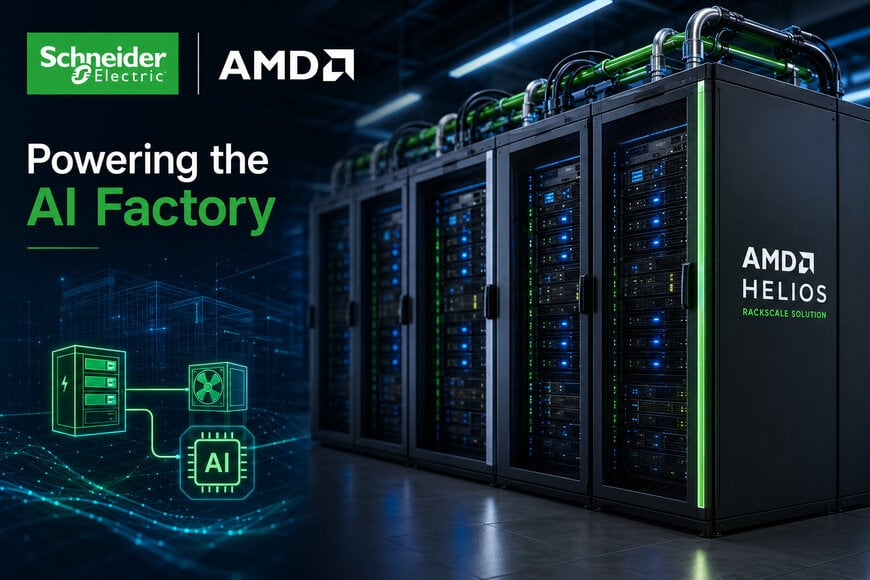
Schneider Electric and AMD have jointly developed a validated reference design for the AMD Helios rack-scale platform to simplify the deployment of high-density AI infrastructure. The engineering blueprint is intended for AI factories, enterprise data centres, and hyperscale computing environments that require integrated power, cooling, and IT infrastructure.
Cooperation Addresses High-Density AI Infrastructure
The collaboration combines AMD's expertise in AI computing platforms with Schneider Electric's capabilities in electrical distribution, cooling systems, and digital infrastructure. As AI clusters continue to increase in power density, deploying reliable infrastructure requires coordinated engineering across compute, power, thermal management, and facility operations. The reference design provides a standardized approach to reduce engineering complexity and integration risks during deployment.
Technical Solution and Partner Responsibilities
AMD provides the Helios rack-scale platform, incorporating AMD Instinct MI455X GPUs, 6th Generation AMD EPYC processors, AMD Pensando Vulcano network interface cards, and the ROCm software ecosystem. Schneider Electric contributes the physical infrastructure architecture, including electrical distribution, liquid cooling technologies, digital infrastructure management, and facility design validation.
The reference design covers four technical domains: facility power, facility cooling, IT space planning, and lifecycle software management. Infrastructure modelling uses ETAP electrical system analysis and EcoStruxure IT Design computational fluid dynamics simulations to validate electrical and thermal performance before deployment. Digital Twin functionality supports infrastructure modelling and operational analysis, while AVEVA Unified Operations Centre provides centralized monitoring and operational visibility.
Deployment Strategy
The reference design supports both new AI factory construction and upgrades of existing data centres. It accommodates modular AI clusters with IT loads of up to 10.4 MW and rack power densities reaching 246 kW.
The cooling architecture combines Motivair coolant distribution units with hybrid air- and liquid-cooling techniques capable of removing up to 84% of generated heat. The design also targets a power usage effectiveness (PUE) value as low as approximately 1.12 under full-load operating conditions. The initial validation complies with ANSI standards for U.S. installations, while support for IEC standards is planned for future international deployments.
Industrial Applications
The reference design is intended for hyperscale cloud providers, AI research facilities, enterprise AI infrastructure, and high-performance computing environments. By providing predefined electrical, thermal, and operational architectures, the framework helps engineers shorten planning cycles, improve infrastructure interoperability, and simplify integration between computing hardware and facility systems.
"AI infrastructure is rapidly moving to full-scale AI factories, and that requires compute, networking, power and cooling to be designed together from the start," said Forrest Norrod, executive vice president and general manager, Data Center Solutions Business Group, AMD.
Edited by Sucithra Mani, Induportals editor – adapted by AI.
www.se.com
