
www.ptreview.co.uk
29
'26
Written on Modified on
Compact Stereo Vision Systems for Logistics and Robotics
Basler introduces a hardware depth-sensing solution designed to improve navigation and object recognition in autonomous mobile robots and warehouse drones.
www.baslerweb.com
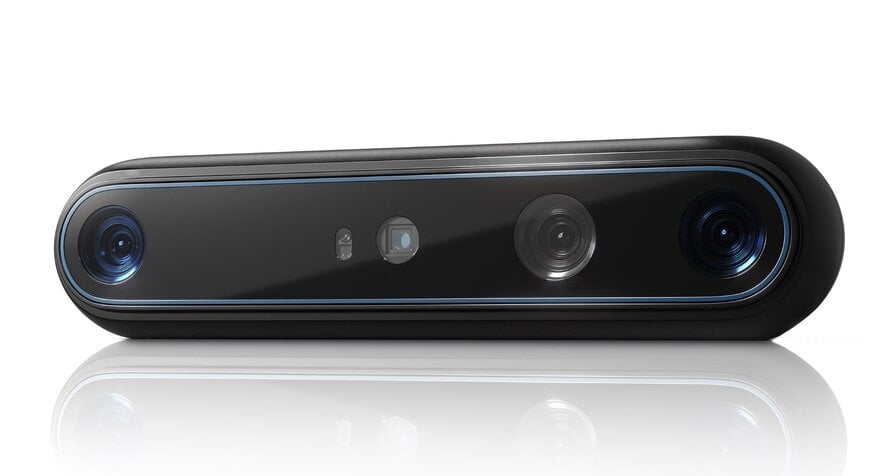
Basler AG is releasing the Stereo mini, a compact 3D camera system engineered for short-to-medium range depth detection in mobile robots, warehouse drones, and automated logistics. This machine vision hardware provides spatial capture capabilities to facilitate autonomous navigation and precise object recognition within price-sensitive industrial automation environments.
System Architecture and Interface Options
The camera architecture is optimized for short to medium depth measurement ranges, utilizing physical baselines of either 50 or 95 millimeters. To accommodate varying bandwidth and processing requirements, the hardware supports standard industrial communication interfaces, including USB 3.0 and Gigabit Ethernet (GigE), with planned support for Gigabit Multimedia Serial Link (GMSL) protocols. The system features factory-calibrated stereo geometry, which establishes a reliable mathematical model for depth calculations and reduces initial mechanical setup requirements. System integration is managed through the proprietary pylon Software Development Kit (SDK), allowing engineers to incorporate the depth sensors into existing machine vision workflows alongside matching lighting, cables, and frame grabbers.
Application Areas and Operational Mechanics
Deployed primarily within the logistics and robotics sectors, the hardware provides the volumetric and spatial data necessary for autonomous mobile robots (AMRs) and automated guided vehicles (AGVs). Specific operational use cases include dynamic obstacle detection, collision avoidance, and automated pick-and-place routines. In warehouse management, the stereo vision system facilitates the measurement of pallets and load carriers for inventory tracking. The dual-lens configuration captures stereoscopic depth data to maintain object detection across complex scenes and variable ambient lighting conditions, functioning in both indoor and outdoor industrial environments.
Martin Gramatke, Product Manager for 3D Vision at Basler, notes that the hardware provides an entry-level deployment option that integrates directly into established computer vision environments via the standard pylon architecture.
Additional Context
This section details technical specifications and competitive benchmarking not included in the original news release.
Within the compact 3D stereo camera market, comparable hardware includes the Intel RealSense D400 series and the Luxonis OAK-D spatial artificial intelligence cameras. The Intel RealSense D435 utilizes a 50-millimeter baseline and active infrared stereo for depth calculation, operating primarily over standard USB 3.0 connections. Luxonis OAK-D devices typically feature a 75-millimeter baseline and incorporate dedicated on-board neural processing units for edge processing workloads.
The Basler Stereo mini differentiates itself by offering a choice between 50-millimeter and 95-millimeter baselines, allowing engineers to optimize the baseline-to-depth ratio specifically for their required operational detection range. Furthermore, while many entry-level stereo cameras rely exclusively on USB protocols, Basler’s inclusion of GigE and future GMSL interfaces aligns directly with strict industrial automation standards. These protocols provide secure locking connectors and support the significantly longer cable runs required for large-scale mobile robots and automated guided vehicles.
Edited by Aishwarya Mambet, Induportals Editor, with AI assistance.
www.baslerweb.com
