
www.ptreview.co.uk
06
'26
Written on Modified on
Bosch Rexroth Expands Hägglunds CA Radial Piston Motor Series
CA Series radial piston motors redefine power density, combining maximum torque with minimum footprint for the most demanding industrial applications.
www.boschrexroth.com
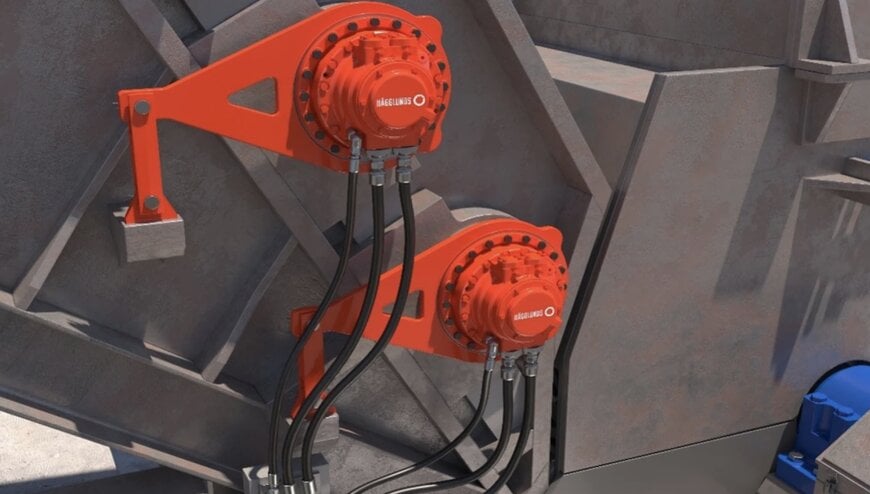
The Hägglunds CA series of radial piston motors from Bosch Rexroth provides compact, high-torque hydraulic direct drives designed for demanding heavy-duty industrial applications. Mounted directly to driven shafts, these motors eliminate mechanical gearboxes, clutches, and structural foundations across mining, recycling, and heavy manufacturing equipment.
Elimination of Mechanical Gearbox Limitations
Traditional drivetrain configurations pairing electric motors with mechanical gearboxes encounter operational constraints in harsh environments, including mechanical wear, energy conversion losses, and structural mass penalties. In addition, when driven equipment experiences a sudden shaft lockup during crushing or shredding operations, the rotational kinetic energy stored within a mechanical gearbox can cause catastrophic failure to drivetrains and shaft assemblies.
Hägglunds CA direct drive motors connect directly to the driven machine shaft using a shrink disk or gear connection. This mechanical setup removes intermediary drivetrain components, simplifying machine construction and reducing maintenance intervention requirements.
Radial Piston Architecture and Operating Principle
The Hägglunds CA motor utilizes a radial piston layout with a rotating cylinder block and a stationary housing. The cylinder block is supported within the housing by fixed roller bearings and contains an even number of radially arranged pistons. An internal fluid distributor directs inflowing and outflowing hydraulic oil to the active pistons.
As hydraulic pressure acts upon the pistons, integrated cam rollers are forced against the corrugated surface of a stationary cam ring attached to the motor housing, producing smooth torque proportional to operating system pressure. The symmetrical internal architecture allows for an optional two-speed configuration. When paired with a two-speed valve, the motor can switch between two displacements and rotational speeds at a constant volumetric oil flow rate.
Overload Protection and Environmental Features
The direct drive design exhibits a low moment of inertia compared to mechanical geared drives. During sudden operational overloads or equipment blockages, the hydraulic circuit cushions mechanical shock loads while pressure relief valves open within a fraction of a second to protect the shaft line and working tools.
Additional features include a freewheeling function that allows the driven shaft to rotate freely without hydraulic resistance when inactive. The motor series is compatible with Environmentally Acceptable Lubricants (EAL) for use in marine, mining, and environmentally protected areas, and manufacturing operations are certified under ISO 9001 standards.
CA 280 Model and System Integration
The Hägglunds CA 280 represents the largest displacement model within the CA platform, engineered to maximize torque output within a compact physical envelope. Daniel Kajhager, Director of Global Engineering at Hägglunds, noted that the engineering goal focused on delivering high torque in a compact package without compromising strength or reliability. Targeted applications include raise boring rigs, apron feeders, heavy belt conveyors, and twin-shaft recycling shredders.
For integrated drive installations, the CA motor serves as the core component of the Hägglunds Fusion system. This factory-tested assembly mounts directly onto the driven machine shaft, integrating the hydraulic motor, piston pump, and electronic control system into a single unit. This self-contained setup eliminates the requirement for separate hydraulic equipment rooms and external interconnecting pipework.
Additional Context
This section details technical specifications not included in the original news release.
Radial piston hydraulic motors operate as high-torque, low-speed (HTLS) hydrostatic drives, converting fluid pressure directly into mechanical rotational torque at low angular velocities without internal gear reduction. In multi-cam radial piston designs, the static cam ring features multiple sinusoidal lobes, enabling each piston to execute multiple stroke cycles per complete revolution of the cylinder block. This multi-lobe configuration increases total volumetric displacement within a small radial footprint while distributing mechanical contact stress evenly across the roller bearings and cam surfaces.
Hydrostatic shock absorption in direct hydraulic drives relies on the fluid compressibility of hydraulic oil and high-speed relief valve dynamics. When a driven load encounters an instantaneous mechanical lockup, kinetic energy is dissipated into the hydraulic fluid rather than transferring rigid torsional stress through mechanical gear teeth. Direct-operated or pilot-operated pressure relief valves bypass high-pressure fluid directly to the reservoir within milliseconds, limiting peak system pressure and preventing mechanical shear failure across the driven shaft assembly.
Edited by Romila DSilva, Induportals Editor, with AI assistance.
www.boschrexroth.com
