
www.ptreview.co.uk
11
'26
Written on Modified on
Custom Controller Integrates Air Curtain System Functions
akYtec developed a customized OEM controller that combines application-specific control logic, HVAC interfaces and communication functions for air curtain manufacturers.
akytec.de
Air curtains are used at openings between areas with different temperatures or environmental conditions. A controlled air jet forms a barrier across the opening, reducing the exchange of air and associated transfer of heat, moisture and contaminants. Their performance depends on factors such as discharge velocity, jet angle, doorway geometry, pressure difference and temperature conditions. Research has shown that these parameters directly influence infiltration and exfiltration through an open doorway.
Typical applications include loading-bay doors, warehouse entrances, cold-storage and deep-freeze rooms, production access points and transitions between areas with different hygiene or temperature requirements. In these applications, air curtain operation has to respond to conditions such as door opening, temperature, fan demand and heating requirements.
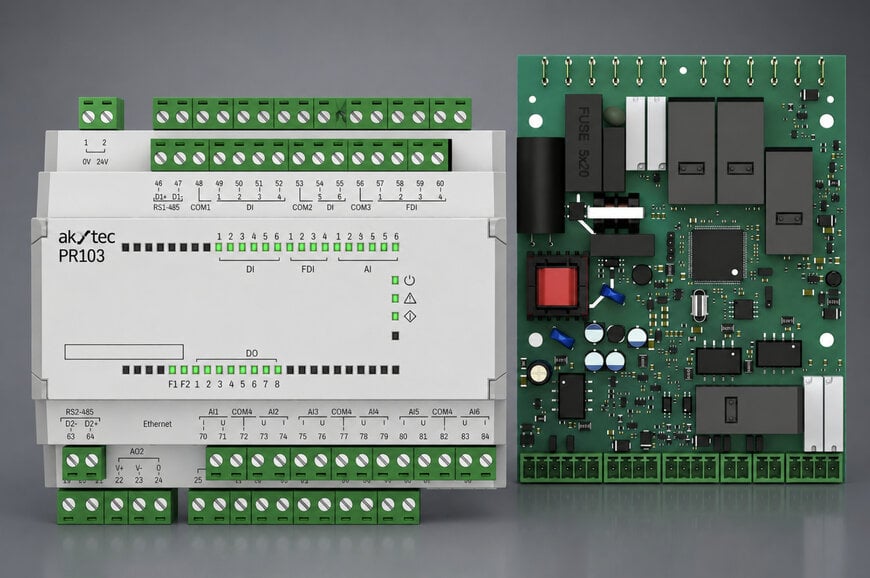
For a leading manufacturer of air curtain and heated air curtain systems, akYtec developed a customized OEM controller based on its PR103 programmable relay. The project combines application-specific control algorithms, a simplified user interface and a hardware configuration adapted to the requirements of the manufacturer's equipment.
The approach uses an established controller platform rather than developing the complete control hardware and software architecture from the beginning. According to akYtec, this reduces development effort and allows a customized device to be produced within a comparatively short development cycle.
Control functions for heating, airflow and door operation
The customized controller manages operating functions required for commercial and industrial air curtain systems. These include automatic heating and temperature control, fan-speed regulation and several door-contact operating modes.
The controller can also manage operating schedules, equipment protection functions, alarms and fault monitoring. It supports electrically heated and water-heated air curtains and can be adapted for different product families within the OEM manufacturer's portfolio.
These functions are relevant because air curtain performance is not determined solely by whether the fan is running. Studies of air curtain systems show that supply velocity, discharge angle and pressure differences affect the stability and effectiveness of the air jet. Wind and other external disturbances can also change the airflow conditions at an opening.
For heated systems, temperature control introduces an additional consideration. Experimental research has found that heating the air curtain can alter its buoyancy and that excessive heating can reduce aerodynamic effectiveness under some conditions. This makes coordinated control of airflow and heating relevant when the system is used between spaces with significant temperature differences.
PR103 integrates I/O and industrial communication
The controller is based on the PR103 Ethernet-enabled mini-PLC. The platform is designed for applications including ventilation, heating and equipment control and provides Ethernet alongside two RS-485 interfaces. It supports Modbus TCP through Ethernet and Modbus RTU/ASCII through RS-485.
The PR103 is available in configurations with six digital inputs, four fast digital inputs, six analogue inputs and either up to 10 digital outputs or eight digital outputs plus two analogue outputs. The four fast inputs can process pulse signals up to 100 kHz.
Its analogue inputs can accept 4–20 mA, 0–10 V, Pt1000 and NTC/PTC signals, among other configurable signal types. This allows temperature sensors and other analogue field devices to be connected directly to the controller without necessarily requiring a separate signal-conversion device. The specified maximum analogue-input refresh rate is 1 ms.
The controller can also be expanded with up to two PRM expansion modules. Its programming and configuration interfaces include microUSB, Ethernet and RS-485, while the control algorithm is developed using the akYtec ALP programming environment. The controller has a built-in real-time clock for functions such as scheduling.
The PR103 operates from a nominal 24 V DC supply, with a specified supply range of 9 to 30 V. Its operating temperature range is -40 °C to +55 °C. The DIN-rail device measures 123 × 108 × 58 mm and has an IP20 enclosure.
For an air curtain OEM, this combination of digital inputs, analogue temperature inputs, outputs and industrial communications allows functions such as door-contact monitoring, temperature measurement, fan control, heating control and communication with supervisory equipment to be incorporated into one control architecture.
OEM customization from software to hardware
The project illustrates a development model in which a standard automation platform provides the underlying control hardware while the OEM-specific elements are implemented through software, user-interface and hardware adaptations.
akYtec states that the typical timeframe from an initial enquiry to a customized, ready-to-use device is approximately two months. The company offers white-label versions without akYtec branding and private-label versions with customer-specific labelling.
The OEM service also covers software modifications, adaptations to device algorithms and customer-specific printed circuit board development. This allows the scope of customization to extend beyond programming when the standard controller configuration does not fully correspond to the requirements of an equipment manufacturer.
For manufacturers producing several air curtain models, application-specific software can also allow a common hardware platform to be configured for different operating requirements. The extent of this reuse depends on the I/O configuration, heating technology, sensors, actuators and communication requirements of each product family.
Additional Context:
This section details technical specifications and competitive benchmarking not included in the original product announcement
The PR103 occupies the compact automation segment between traditional programmable relays and more general-purpose PLC architectures. Its combination of analogue inputs, multiple communication interfaces and expansion capability makes it suitable for applications requiring more than basic digital switching.
A direct comparison can be made with compact automation platforms such as Siemens LOGO! 9 and Schneider Electric Zelio Logic SR2/SR3, although the products use different architectures and feature sets.
The PR103 provides six standard digital inputs plus four fast digital inputs, six analogue inputs and up to 10 digital outputs. One configuration adds two analogue outputs instead of two of the digital outputs. It also integrates Ethernet with Modbus TCP and two RS-485 interfaces supporting Modbus RTU/ASCII. Up to two PRM expansion modules can be connected.
Schneider Electric's Zelio Logic SR2/SR3 is a comparable smart-relay platform for small automation applications. Schneider specifies up to 26 I/O within a 124.6 × 90 × 59 mm enclosure, with 6, 10 or 14 discrete I/O configurations and analogue I/O available through extension modules. Modbus and Ethernet are provided through communication extension modules rather than the same integrated communication configuration used by the PR103.
Siemens LOGO! 9 provides a different approach, combining a compact logic controller with integrated Ethernet connectivity and scalable I/O. Siemens specifies system expansion of up to 64 digital inputs, 60 digital outputs, 16 analogue inputs and 16 analogue outputs. LOGO! 9 also supports Modbus TCP/IP and MQTT directly and includes an integrated web server for monitoring and visualization.
The comparison shows that there is no single specification that determines which platform is preferable for an air curtain application. The relevant criteria include the number and type of analogue and digital signals, whether temperature sensors can be connected directly, the availability of Ethernet and serial communication, expansion requirements, programming environment and the degree of OEM customization required.
For the application described by akYtec, the PR103 provides a combination of six analogue inputs, multiple digital I/O channels, two RS-485 interfaces and Ethernet in a single DIN-rail controller. That configuration can reduce the number of separate interface components required when an air curtain system needs temperature measurement, door-status monitoring, fan and heater control and communication with external automation equipment.
The technical requirements of the air curtain itself also remain important. Published research identifies discharge velocity, discharge angle, pressure difference, temperature difference and doorway geometry as key parameters affecting barrier performance. Consequently, the controller's value is primarily in coordinating the equipment according to its defined operating requirements rather than in determining air curtain effectiveness independently of the mechanical and aerodynamic design.
Edited by Sucithra Mani, Induportals editor – adapted by AI.
www.akytec.com
